


 Sasha Archibald
Rosa Campbell chronicles Shere Hite’s groundbreaking 1976 report on clitoral stimulation and its fate in the culture.
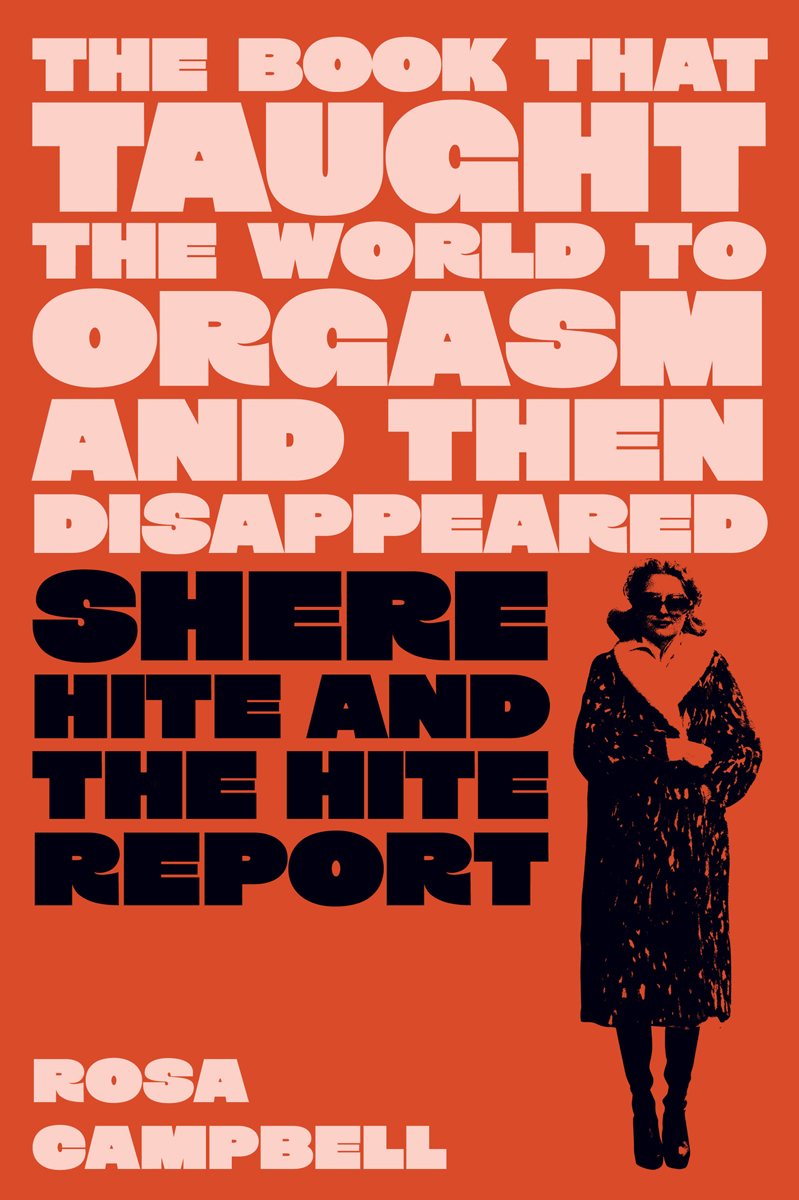
The Book That Taught the World to Orgasm and Then Disappeared: Shere Hite and the Hite Report, by Rosa Campbell,
Melville House, 186 pages, $32
• • •
The Hite Report, published in 1976, was the first book to turn mass attention to the keen, quivering, neglected nub that is the clitoris. Its author, Shere Hite, compiled surveys from over three thousand women to reveal that arousal for most depended on clitoral stimulation. (Surprise!) Masters and Johnson had documented the clitoris’s importance in their seminal Human Sexual Response (1966), but their prose was verbose, and in their next book, Human Sexual Inadequacy (1970), they endorsed a bizarre “Rube-Goldberg model” of orgasm: the petite organ need not be directly touched; adjacent stimulation was adequate. Quips a sexologist in the documentary The Disappearance of Shere Hite (2023), suppose “men were expected to have orgasms simply by stimulating their balls . . . that’s exactly what happened to women.”
Copies of The Hite Report flew off the shelves. Women had answered Hite’s survey questions in long-form narrative, and she published hundreds of these passages verbatim. There are eight pages of quotes about how and why women fake orgasms, and an even more harrowing section titled “How Have Most Men Had Sex with You?” Aside from the cunnilingus statistic tables, the book reads like eavesdropping feels: a bit oily and prurient, compelling then dull, with strains of The Confessions of St. Augustine mixed with Masturbation for Dummies.
Rosa Campbell’s The Book That Taught the World to Orgasm and Then Disappeared is about the making of this text and its fate in the culture. Campbell goes big with her claims. “Without The Hite Report,” she writes, “there would be no understanding, now common sense, that great sex means pleasure for all involved . . . there would be no imperative that women speak up about what they want in sex, no knowledge of the clitoris as important.”
Certainly, feminists were working on the cause. There was Anne Koedt’s “The Myth of Vaginal Orgasm” (1970) and Judy Chicago’s “Cunt Cheerleaders” (1971); Erika Jong’s Fear of Flying (1973) sold millions of copies. But according to Campbell, none did as much to bring then-fringy ideas about women’s sexual pleasure—that they should have some—to non-fringy people.
Hite herself was a head-scratching conundrum: brittle and generous; vainglorious and insecure; a workaholic and “a shiny bauble” of pink satin; prone to delusions of grandeur and victimhood. She took her book project deathly seriously, but she also cultivated the mien of a sexy floozy, a giggling “Tinkerbell” “shepherdess,” with hair a cloud of strawberry-blonde spun sugar and eye makeup an homage to the twelve-color shadow palette. Most young women get a memo from the patriarchy that this combo amounts to self-sabotage; Hite ignored it.
After dropping out of Columbia’s PhD history program, she turned to modeling. Hite did adverts for luggage and perfume, and posed for the artists who painted the schlocky covers of paperback romance novels. In the movie poster for Diamonds Are Forever (1971), two women in lamé bikinis hang on either side of Sean Connery; Hite was the model for both. Porn, of course, paid the best.
It was through her modeling career that Hite was introduced to women’s liberation. She happened to be cast for a particularly offensive advert for Olivetti typewriters (“The typewriter is so smart that she doesn’t have to be”). The National Organization of Women then had an image committee, and they called a protest. Hite showed up and shyly outed herself as the model. She began attending NOW meetings and gestated her book idea. Eventually, NOW agreed to help distribute her survey, in return for some fraction of potential profits.
That deal went south. When The Hite Report became a phenomenal bestseller, “the thirtieth-bestselling book of all time,” Hite refused to pay up, though she managed to buy gold-embossed stationery from Cartier and a flat on Fifth Avenue with a bedroom as big as a ballroom. NOW sued, reasonably so, and Hite was extremely hurt, writing that the lawsuit “has made me feel literally suicidal.” She groused that the women in NOW must be jealous.
Campbell does her best to gloss over such perplexing indications of character, and is unduly credulous of Hite’s version of events. This book is a rescue mission, with the goal of securing for Hite a spot in the feminist pantheon. Except Campbell assumes, perhaps correctly, that membership is restricted to congenial, sensible types. Her tale soldiers along as if there’s no elephant in the room, batting its eyelashes.
The Hite Report’s sales figures should have launched a fabulous career. Instead, Hite fled the US and described herself ever after as a “political refugee.” The problem was that she published a real ballbuster and yet hadn’t steeled herself for misogynist back talk. As the media swarmed, two things came into play: first, though Hite might have chosen otherwise, she’d gone for the brass ring of serious, rigorous science, leaving a vulnerable front of attack. And second, insulting Shere Hite was like poking the bear. She was flappable to the extreme, “made of glass.” She smashed things with her pink telephone, assaulted a limo driver, missed one prime-time TV appearance and threw a tantrum during another. She invented a fake secretary to write letters in her defense; when the ruse was exposed, the scorn piled on.
What a bloodthirsty lark, and what a relief, to cut Shere Hite down to size. Hustler went so far as to accompany their so-called review—“Come on Shere, all you need to do is ask, and the entire male staff of Hustler will gratify you”—with photos taken years earlier, and dug up for the occasion, of Hite naked in a shabby hotel room. (Campbell compares this to revenge porn.) The Hite Report was nicknamed “Sheer Shite.” Eventually, Hite’s agent and publisher severed ties. She continued working in Europe, publishing some fifteen more books, but she lost the fancy flat, her fat income, and her public reputation. In response to the last, she pitifully inflated her self-importance, to the point of arguing that she’d “replaced Freud.”
Campbell describes more than 280 boxes at the Schlesinger Library that contain “thousands of letters” from Hite’s readers and correspondents, a trove that attests to their deep-seated, genuine gratitude. “To read these letters,” Campbell writes, “is to see the idea of sexual normalcy changing before our eyes.” Many tell a version of the same story: there was a woman who didn’t realize she had a multitudinous marvel called a clitoris, and then she read The Hite Report and was emboldened to touch her body, and she had an orgasm, and another, and it felt just wonderful, and she lived happier ever after.
Campbell quotes one letter from a mother of five, married twenty-two years: “You, Miss Hite, saved our marriage and made it a dream . . . Keep up the good work.” Long marriage a dream, thanks to a single book? A life with orgasms rather than without? Thousands of grateful readers? If only that had been enough. If only Shere Hite had held these letters close, and ignored everything else.
Sasha Archibald’s essays have appeared in the White Review, the New Yorker, the Point, the Believer, and in books published by the Academy Museum of Motion Pictures, Walker Art Center, Whitechapel Gallery, and other institutions. She is an associate editor at Places Journal. Her biography of gay liberationist Carl Wittman (1943–1986) is forthcoming from Yale University Press.