


 Andrew Chan
Qian Zhongshu’s epic picaresque from 1947 presents a world in which fraudulence and opportunism cast a shadow across all levels of society.
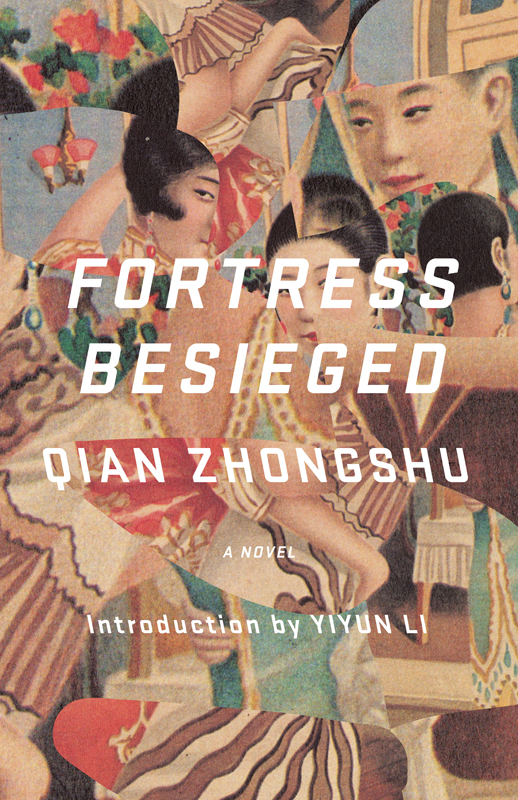
Fortress Besieged, by Qian Zhongshu, translated by Jeanne Kelly and Nathan K. Mao, New Directions, 395 pages, $29.95
• • •
When Qian Zhongshu’s Fortress Besieged (1947) became the unlikely inspiration for a popular television series of the same name in 1990, the book went from being a well-kept secret among the literati—one that had a limited impact upon its initial release and went out of circulation for many years during the Cultural Revolution—to being considered one of the great works of modern Chinese fiction. As the author Yiyun Li explains in her introduction to the novel’s newly reissued English translation (by Jeanne Kelly and Nathan K. Mao, first published in 1979), audiences were fascinated by Qian’s deeply personal view of the pre-Communist era precisely because it stood in contrast to the propagandistic bent of most of the nation’s art and media throughout the latter half of the twentieth century. This explanation for the novel’s belated breakthrough makes sociological sense, but for anyone expecting a display of cultural prestige or nostalgia, reading Fortress Besieged will be a disorienting experience. Qian’s epic charts a rocky path through a society whose value system has been radically upended—a world where careers are built on fabricated credentials and private lives are shaped by draconian codes and mercenary relationships. Though the book isn’t lacking in shades of humanist compassion, any possibility for warmth or enlightenment is typically overshadowed by the characters’ selfish opportunism.
The protagonist is the peripatetic Fang Hung-chien, whom the novel follows through a series of professional blunders and romantic misadventures. We first meet him in 1937, just before the start of the Sino-Japanese War, on a French ocean liner returning him home from his fruitless studies in Europe. The other exchange students he meets onboard—including a pair of beautiful women he tries and fails to woo—constitute a microcosm of Chinese cosmopolitanism in that period, which had arisen from the ashes of imperial rule and was fueled by a conviction that the old Confucian ways needed to be abandoned in favor of Western modernity. As the story takes the form of a roving picaresque, Qian introduces us to a host of characters who flaunt their globalized erudition, from a woman whose speech is “full of French exclamations . . . as she [squirms] her body around into various seductive poses” to a poet whose verse references T. S. Eliot and Leopardi. If its themes were not so densely layered, Fortress Besieged might be appreciated first and foremost as a brilliantly funny attack on academic pretensions. While Hung-chien is the book’s most prominent imposter—to prevent an anticlimactic homecoming, he procures a degree from a fake American university, purchased from a shady Irishman—he is hardly alone in his fraudulence.
Qian knew this milieu well. Born in 1910 (a year before the Xinhai Revolution, which toppled the Qing Dynasty) to a scholarly family, the author studied at Oxford and the Sorbonne, had a deep knowledge of the Chinese canon, and wrote his thesis on representations of his country in British literature. You can sense his double consciousness in the book’s many observations on racial difference, which encompass crude generalizations about physiognomy (“Chinese ugliness seems to be the result of the Creator’s having skimped on time and materials. . . . Westerners’ ugliness seems a mark of the Creator’s spite”) and gastronomical customs (“When it comes to food,” Hung-chien’s friend Chao Hsin-mei notes, “foreigners are cowards”). In one of the book’s most hilarious scenes, Hung-chien is forced to deliver a lecture at a Shanghai high school on “the Influences of Western Civilization on Chinese History”; lacking any qualifications to expound on the topic, he ends up rambling about opium and syphilis. Rather than glamorizing the West or sentimentalizing the East, Qian is highly attuned to the delusions and misunderstandings that impede cross-cultural understanding, as well as the arrogance of believing one has grasped the world simply by glimpsing another side of it.
Qian’s send-ups of pseudo-intellectual banter are often juxtaposed with depictions of bodily abjection. These moments come to us in vivid sketches of minor characters, such as one passage that singles out a woman who has returned from France with “a whole symphony of foul odors” and teeth that “look like hemorrhoids dripping with blood,” or another that describes a man’s countenance as “a large orange-peel nose with a face appended to it.” But Qian’s parodic style is especially suited to spectacles of collective humiliation. In one breathtakingly manic chapter, a band of academics (including Hung-chien and Hsin-mei) embark on a journey to a newly established, barely operational university where they have been employed to teach. During a harrowing trek deep into the interior of the country, the scholars are engulfed by an untamed rural landscape that seems designed to mock their middle-class, urban notions of progress. With diabolical glee, Qian subjects these poor souls to a marathon of indignities: the lice that infest their lodgings; the cream in their coffee, which looks “like human spit”; the slabs of maggoty meat they get served one night for dinner.
Long stretches of Fortress Besieged are spent chronicling the characters in transit, which gives the story a restless, pell-mell energy that will certainly test some readers’ patience. But even when Hung-chien finally seems to be settling down, with a fellow professor named Sun Jou-chia, Qian sustains this mood of perpetual anxiety, as the promise of domestic stability becomes a claustrophobic vision more unnerving than the ongoing war itself (whose effects are only obliquely portrayed). During one of the couple’s interminable quarrels, the hero concludes that “a family is really just a nest of scandal,” not unlike the shoddy university that brought them together. In this dizzyingly idiomatic novel, Hung-chien’s remark is not the only metaphor for conjugal unhappiness on offer; another lies in the French adage that gives the book its title: “Marriage is like a fortress besieged: those who are outside want to get in, and those who are inside want to get out.” A polymath who became a symbol of worldly sophistication, Qian had spent his life breaking into such fortresses, the kinds of venerable institutions that promise security and honor in a time of rapid social transformation. And so it is all the more poignant that at the end of his masterpiece—the only novel he ever completed—he reveals these structures to be fig leaves, flimsy illusions concealing the loneliness of our modern existence.
Andrew Chan is a writer and editor living in Brooklyn, New York. He is the author of Why Mariah Carey Matters, published by University of Texas Press.