


 Rhoda Feng
At the outset of the Great Migration, trajectories converge beyond the wreckage of history in August Wilson’s 1988 drama.
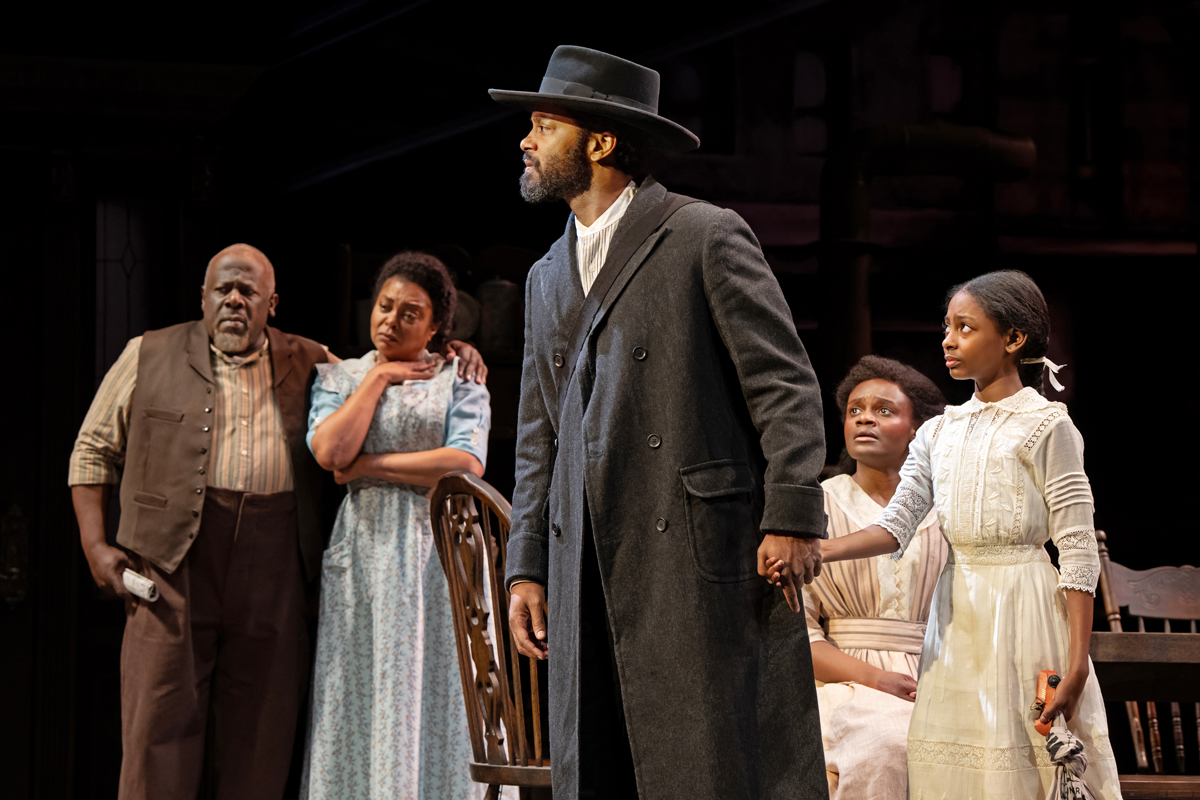
Cedric “The Entertainer” as Seth Holly, Taraji P. Henson as Bertha Holly, Joshua Boone as Herald Loomis, Nimene Sierra Wureh as Mattie Campbell (background), and Savannah Commodore as Zonia Loomis in Joe Turner’s Come and Gone. Photo: Julieta Cervantes.
Joe Turner’s Come and Gone, written by August Wilson, directed by Debbie Allen, Barrymore Theatre, 243 West Forty-Seventh Street, New York City, through July 26, 2026
• • •
“In [Romare] Bearden I found my artistic mentor and sought, and still aspire, to make my plays the equal of his canvases,” August Wilson once wrote. Like Bearden’s complex compositions, the new Broadway revival of Wilson’s 1988 drama Joe Turner’s Come and Gone collages disparate lives, stories, and tonal registers, slanting characters toward one another as they seek work, love, a sense of purpose, a song.
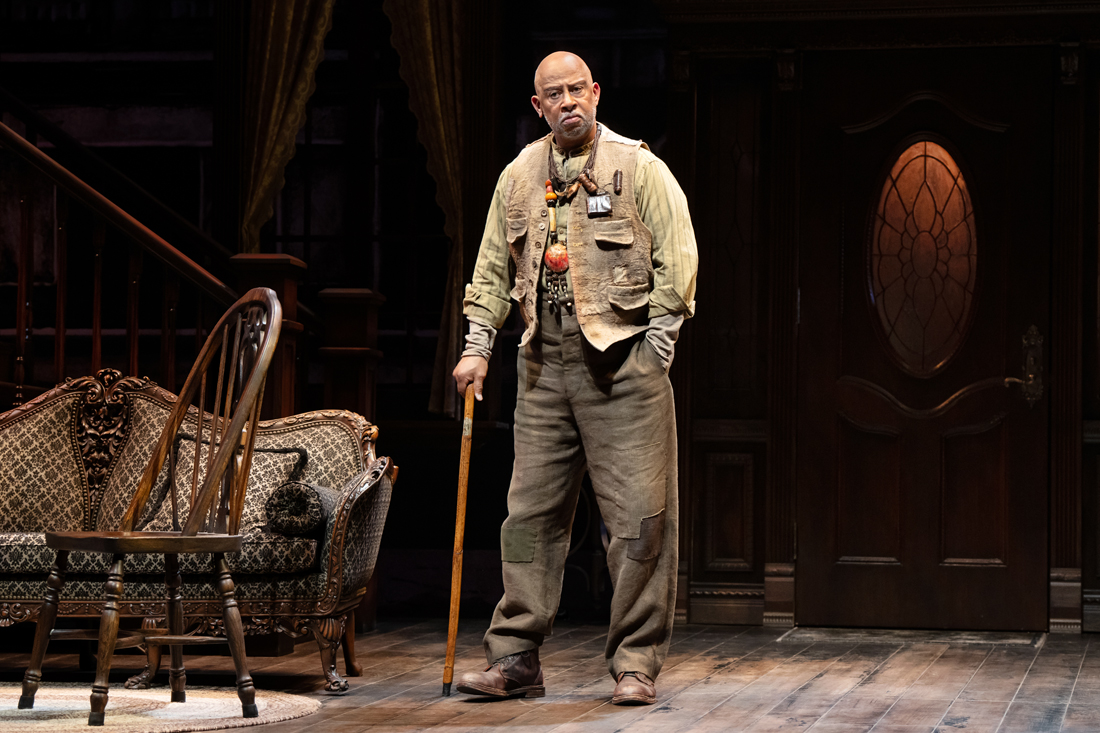
Ruben Santiago-Hudson as Bynum Walker in Joe Turner’s Come and Gone. Photo: Julieta Cervantes.
The play takes place in a Pittsburgh boardinghouse in 1911, right at the outset of the Great Migration. Three freestanding windows hover above David Gallo’s set (which strongly echoes the particular Bearden work that inspired Wilson, 1978’s Mill Hand’s Lunch Bucket [Pittsburgh Memories]), suggesting a noumenal upstairs and leading us to wonder what else might be recessed from view. A clock in an upstage cabinet is fixed at six, while Stacey Derosier’s lighting—shifting from purple to pink to ocher—provides the only indication that time passes at all. Somewhere, just out of frame, one imagines, the sun shines solipsistically on. But the residents of the boardinghouse know mostly darkness.
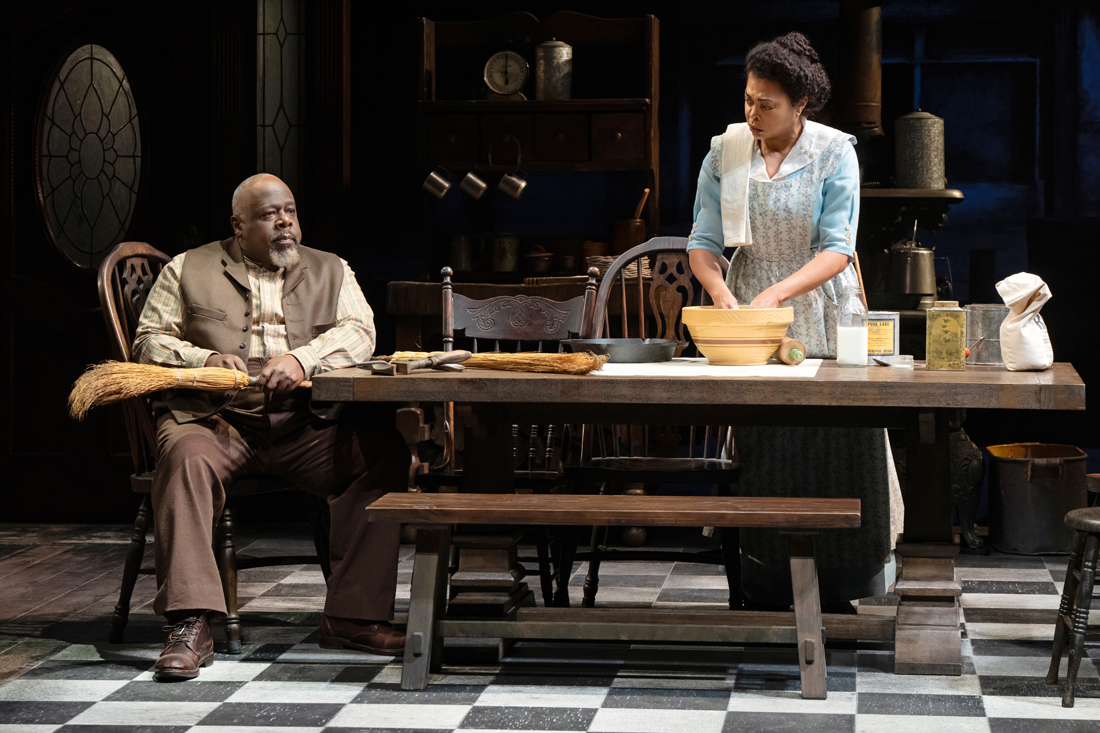
Cedric “The Entertainer” as Seth Holly and Taraji P. Henson as Bertha Holly in Joe Turner’s Come and Gone. Photo: Julieta Cervantes.
For the first few minutes, Debbie Allen’s direction leads us to expect a kitchen-sink drama. Seth Holly (Cedric “The Entertainer”), the freeborn proprietor of the boardinghouse, works nights at the nearby steel mill, but his true métier is critiquing his tenants. He runs his establishment with an eye toward order and respectability, keeping careful track of rental income and debts. (He loves reminding his lodgers of the two dollars due each Saturday.) Opposite him is his mirthful wife Bertha (Taraji P. Henson). She matches her husband’s jaundiced jollity with a nurturing sense of “love and laughter.” The kitchen, under her kind eye, becomes the emotional center of the house, where rumors are aired, shade is thrown, deals are brokered, romances are kindled.
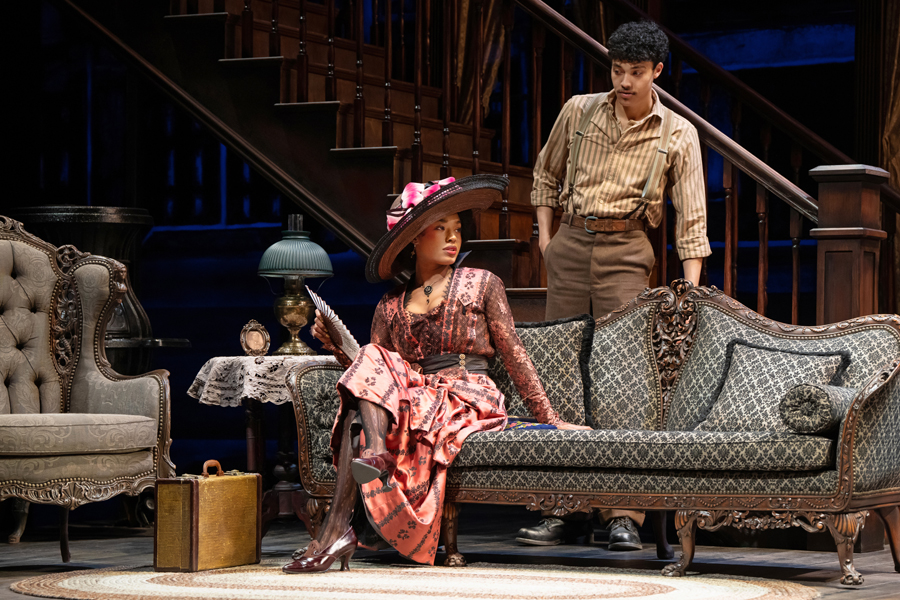
Maya Boyd as Molly Cunningham and Tripp Taylor as Jeremy Furlow in Joe Turner’s Come and Gone. Photo: Julieta Cervantes.
The other residents gather as a shifting ensemble. Jeremy Furlow (Tripp Taylor) drifts in and out with his guitar, his sense of purpose only faintly detectable, like a teenage moustache. Mattie Campbell (Nimene Sierra Wureh), one of the women he woos, more out of propinquity than passion, arrives searching—for her husband, for stability—and finds herself suspended between hope and resignation. Her foil, the wily Molly Cunningham (Maya Boyd), has sharper angles: dressed like a wedding cake (Paul Tazewell designed the costumes), she sets her own terms and refuses to be carried along by anyone else’s plans. And then there is Bynum Walker (a magnetic Ruben Santiago-Hudson), the roots worker whom others describe fussing in the yard with pigeons, marking circles, speaking in tongues, and engaging in other superstitious practices. He speaks often of having found a song that allows him to “bind” people together. This claim hangs over the house like a plucked string, its vibration lingering longer than anyone can quite account for.
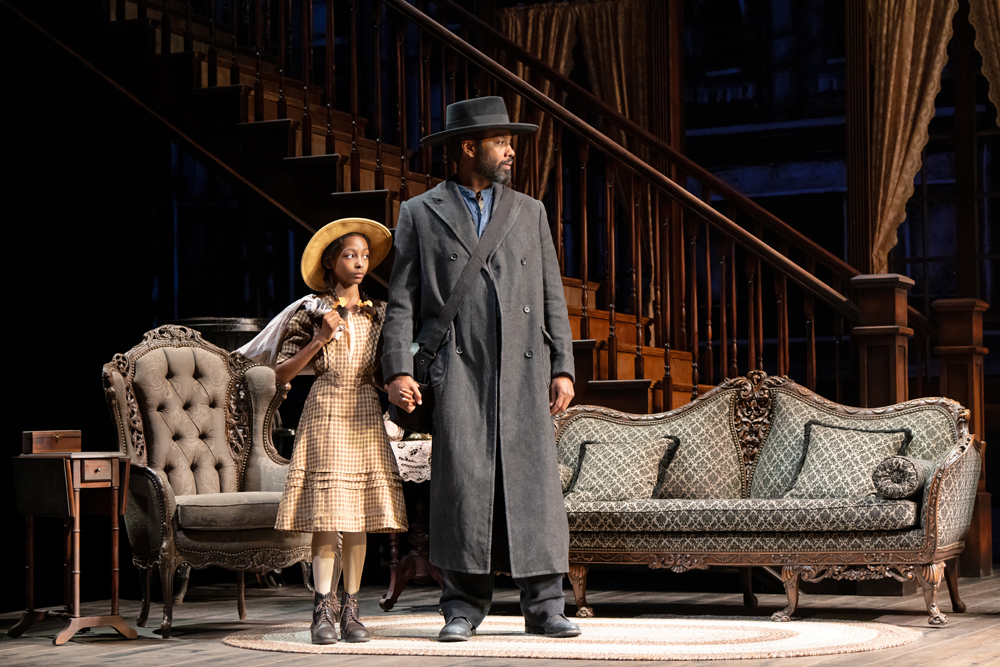
Savannah Commodore as Zonia Loomis and Joshua Boone as Herald Loomis in Joe Turner’s Come and Gone. Photo: Julieta Cervantes.
Against that tenuous cohesion, another presence announces itself. Before he is fully seen, Herald Loomis (Joshua Boone) registers as a dark cutout against the boardinghouse door, his figure pressed into the panes of glass like one of Kara Walker’s silhouettes. When the door opens, we see that he is accompanied by a young child, his daughter Zonia (Savannah Commodore on the night I saw the show, though she alternates with Dominique Skye Turner). The ex-deacon has an aura of unspecified tragedy. He’s also intensity incarnate—so much so that the room temperature rises a perceptible degree or two anytime he enters. He tells the Hollys that he is searching for his wife, Martha, but his mien suggests a deeper rupture.
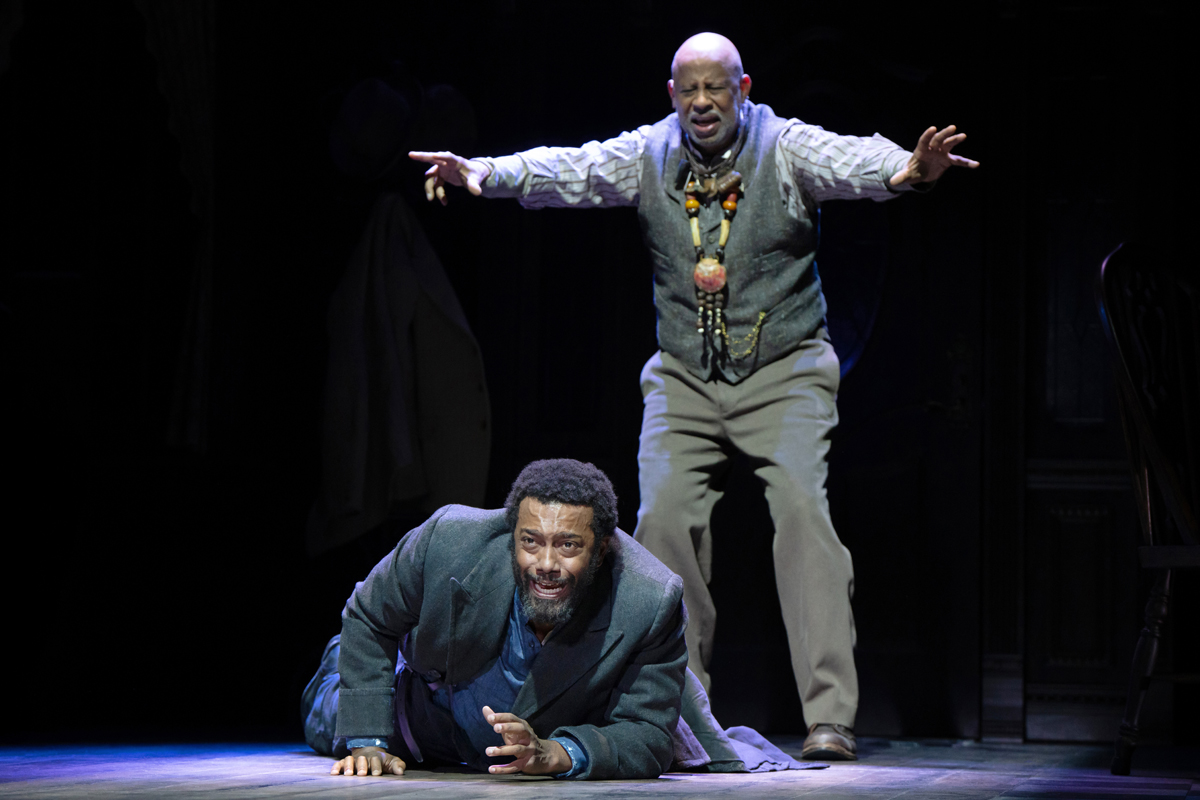
Joshua Boone as Herald Loomis and Ruben Santiago-Hudson as Bynum Walker in Joe Turner’s Come and Gone. Photo: Julieta Cervantes.
His tragic story is undammed in act 2 when Bynum sings, “They Tell Me Joe Turner’s Come and Gone.” The tune palpably unsettles Loomis, who snaps at Bynum to stop. The conjure man, of course, knows all about Herald, knows that he is “a man who done forgot his song. Forgot how to sing it.” Years ago, Herald was seized and held in forced labor by a man known as Joe Turner. The name is redolent of an historical figure—Joe Turney, a sheriff who consigned Black men to years of involuntary servitude. Over time, his name shifted in folk memory to “Joe Turner” and took on mythic proportions: he became a figure who could snatch men off the street or lure them into traps and hold them for years, leaving behind a trail of women’s laments memorialized in early blues music. The story that Loomis unspools sends a chill up the spine in ways Wilson could not have anticipated: impossible to hear his tale of a family separated for years without thinking of families being forcibly torn apart by ICE in the present moment.
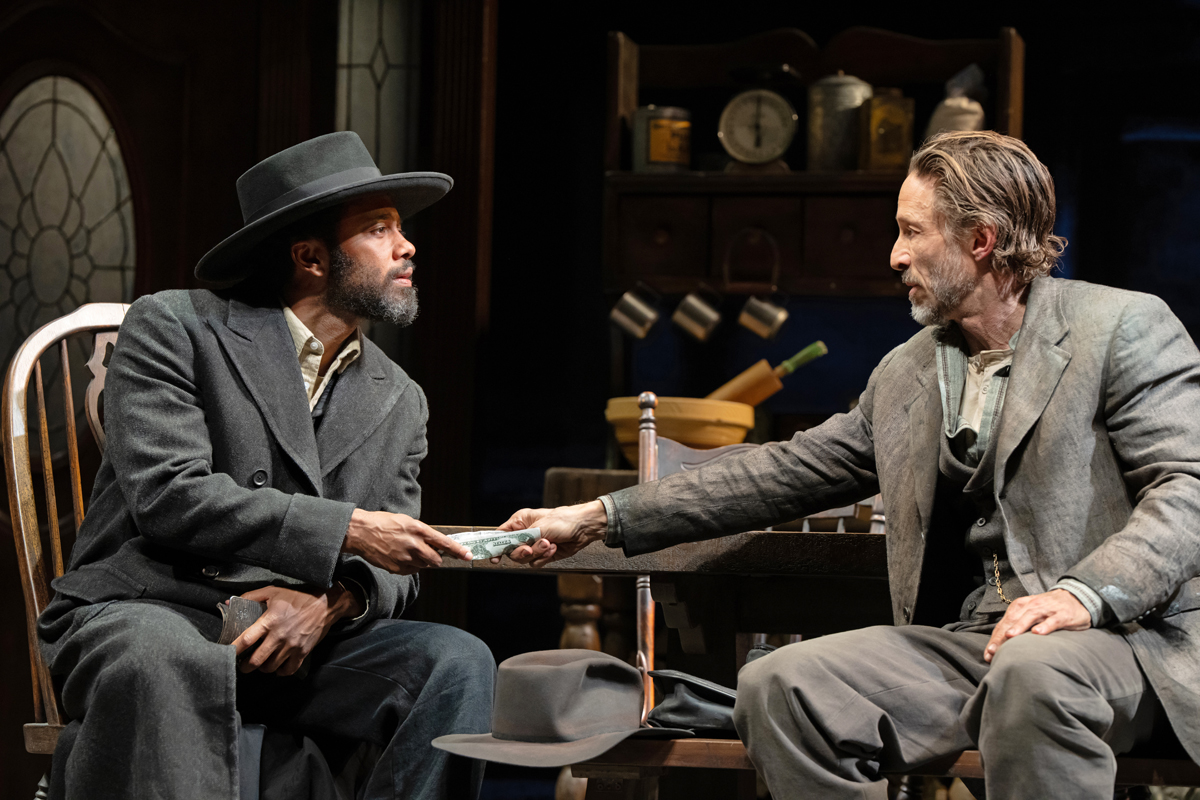
Joshua Boone as Herald Loomis and Bradley Stryker as Rutherford Selig in Joe Turner’s Come and Gone. Photo: Julieta Cervantes.
Rutherford Selig, the white “people finder,” is only one generation away from people who caught runaway slaves for plantation bosses. An itinerant peddler who trades in sheet metal and information, he descends from a long line of “bringers and finders.” Bradley Stryker gives him a mild, even conciliatory manner, as he recounts tricksy aspects of his job. “Now you take this woman you looking for . . . this Martha Loomis,” he tells Herald. “She could be anywhere. Time I find her, if you don’t keep your eye on her, she’ll be gone off someplace else. You’ll be thinking she over here and she’ll be over there.” It’s only after Selig has concluded his business with Herald, promising to look for Martha, that Bertha lets the air out of the balloon: “This old People Finding business is for the birds. He ain’t never found nobody he ain’t took away.”
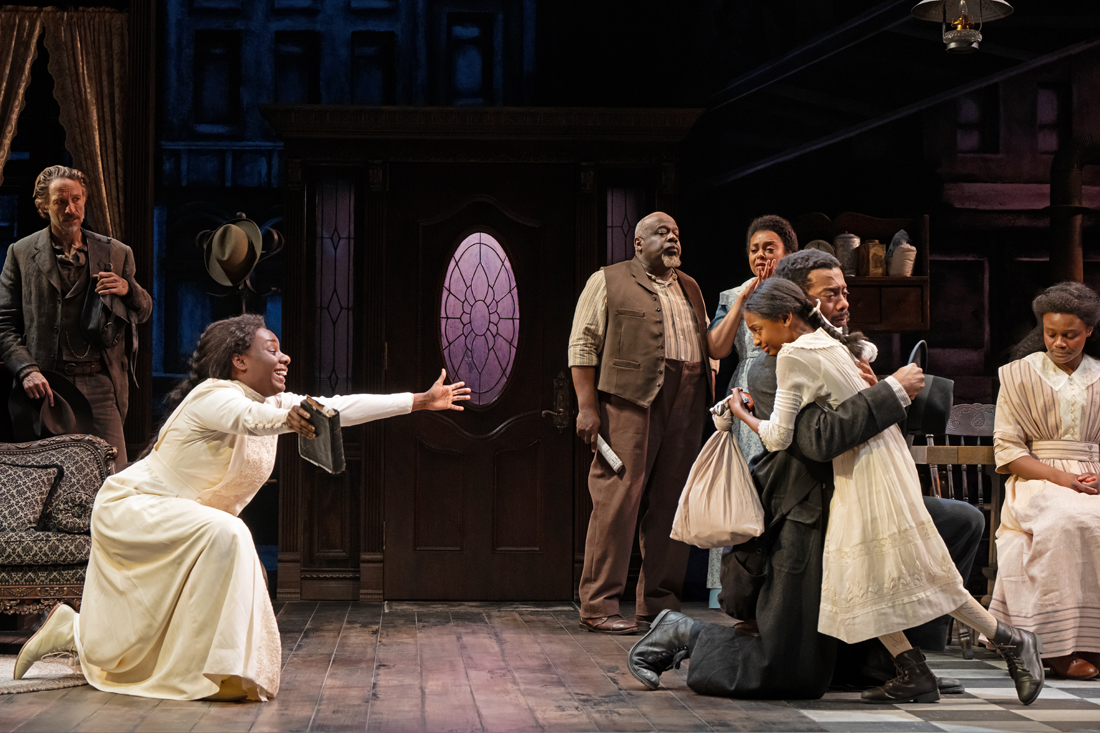
Bradley Stryker as Rutherford Selig, Abigail Onwunali as Martha, Cedric “The Entertainer” as Seth Holly, Taraji P. Henson as Bertha Holly, Joshua Boone as Herald Loomis, Savannah Commodore as Zonia Loomis, and Nimene Sierra Wureh as Mattie Campbell in Joe Turner’s Come and Gone. Photo: Julieta Cervantes.
Myth runs like a major artery through Joe Turner. The play darts between scenes of domestic realism and—especially in sequences with Bynum—what Wole Soyinka, in his essay “The Fourth Stage,” called the “chthonic realm,” a “transitional yet inchoate matrix of death and becoming.” In her direction, you can sense Allen straining to bridge the real. Take the first act’s culminating vision: after interrupting a lively juba call-and-response dance, Loomis is overtaken by an otherworldly force, seizing up and falling to the ground like a mighty oak. He tremulously describes a vision of water without end and of bones rising and walking across its surface; the image reaches back to the Middle Passage, evoking both the dead and the persistence of those who survived. The other tenants of the boardinghouse begin to move in slowed, stylized motions, as though absorbed into what Herald sees. Allen’s stage direction awkwardly asks the ensemble to become extensions of Loomis’s vision rather than individuals who, as Wilson notes in his script, are “isolated, cut off from memory, having forgotten the names of the gods and only guessing at their faces.”
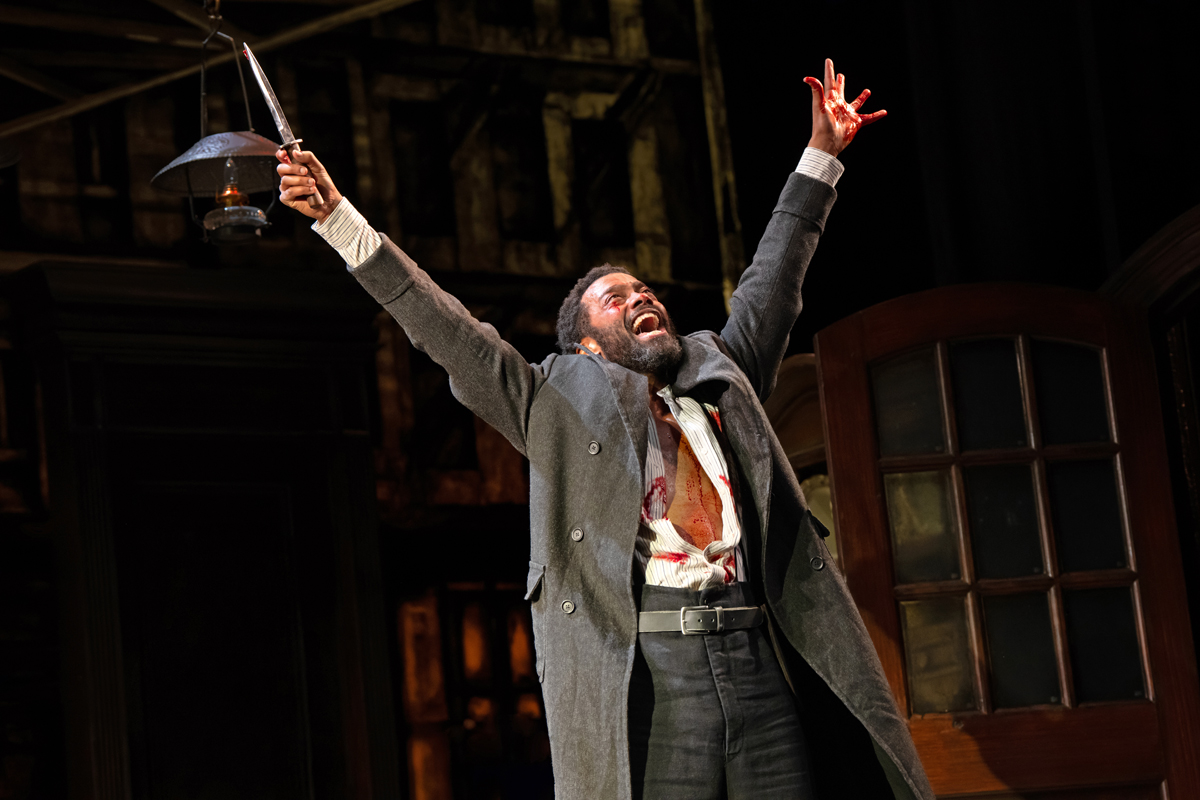
Joshua Boone as Herald Loomis in Joe Turner’s Come and Gone. Photo: Julieta Cervantes.
When Martha (Abigail Onwunali), Herald’s wife, at last appears, she urges her estranged husband toward a Christian redemption, but he rebuffs her. In a scene that elicited the loudest gasps the night I saw the show, he cuts his own chest with a knife and smears himself in his own blood. The gesture nearly echoes Bynum’s earlier account of encountering a “shiny man” who performed a cleansing ritual by rubbing his hands and bloodying himself. Loomis declares that he is standing—and he indubitably is. His recovery completes Bynum’s long search for the “shiny man,” the figure who would confirm the power of his binding song. Their trajectories have converged: Loomis finds his footing; Bynum finds his purpose realized in another. Like Walter Benjamin’s Angel of History, Loomis is finally propelled onward even as his gaze remains fixed on the accumulating wreckage behind him. Benjamin: “The angel would like to stay, awaken the dead, and make whole what has been smashed. But a storm is blowing in from Paradise.” That storm heralds progress.
Rhoda Feng is a freelance writer based in Washington, DC.