


 Jessi Jezewska Stevens
A new volume collects three never-before-translated novellas by Jacqueline Harpman, author of I Who Have Never Known Men.
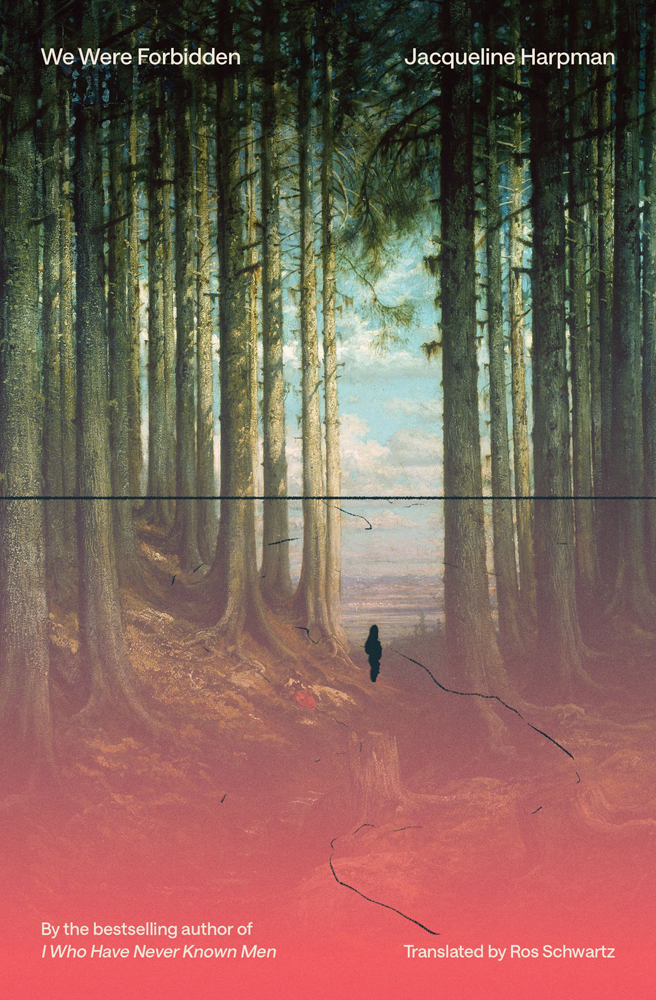
We Were Forbidden, by Jacqueline Harpman, translated by Ros Schwartz, Transit Books, 90 pages, $18.95
• • •
When the Belgian-born author Jacqueline Harpman died in 2012, her slim, bleak novel I Who Have Never Known Men, first published in 1995, had fallen into obscurity. Her vision did not quite jive with ’90s optimism: the novel opens with thirty-nine women and one child caged in an underground bunker, where they are guarded by men with whips who refuse to look at or speak to them. The prisoners are unaware of how they arrived there, why they are being held, or if they will ever be released. In a stroke of luck involving a triggered alarm and a warden’s lost set of keys, they escape into a desolate landscape that may or may not be Earth, only to discover that they are the only survivors of the human race. Even the guards have died.
The novel is narrated by the child, whose inclusion among the other prisoners seems to have been a mistake. Too young to remember the earthly human civilization the others pine for, she is isolated from them by the chasms of age and experience: she will never know men, let alone an inhabited Earth. As the youngest member, she is also destined to die last, a fate that looms horribly as the women who “raised” her begin to pass away. She keeps time according to her own heartbeat. At the end of the book, she is, like The Little Prince, the only person on the entire planet—a generation of one.
I Who Have Never Known Men blends horror and science fiction, drawing on the apocalyptic imagery of the century that Harpman, a Holocaust refugee, lived through. Its recent revival as a viral BookTok sensation has invited more contemporary allegories. When Transit Books reissued Ros Schwartz’s updated translation in 2022, at the height of the pandemic, the novel’s runaway success—it has since sold over 500,000 copies—led critics who came of age before the lockdown to herald it as The Handmaid’s Tale for Gen Z. It’s unclear, though, whether the novel’s violence is gender-based; other bunkers are filled with both men and women, all of them senselessly imprisoned, and, by the time the narrator finds them, deceased. Harpman was a psychoanalyst by profession, but one hardly needs training to speculate (or worry) about why young people in quarantine might have adopted a portrait of utter, profound, and forced isolation—of youth passed over—as a generational mirror.
Whatever readers’ reasons, Harpman, the author of over fifteen works of fiction, deserves to be virally rediscovered. Transit Books has now collected three newly translated novellas, also by Schwartz, under the title We Were Forbidden. They read like preparatory sketches, isolating key elements of I Who Have as if for closer study. They also expand Harpman’s range, showcasing a capacity for lightness, even humor.
The first installment, “The Ardennes Forest,” most closely follows the dystopian template of I Who Have. A mysterious troupe of special forces wanders a depopulated, forested landscape after an apocalyptic war, unable to remember any military directives: “We were told that post-hypnotic orders had been ingrained in us, we were not allowed to know what would reveal them, and then we were led to the edge of the forest to begin our mission.” Lost in a Beckettian ground zero, they find short-lived respite in an abandoned farm village full of extravagances, including an out-of-tune piano, where they celebrate and dance before returning to the woods to die off one by one.
As in I Who Have, each novella is narrated by an isolated female voice, with a minimalism and claustrophobia that feels current to contemporary trends. What distinguishes Harpman is her economy. “The Ardennes Forest” condenses a sprawling, world-ending backstory into a few scattered lines: “Sometimes, one of us would go off to die alone in a thicket”; “We had no idea whether the enemy had left or whether they’d won”; “That question still sparked our interest: was there anyone left to deliver orders?” The storytelling is streamlined because its characters have lost all capacity for recall.
The second novella, “The Outcast,” touches down in real-world history. Set “after the American landing in Casablanca,” in 1942, it is based on Harpman’s own experiences as an adolescent refugee in Vichy Morocco. Like the alienated child savant of I Who Have, the school-age, Jewish narrator believes (correctly) that she is wiser and more intelligent than her elders. Her schoolmate and sole intellectual rival, Henriette, has recently “switched allegiance from Pétain to de Gaulle” following her brother’s conscription to the Allied forces; the narrator has “tactfully refrained from comment.”
The two fifteen-year-olds attend the same French school, to which the narrator has gained admission only by hiding her Jewish heritage. Henriette’s sanctimoniousness over her brother’s service in Europe becomes unbearable, especially after she is awarded sympathy points on her schoolwork: “But, God, did she annoy me! She walked slowly, as if the breeze were wafting the voluminous black veils of mourning around her, a tear always brimming in her eyes and a brave smile hovering on her lips. When she hadn’t done her homework, she would slowly flutter her eyelids and sigh: ‘I wasn’t in the right frame of mind to study.’ ”
The story is narrated at decades’ remove, long after the two have fallen out of touch, but with fresh vengeance. Henriette “may well have had three children but preserved her slim waistline and sharp intellect,” the narrator muses, “or she’s been dead for twenty years, or is an old maid in Ajaccio. Oh! I can’t stop myself, in a few words I have just ruined her life all over again! I hold grudges of biblical proportions.” In the context of a schoolgirl’s gripe, the sentiment has a humor totally absent from I Who Have. In a historical context, it takes on graver proportions.
It was only after reading the collection that I realized I Who Have Never Known Men is, for all its horror, a Künstlerroman—a story of writerly ambition stymied and delayed by historical circumstances, and fulfilled against all odds. The child savant-and-narrator of that dystopian tale is held back from exploring the world by the feebler older prisoners; after they die, she wanders, eventually discovering a luxurious, book-lined bunker once occupied by an officer of the guards, and where she begins to write her own story. Having learned to read from letters the others traced in the ubiquitous gravel, she is confused to find from the officer’s library that in prefaces, authors “often seem to feel the need to emphasize that they wrote the book not out of vanity, but because someone had asked them to.” “How strange!” she continues. “It suggests that people were not avid to learn, and that you had to apologize for wanting to convey your knowledge.”
We Were Forbidden’s third, and longest, novella, “The Broom Closet,” distills this sense of thwarted ambition. On the surface, it is a melodrama about a young bride’s adulterous affair (commenced in the titular broom closet). But it is also an account of artistic anxiety. “I wanted to be loved, respected and appreciated: but I will be forgotten,” says the narrator, who sometimes adopts the confessional “I,” and other times dissolves into the omniscient third of the story she is writing. She interrupts the story’s climactic—and metafictionally melodramatic—murder scene to predict her own death and obsolescence:
If I’m lucky, a novel will be lying in the bookcase in the home of one of my great-grandchildren, yellowing, dried up, likely to crumble to the touch—we know how poor the quality of paper is these days—and my great-grandson’s new girlfriend will open it, read a few lines and say: “Woah! That style of writing is so outdated!” Which will bury me once and for all.
In Harpman’s desperate, ornery, and alien universes, her avatars write their memoirs for no one at all. It is a desolate prospect, but also a triumph. If only she could see them now.
Jessi Jezewska Stevens is the author of the novels The Exhibition of Persephone Q and The Visitors. Her debut story collection, Ghost Pains, was a finalist for the 2025 Story Prize.