


 Melissa Anderson
Rising star Isabelle Huppert and Delphine Seyrig at her peak deliver impressive performances as a Swiss outsider artist in Liliane de Kermadec’s elliptical 1975 film.
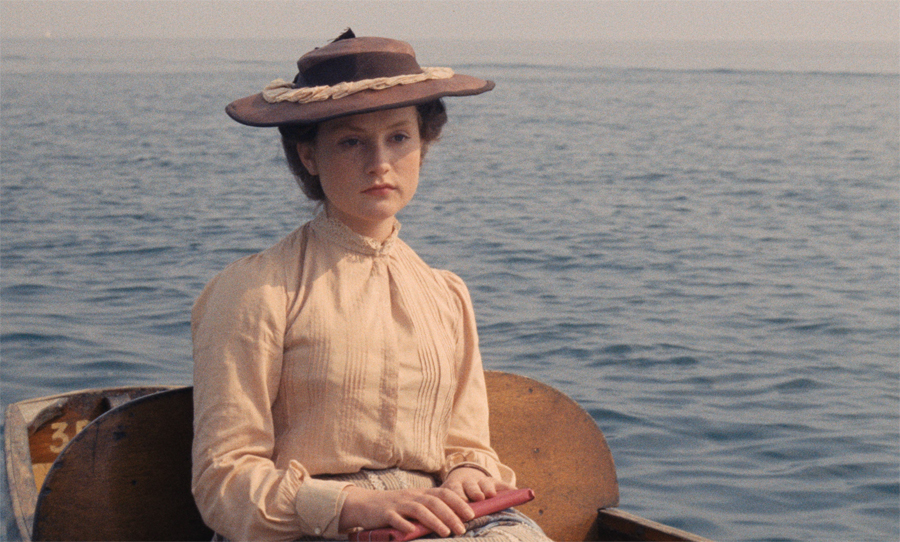
Isabelle Huppert as young Aloïse in Aloïse. Courtesy Several Futures.
Aloïse, directed by Liliane de Kermadec,
now playing at Metrograph, 7 Ludlow Street, New York City
• • •
Nominally a biopic, Liliane de Kermadec’s 1975 Aloïse might be more accurately thought of as an astronomical event—an interpretation bolstered by an image resembling a solar eclipse that appears during the opening credits. In essence, Aloïse is a study of two supernovae: Isabelle Huppert, then in her astral ascendence, and Delphine Seyrig, two decades Huppert’s senior and here in her mid-career annus mirabilis. In the galaxy of de Kermadec’s film, these two celestial bodies never make contact. But neither does one overshadow the other.
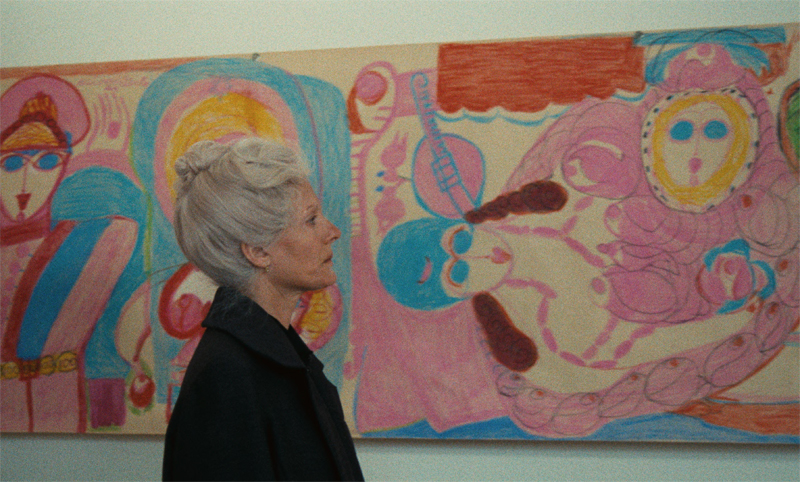
Delphine Seyrig as adult Aloïse in Aloïse. Courtesy Several Futures.
The woman these celebrated actresses portray—Huppert in Aloïse’s youth, Seyrig from her adulthood to her death—was unknown to me (as was the director). Born in 1886 in Lausanne, the Swiss outsider artist Aloïse Corbaz (oddly, she is surnamed Porraz in the movie) was committed in 1918 to a mental asylum, where she would spend the rest of her life; she died, at age seventy-seven, in 1964. The art she created at the facility—vibrantly colored drawings of voluptuous women rendered in crayons and pencils that anticipate Niki de Saint Phalle’s oeuvre—would be championed by Jean Dubuffet in the late 1940s. Aloïse was de Kermadec’s second feature; she began her career as a set photographer on such now-canonical French films as Agnès Varda’s 1962 watershed Cléo from 5 to 7 and Alain Resnais’s 1963 mnemonic chamber piece Muriel, or the Time of Return. (Both these titles accompany Metrograph’s theatrical run of the recently restored Aloïse, along with movies that de Kermadec produced. She continued directing until 2018, two years before her death at ninety-one.)
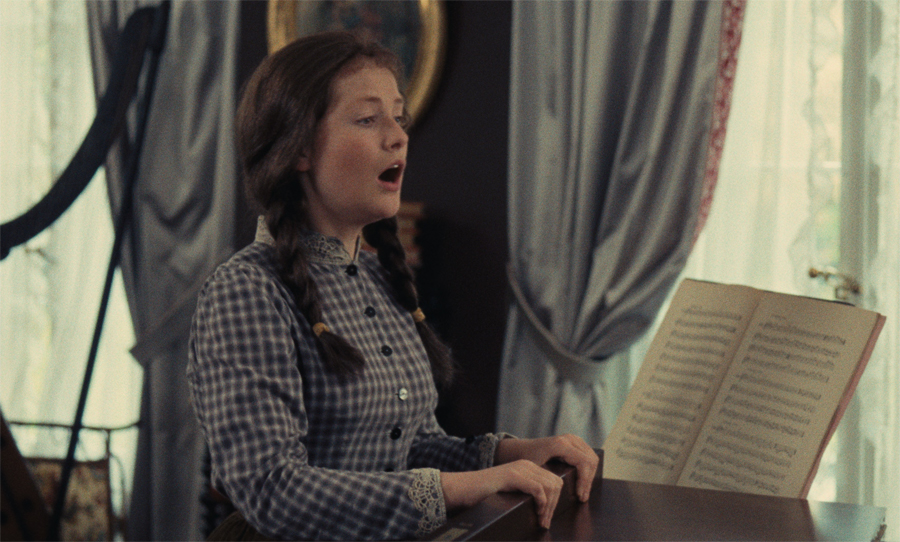
Isabelle Huppert as young Aloïse in Aloïse. Courtesy Several Futures.
Aloïse is a strange, austere film, tracing its subject from childhood to death with no smooth transitions. It begins with Aloïse at age seven or so in bed with her sister Élise, perhaps a year younger, on the night their mother dies. The little girls discuss the number of vowels in their names. After a cut, the film leaps ahead by a decade, as a teenage Aloïse—Huppert was twenty-one during the shoot but easily passes for an adolescent, her round face and rosy complexion suggesting a Cabbage Patch Kid—impassively endures remarks by her father (Marc Eyraud) concerning the cost of her music lessons.
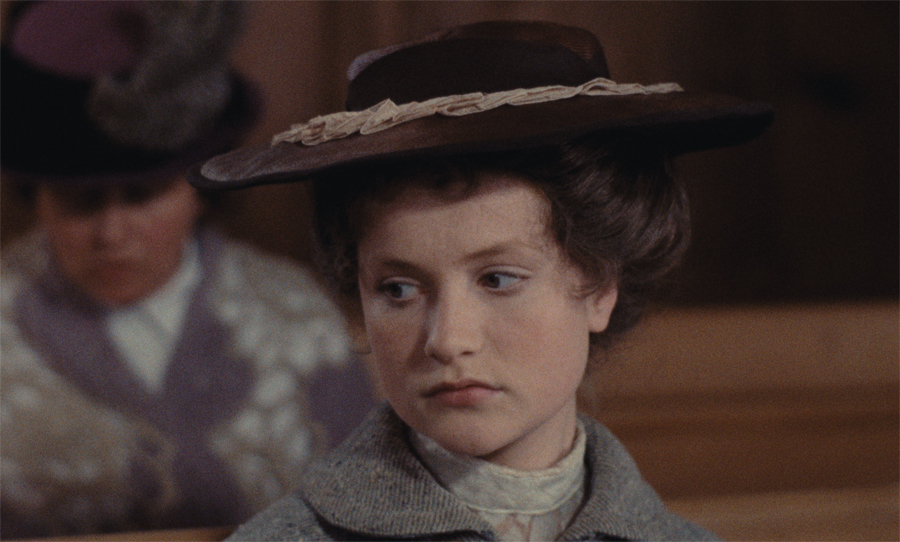
Isabelle Huppert as young Aloïse in Aloïse. Courtesy Several Futures.
Singing and piano-playing both provide an outlet for the recalcitrant teen and offer some respite from Belle Époque strictures. “I want to sing alone, not with others. I want to be heard,” she practically hisses after church has emptied out following Easter service. She forgoes the tedium of a family dinner to practice operatic trilling. After Aloïse’s lycée graduation, a series of brief scenes intimate various opportunities she had—a meeting with an opera impresario, mention of an upcoming trip to England—whose outcomes are never revealed. By the time Huppert’s Aloïse departs the film for good, about a third of the way through, she has made clear to an admirer that she never plans to marry and is on a train to Germany for a teaching position.
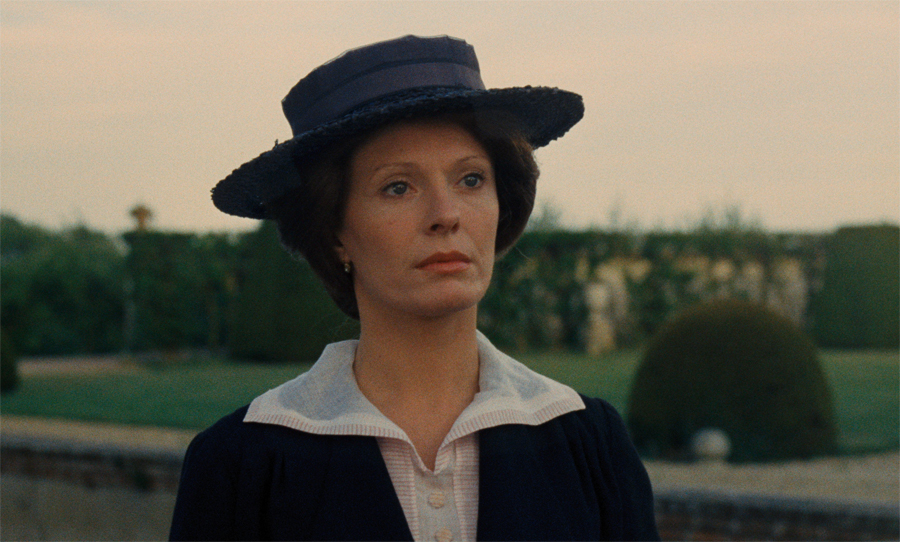
Delphine Seyrig as adult Aloïse in Aloïse. Courtesy Several Futures.
Another cut: Aloïse is now incarnated by Seyrig, first seen tending her charges—the three small daughters of a chaplain—in Potsdam. Not only does the majority of the film belong to Seyrig but she is also tasked with the challenge of embodying the title character’s mental illness, the depiction of which takes up Aloïse’s second hour, its onset roughly coinciding with the protagonist’s repatriation following the declaration of World War I. (She was diagnosed with dementia praecox, now known as schizophrenia.) Yet while Seyrig may have the more demanding part, Huppert’s performance is no less impressive for its comparative tranquility. Shades of her teen Aloïse presage her role in The Brontë Sisters, in which Huppert portrays Anne, the youngest of the genius brood. That 1979 biopic was directed by André Téchiné, who cowrote Aloïse with de Kermadec. Both films share a jagged, off-kilter solemnity enhanced by Huppert’s talent for conveying emotional turmoil churning beneath a placid surface—a quality that has come to define many of her greatest roles in the half century since (her characters in Michael Haneke’s The Piano Teacher, from 2001, and Paul Verhoeven’s Elle, from 2016, immediately come to mind).
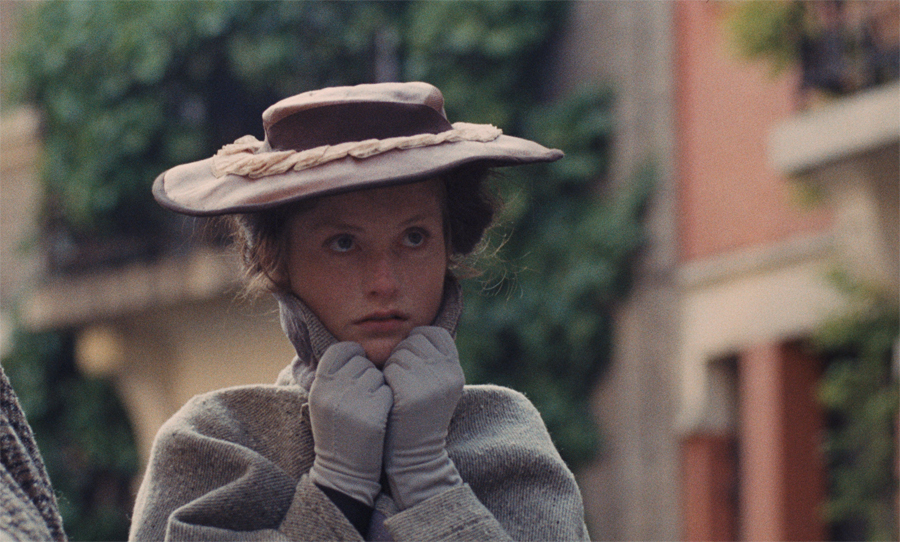
Isabelle Huppert as young Aloïse in Aloïse. Courtesy Several Futures.
Just as thrilling as witnessing a young actress coming into her own style is observing a veteran performer moving away from the kinds of movies that established her name. Beginning with her breakthrough role, in Resnais’s enigmatic Last Year at Marienbad (1961), Seyrig would, for the next decade or so, serve as a model of exalted, distant womanhood in films by Continental male auteurs, a roster also including François Truffaut, Jacques Demy, and Luis Buñuel. By the early 1970s, Seyrig was a committed feminist; as an extension of her political activism, she began to work primarily with women filmmakers, several of whom became renowned for their radical interventions in narrative cinema, whether via form, subject matter, or both.
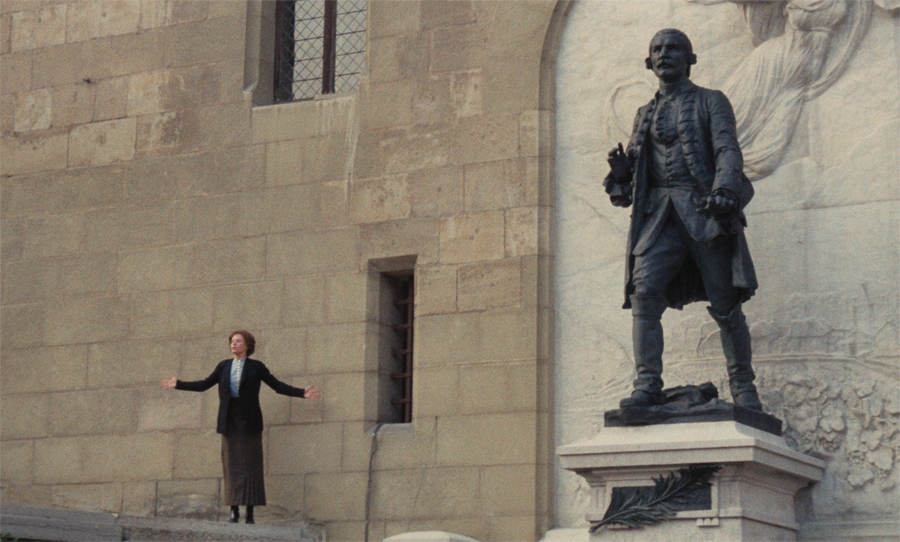
Delphine Seyrig as adult Aloïse in Aloïse. Courtesy Several Futures.
Two of those directors, Chantal Akerman and Marguerite Duras, would collaborate with Seyrig repeatedly. Each cast the actress as the lead in their respective works of 1975, Jeanne Dielman, 23 quai du Commerce, 1080 Bruxelles and India Song. These films have endured as the best-known of their creators in no small part owing to Seyrig’s performances: her titanic minimalism in Jeanne Dielman, an opus in which the title character’s routinized domestic drudgery plays out in extended time; her obliquely potent personification of lassitude and desire as the wife of an ambassador in the 1930s-set India Song, a hypnotic work whose sundering of sound and image underscores the derangement inherent in colonial rule.
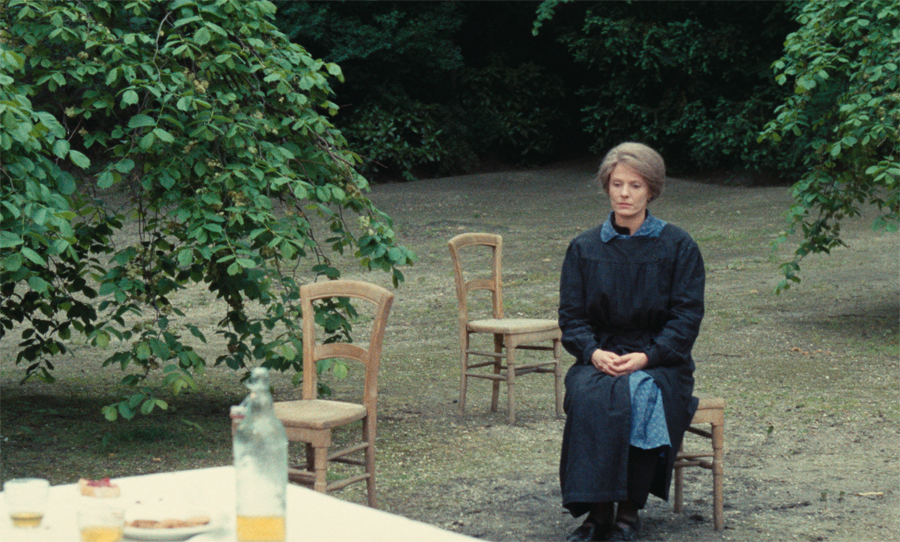
Delphine Seyrig as adult Aloïse in Aloïse. Courtesy Several Futures.
However elliptical it may be, nothing in Aloïse, which is based in fact, is as unconventional as the wholly fictional India Song or Jeanne Dielman (for which de Kermadec served as a producer and which also screens at Metrograph). And yet Seyrig’s Aloïse is of a piece with the widowed homemaker she plays in Akerman’s movie and the languid diplomat’s spouse in Duras’s. All are touched by madness in some way, their psychic disintegration stemming from rules and codes taught to be immutable and created to stifle and oppress. Similar to the ways that Aloïse is the most marginalized of these three protagonists, Aloïse has been the most occulted of this trio of films. Aloïse awaits to be newly appreciated—to be seen as consonant with, and not obscured by, the luster of two other Seyrig vehicles.
Melissa Anderson is the film editor of 4Columns and the author of a monograph on David Lynch’s Inland Empire from Fireflies Press. A collection of her film criticism, The Hunger, is now available from Film Desk Books.