


 Brian Dillon
Six short essays by Trevor Paglen on seeing and believing in an era of digital images.
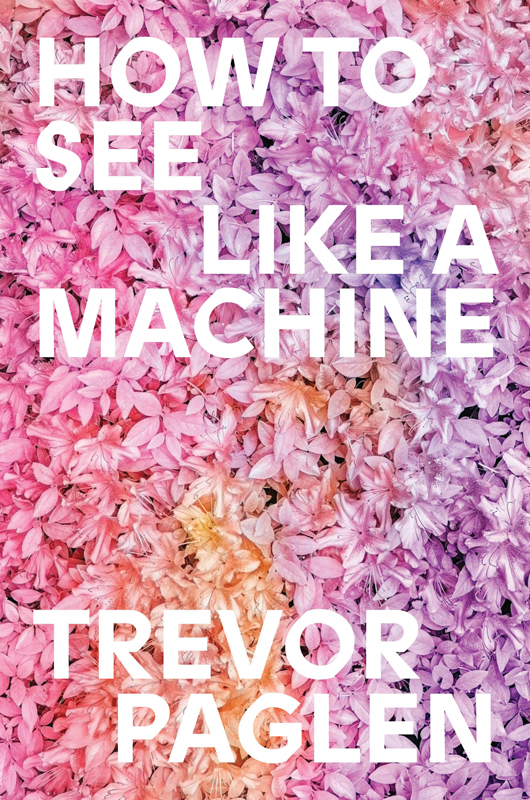
How to See Like a Machine: Images After AI, by Trevor Paglen,
Verso, 176 pages, $24.95
• • •
The artist Trevor Paglen’s new book about images, tech, and belief is here and there haunted by the UFO poster (much mimicked and memed) that Fox Mulder kept above his desk in The X-Files. I WANT TO BELIEVE—hard not to relish the thought of putting that phrase to Richard Dawkins, zealous atheist and sometime scientist, who at the time of writing has been claiming that his recent interactions with an AI chatbot are proof of its possessing actual consciousness. Anthropic’s unctuous Claude seems to have found Dawkins’s emeritus witticisms quite “delightful,” and offered feedback on his novel manuscript (unpublished) that the author found “so subtle, so sensitive, so intelligent” that there must be a thoughtful entity behind it all. You may imagine the polemicist of The God Delusion would spot such an ego-pampering sleight straight away, but we live in an age when skepticism and dupability can be hard to tell apart. In How to See Like a Machine, Paglen provides a patchy prehistory of this moment, and a limited sense of how to survive it.
Paglen is well-placed to brings news from the more obscure, unexpected sites and sources of present technological predicaments. For the past twenty years, his wide-ranging practice—which includes sculpture, installation, photography, and a prodigious amount of text and talk—has explored the hinterland between secret military technology and the more or less subtle distortions of everyday life that technology eventually wreaks. His art has things in common with critiques of image and power in the work of Harun Farocki or (less convincing) Hito Steyerl. Like practices of similar vintage that straddle research and exhibition-making, such as the Center for Land Use Interpretation and Forensic Architecture, Paglen’s career has been especially attentive to geography: the blank spots on the map where the likes of the Pentagon and the CIA carry out their crimes. The six essays (plus introduction and conclusion) in How to See Like a Machine are not exactly untethered from space and place—we all know that AI currently depends on vast physical facilities, and that the machinery of power is still pointed at real bodies—but Paglen’s first substantial subject here is the immateriality, indeed invisibility, of images today. They are no longer seen, he argues, in the sense we once meant by the word.
In the book’s opening essay, “Invisible Images (Your Pictures are Looking at You),” Paglen writes: “Human visual culture has become a special case of vision, an exception to the rule.” In earlier regimes of the image, whether religious and iconographic, representational (painting and photography), or structured for surveillance and persuasion, pictures needed to be viewed by human subjects in order to perform their functions, be these sacred, aesthetic, commercial, or coercive. “What’s truly revolutionary about the advent of digital images is the fact that they are fundamentally machine-readable: They can only be seen by humans in special circumstances and for short periods of time.” This is mundanely true of the photos on your smartphone, which are not there when you’re not looking. Much more troublingly, it’s also the case with the images (if that is even what they are) that track your face in a crowd, your license plates in the city, your presence or not in front of your work-from-home laptop. The fact that machine may now talk to machine about such imagery, without human oversight: this is a key development in the exercise of power, both on a global scale and in the infra-thin, once-private spaces of our lives.
Paglen traces the history of this machine vision through neurologists’ efforts to understand human facial recognition via simplified graphic forms. He demonstrates that, as it emerges, this field seems to turn back toward premodern modes of understanding images as actions rather than passive representations. And he tracks the development of large visual data sets, and their absurd (until implemented) categories, which repeat racist, misogynist, and ableist figures from nineteenth-century criminal physiology. But the most compelling line of inquiry—here is where Mulder comes in—concerns the overlaps between the development of large language models and the long history of (especially) American psyops and related activities, sinister or mad. Some of this material may seem antiquated, recalling an age of clumsy, expensive, and implausible ruses by Cold War operatives. State-sanctioned UFO misinformation, the efforts at brainwashing imagined under the CIA’s MKUltra program, the same agency hiring celebrity magician John Mulholland to teach it about deception: the efficacy of these matters less for Paglen than what they say about a history of managing and predicting gullibility. It’s the last that links the present desire to believe in AI back to military-industrial ventures of the twentieth century.
One of the limitations of a book such as Paglen’s is that these short essays—a little like Steyerl’s, which have also been collected by Verso—can seem orphaned from the full scale of the artist’s research, and from its presentation in his art. The writings stand or fall on the quality of argument made of and about Paglen’s arcane discoveries, or his rehearsal of AI developments now frequently discussed in mainstream media. And the arguments can seem thin, repetitive, or contradictory. Paglen is keen to conclude that the new proliferation of images that are fake-not-fake, visible-but-invisible, cannot be understood let alone critiqued using the tools of the past, whether theories of mimesis or semiosis. At the same time, he wants to say that machine looking and machine learning return us to earlier modes of image-making and apprehending. Icon, emblem, relic, talisman: these are surely rich with their own interpretive modes that, negatively applied, may yet yield strong positions from which to resist what Paglen calls “the society of the psyop.” But for the most part, beyond the unelaborated notion that we must learn ourselves to see like a machine, his book is notably short on visions of an alternative to the slop era, or strategies for its subversion.
Brian Dillon’s memoir Ambivalence: An Education will be published in September by New York Review Books. He is working on Charisma, a novel.