


 Aruna D’Souza
Works by Asian and British artists created for East India Company agents from 1750 to 1850 exemplify multidirectional influences and
extractive relationships.
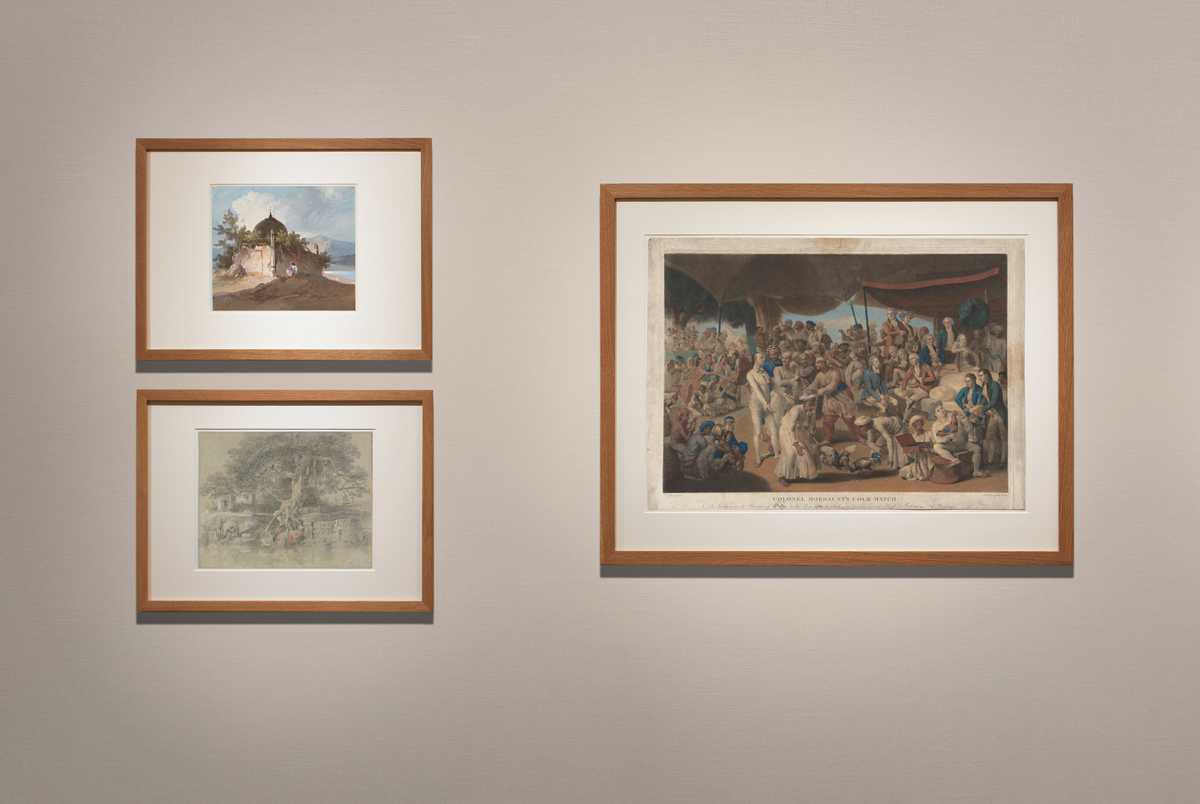
Painters, Ports, and Profits: Artists and the East India Company, 1750–1850, installation view. Courtesy Yale Center for British Art. Photo: Richard Caspole. © Yale Center for British Art.
Painters, Ports, and Profits: Artists and the East India Company, 1750–1850, curated by Laurel O. Peterson and Holly Shaffer, Yale Center for British Art, 1080 Chapel Street, New Haven, Connecticut,
through June 21, 2026
• • •
Painters, Ports, and Profits: Artists and the East India Company, 1750–1850, on view at the Yale Center for British Art, is a fascinating survey of what might be the first instance of a “corporate style” of art—manifested in paintings, drawings, watercolors, and prints that were made by South Asian, Chinese, and British practitioners catering to the tastes and business interests of agents of the British East India Company. The approach, when adopted by South Asian artists, has usually been called “Company painting,” and by Chinese artists, “export painting”; the curators of Painters, Ports, and Profits avoid these terms in an attempt to see these practices, as well as those of British artists in the region, as part of a larger whole.
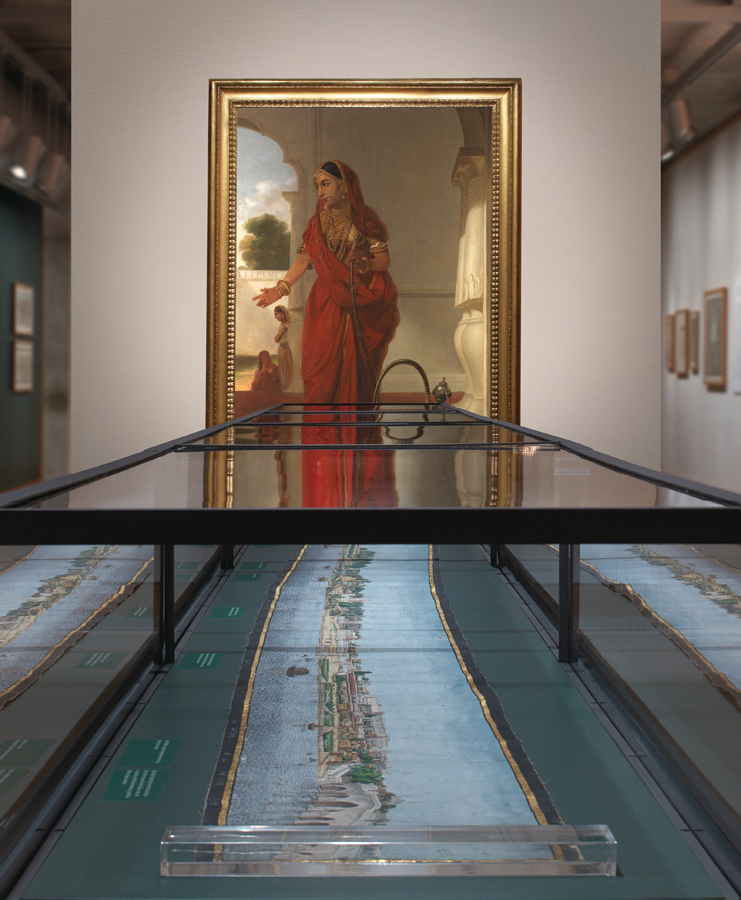
Painters, Ports, and Profits: Artists and the East India Company, 1750–1850, installation view. Courtesy Yale Center for British Art. Photo: Richard Caspole. © Yale Center for British Art.
Chartered in 1600, the East India Company was granted a near monopoly in South and Southeast Asia, and eventually in China, to trade spices, cotton and silk, tea, and other lucrative commodities. It also engaged in drug dealing (opium) and human trafficking (slaves and indentured laborers). By the mid–eighteenth century, it controlled fully half of the world’s trade, had a militia larger than the British army itself, and, in addition to ports such as Calcutta (Kolkata), Madras (Chennai), and Canton (Guangzhou), claimed vast amounts of land on the Indian subcontinent. Its methods of wresting power from South Asian rulers and subjugating local populations were so brutal that, in the face of violent resistance, the British government eventually took over the administration of the colony in the mid–nineteenth century. (The Raj, as the British colonial administration was known, was no less brutal, just for the record.) By the time the British quit South Asia in 1947, thanks in very large part to over 250 years of the East India Company’s operations it had extracted somewhere between forty-five and sixty-five trillion pounds in wealth from the place, an almost unimaginable sum. (Elihu Yale, after whom the university and thus museum is named, made his fortune as a Company agent in the late seventeenth century.)
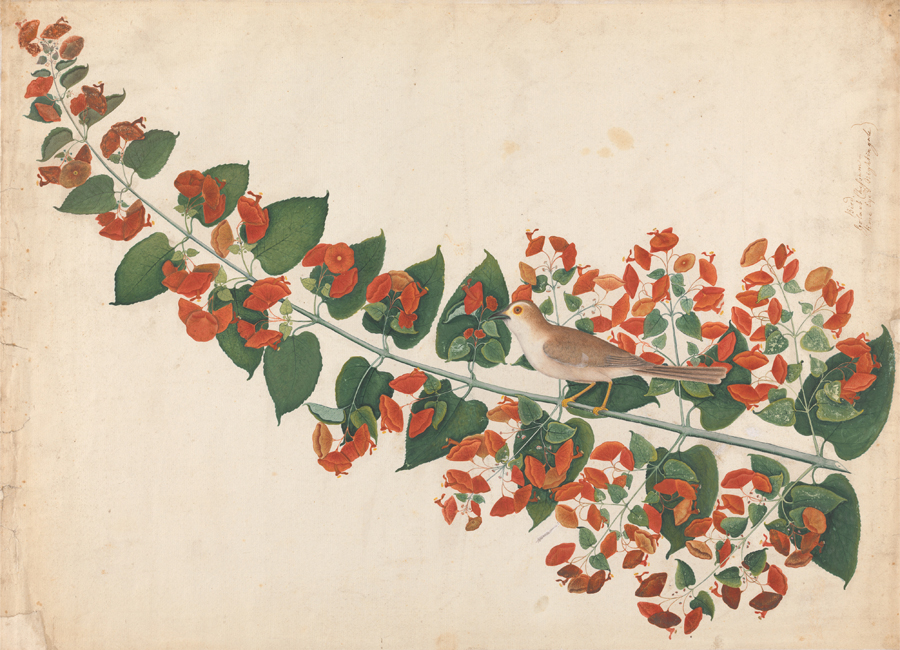
Artist now unknown, Yellow-eyed Babbler (Chrysomma sinense) Perched on Chinese Hat Plant (Holmskioldia sanguinea), ca. 1770. Courtesy Yale Center for British Art.
The exhibition, consisting of more than one hundred works drawn almost entirely from the YCBA collection, takes as its premise the need to hold in balance the brutality of the corporation with the innovations of the art made in its ambit, recognizing the aesthetic achievements that emerged when Indian, British, and Chinese artists learned each other’s techniques and used each other’s materials. The watercolor, gouache, and ink Yellow-Eyed Babbler (Chrysomma sinense) Perched on Chinese Hat Plant (Holmskioldia sanguinea) (ca. 1770) is a lovely example of this phenomenon: the miniaturist technique, as well as indigo and Indian yellow (a pigment produced with the urine of cows fed exclusively mango leaves), come from South Asia; the style of botanical illustration and Prussian blue from Europe; and the tradition of bird and flower painting and vermilion from China. The artist who made this work hasn’t been identified—he (less likely she) is probably Indian, but could plausibly come from any one of those places.
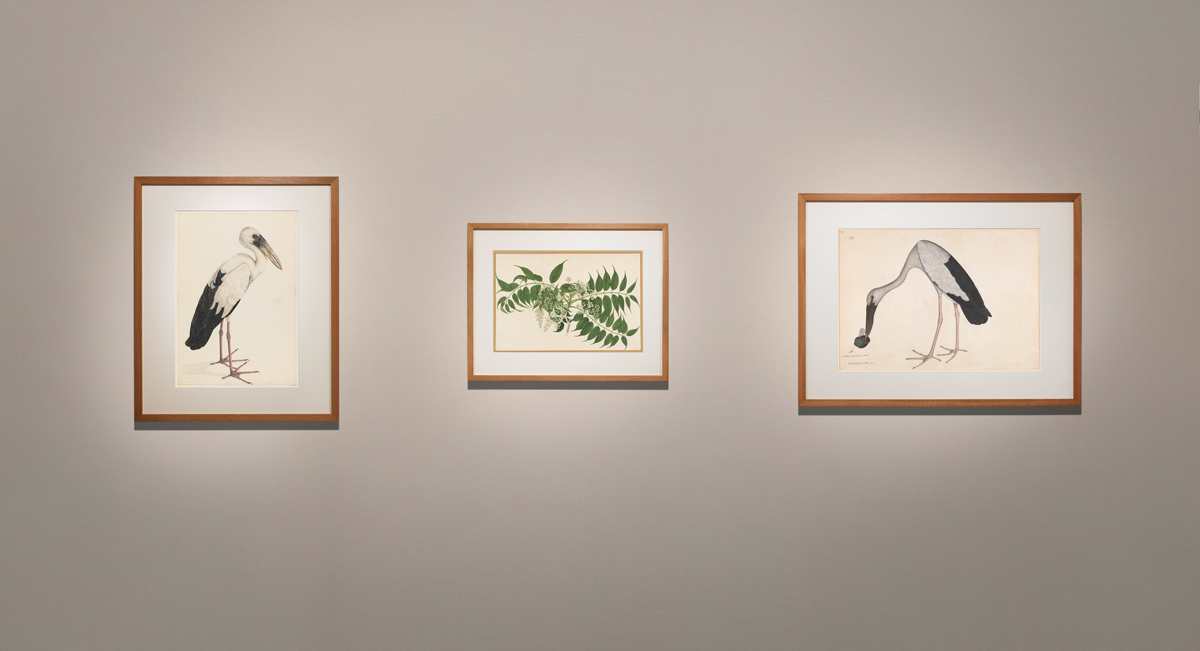
Painters, Ports, and Profits: Artists and the East India Company, 1750–1850, installation view. Courtesy Yale Center for British Art. Photo: Richard Caspole. © Yale Center for British Art. Pictured, far right: Shaikh Zain al-Din, Asian Openbill Stork (Anastomus oscitans), 1781.
Such images served the desires of Company men and, often, their wives, to document and ease their encounters in Asia—to have a record of what they saw and did, to promote their understanding of the cultures they encountered, or, when given as gifts, to curry favor with South Asians of influence. Many sought to enumerate the flora and fauna in a systematic way, sometimes to identify potential new sources of profit and other times to promote scientific inquiry. For example, Mary, Lady Impey, the wife of the first chief justice of Bengal, commissioned more than three hundred watercolors of plants and animals, many from the painter Shaikh Zain al-Din. The latter’s 1781 image of an Asian openbill stork puts the delicacy and precision of miniature, or manuscript, painting—in which artists used brushes made up of just a few squirrel hairs to render impossibly fine details—in service of European scientific illustrations. Bhawani Das’s incredible image of a great Indian fruit bat (also known as a flying fox) took advantage of larger, European sheets of paper to capture the bat’s image nearly to scale.
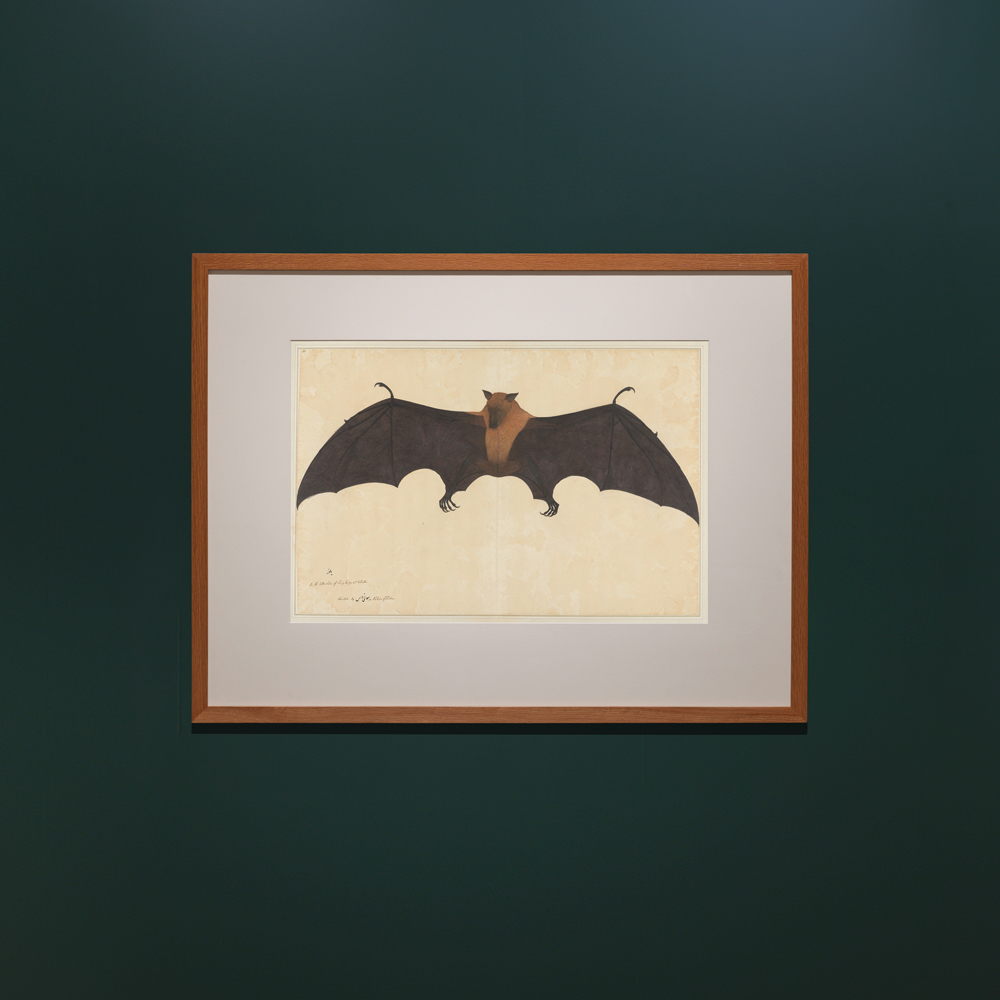
Painters, Ports, and Profits: Artists and the East India Company, 1750–1850, installation view. Courtesy Yale Center for British Art. Photo: Richard Caspole. © Yale Center for British Art. Pictured: Bhawani Das, A Great Indian Fruit Bat or Flying Fox (Ptreopus giganteus), 1778–82.
But even such innocent-looking studies of nature hold violent histories. A gorgeous watercolor, gouache, and graphite work from around 1825 of breadfruits hanging from a leafy branch, one cut open so that you can see inside its bumpy green exterior, is a case in point. The British transplanted breadfruit from Tahiti to Jamaica, hoping it would provide a cheap food source for enslaved plantation workers; they also promoted its growth in Bengal after a famine—exacerbated by their own greed—killed tens of millions of people. In addition, Company agents saw the starchy fruit as a possible commodity for British markets, to be consumed as a bread substitute.
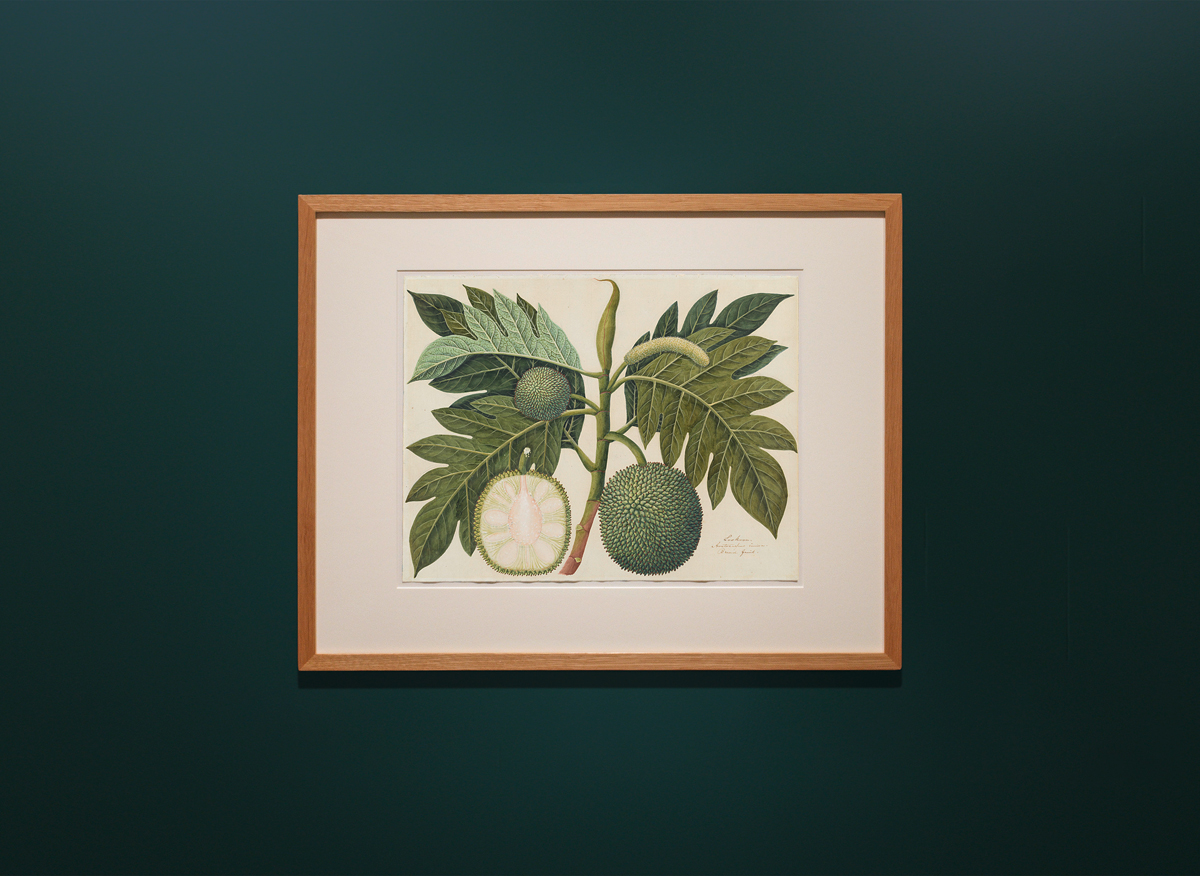
Painters, Ports, and Profits: Artists and the East India Company, 1750–1850, installation view. Courtesy Yale Center for British Art. Photo: Richard Caspole. © Yale Center for British Art. Pictured: Artist now unknown, Breadnut (Artocarpus camansi), ca. 1825.
The enumeration of human types is another recurring theme in the show. An illustrated book of military costumes in India from 1814 by Abraham James includes a picture of three Indian soldiers holding their firearms. James was clearly fascinated by the men’s muscular brown legs, which he draws more or less like tree trunks—they are visible thanks to the standard-issue black-and-white shorty-shorts Indian soldiers wore below the more familiar regimental red coats. In the Irishman Robert Smith’s watercolor rendition of a gardener, painted directly into an 1826 edition of his book Asiatic Costumes, the man—whose dhoti seems to incorporate a codpiece?—is as much an object of consumption as the tray of exotic fruits he proffers. In contrast, the unnamed South Asian artist who painted a karanam—one of the highly educated, multilingual, respected local officials upon whom the Company depended to transact its business—imbues the figure with the import and elegance befitting his station. He is no petty “native clerk,” despite the English inscription on the page.
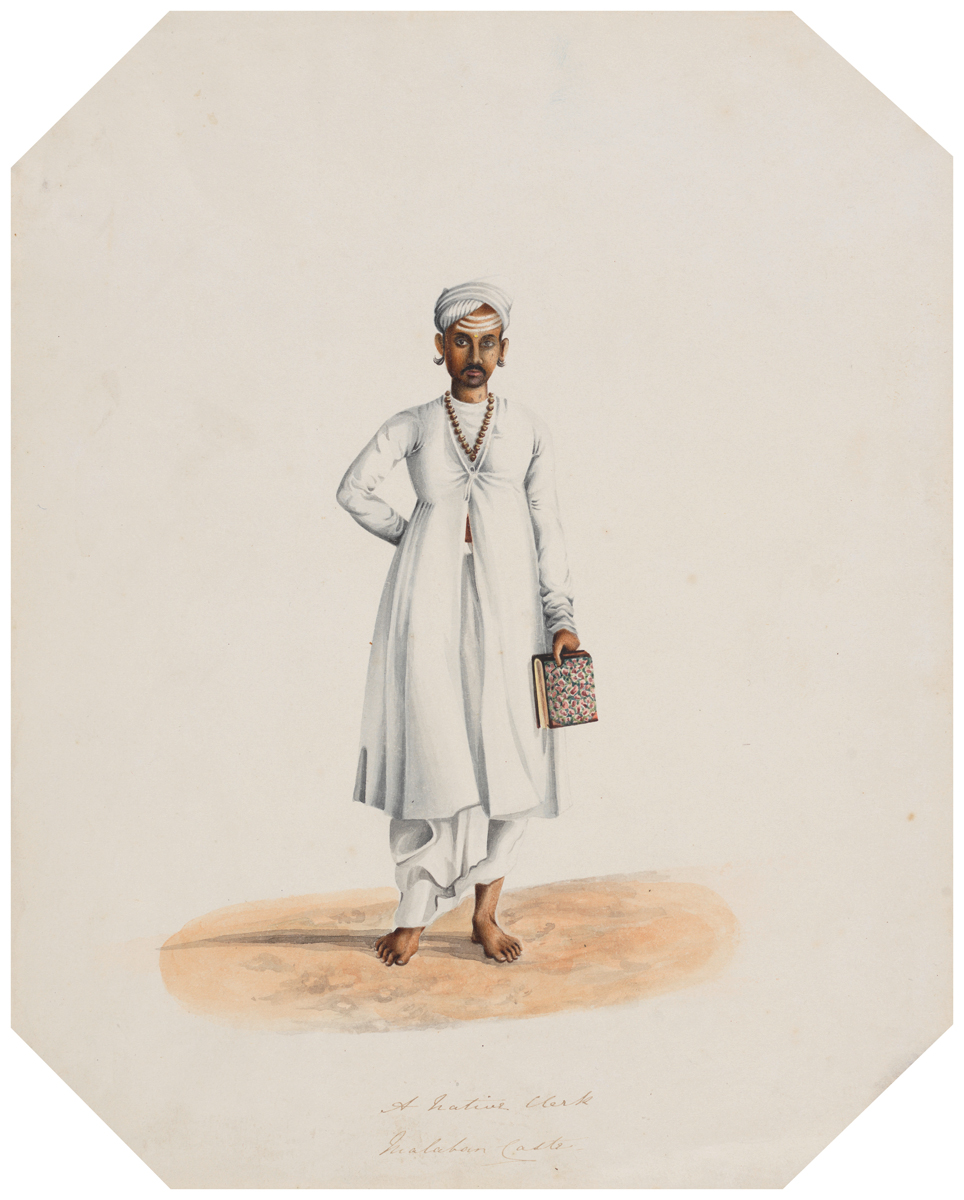
Artist now unknown, Karanam, ca. 1800. Courtesy Yale Center for British Art.
Not surprisingly, almost all of the British artists in the show are named, while the Asian artists are for the most part listed as “now unknown”—the term contains an implicit wish that details of their lives will someday be uncovered by scholars. An exception is Gangaram Chintaman Navgire Tambat, from Poona (Pune), who, along with a number of British artists, was commissioned by the Company agent Charles Warre Malet to document the rock-cut architecture distinctive of the Deccan plateau, among other subjects. Gangaram’s accomplished documentary sketches were used by his British counterparts to create larger, finished images—as with a pair of Gangaram’s drawings of relief sculptures in the Ellora Caves, which then informed Thomas Daniell’s The Ashes of Ravana, Interior View (1795–1807). Daniell even includes an Indian artist sitting cross-legged in the temple, drawing the scene—perhaps in honor of Gangaram.
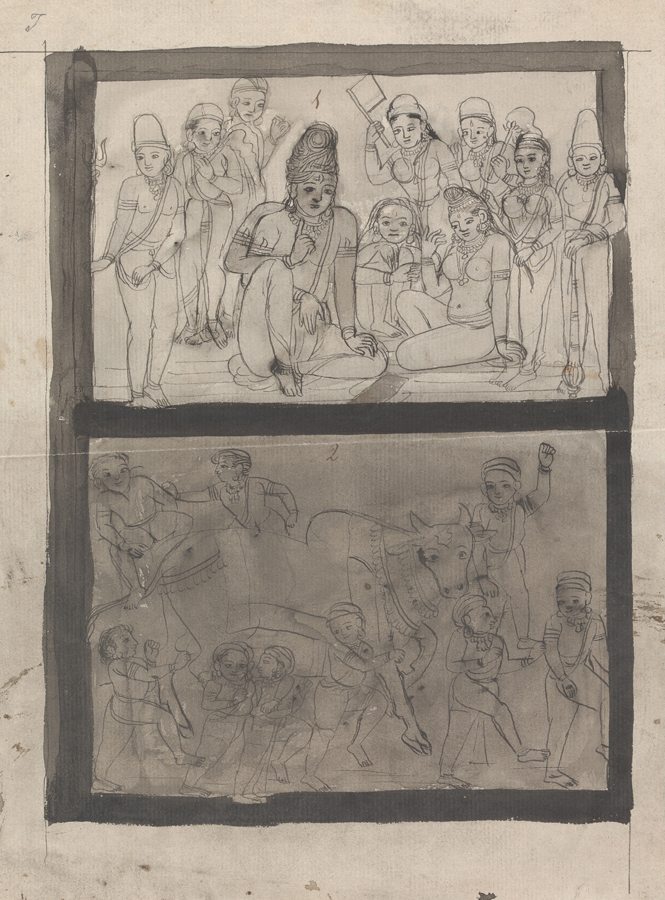
Gangaram Chintaman Navgire Tambat, Shiva and Parvati Playing Chaupar, relief sculpture at Ellora, 1793–95. Courtesy Yale Center for British Art.
Jarringly, the curators describe the interaction of these artists who worked for Malet as “collaborative”—indeed, the word pops up not infrequently in the catalog and on wall labels. Collaboration is a strange choice in this context. It’s a way, I suppose, of insisting on the impact that Indian artists had on the British—a corrective to past scholarship that largely treated artistic influence as unidirectional, a matter of Asian artists absorbing European visual idioms. The exhibition makes a strong case that, indeed, influence was a two-way street. But the term collaboration suggests some kind of parity, a cooperation of equals, which certainly wasn’t the case here. In a telling detail revealed in the catalog, we discover (unsurprisingly) that Malet paid the British artists he commissioned more than ten times what he paid Gangaram. Under the conditions of colonization, Indians adapted, while the British extracted. No amount of revisionism can change that basic truth.
Aruna D’Souza is a writer and critic based in New York. She contributes to the New York Times, 4Columns, and Hyperallergic. Her new book, Imperfect Solidarities, was published by Floating Opera Press in 2024.