


 Andrew Chan
Here, there, Middle of Nowhere: the singer embraces the messy in-between on her latest album.
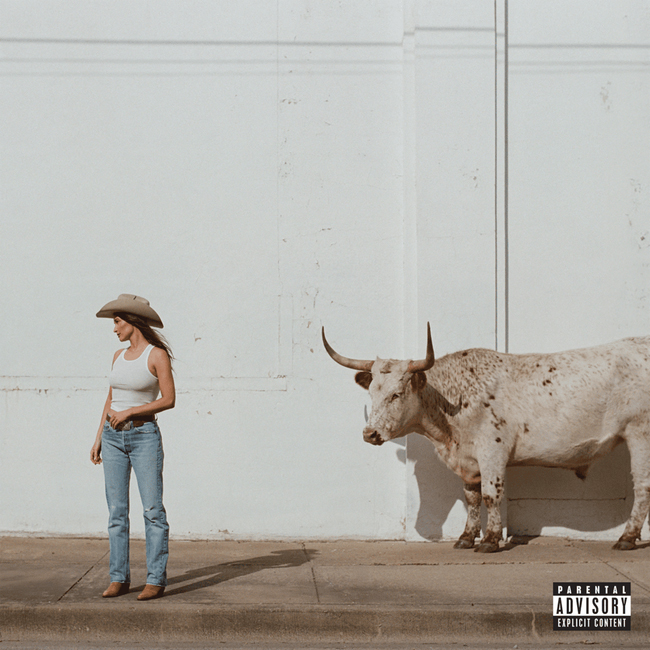
Middle of Nowhere, by Kacey Musgraves,
Lost Highway Records
• • •
In a pop-culture landscape that feeds on histrionic self-declaration, Kacey Musgraves is the rare musician whose best work centers on her inside voice. Many of country’s biggest female crossover acts of the past quarter century—from Martina McBride to Trisha Yearwood to Maren Morris—are bluesy, big-lunged belters, but Musgraves has a much more modest instrument, one that confines her to the tones of everyday speech. From the beginning of her career, she seems to have accepted the narrowness of her vocal range and the thinness of her timbre, developing a low-key, conversational style that turns these constraints into virtues. What she lacks in passion and dynamism she makes up for in being a companionable raconteur who views life’s contradictions with equanimity and good humor. Her attitude toward all manner of turmoil could be summed up by the title of the song that closes her 2013 debut release, Same Trailer Different Park: “It Is What It Is.”
On her seventh record, Middle of Nowhere, Musgraves is at ease singing about mixed feelings that have no name. Her minimally inflected vocals constitute a kind of Rorschach test for the listener: they can sound at once anxious and carefree, oblivious and self-aware, sometimes on the same lyric. These contradictions are front and center on the excellent “Back on the Wagon,” in which she explains that she’s rekindled a relationship with a no-good ex. Amid a lean arrangement embellished by a whining pedal-steel guitar, her poker-faced performance convinces us that she’s ready to defend her man against all the naysayers and that she’s well aware of the trap she’s stepping into.
Musgraves’s music sometimes hides its ironies beneath a deadpan simplicity. The album’s lead single, “Dry Spell,” vents her angst about a recent period of celibacy, but she delivers her “cry for help” so impassively that you wonder if she might not be happy to remain sexless for a while longer. The chorus—a pile-on of clichés (“ain’t nobody’s tool up in my shed / ain’t nobody’s boots under my bed”) that only serves to accentuate the singer’s lightheartedness—finds Musgraves coming to terms with what it means to have a craving without necessarily being hell-bent on satisfying it. A few tracks later, on “Loneliest Girl,” she boasts that she “could go days without seeing someone,” her acceptance of singlehood sounding just as mutable—but also just as real—as her earlier frustrations with it.
Musgraves’s stellar first two albums were light on songs about sex and romance. Despite a few exceptions—the flirty “Late to the Party,” on 2015’s Pageant Material, is a particular highlight—those records are primarily preoccupied with the pleasures and absurdities of life in small American towns like her native Golden, Texas, where neighbors are constantly getting into one another’s business and people distract themselves with the usual addictions. In Star-Crossed (2021), a chronicle of her short-lived marriage to singer-songwriter Ruston Kelly, the complexities of love emerged as a dominant theme in her work, but the underwhelming results indicated her discomfort with mining the extreme end of the emotional spectrum. The follow-up, Deeper Well (2024), coasted on its inviting Laurel Canyon textures but was marred by a few too many self-help generalities. Some critics and fans have hoped she would return to her roots—the kind of expertly crafted, winningly witty songwriting that established her as one of Nashville’s premier tunesmiths more than a decade ago.
But in this transitional period in her creative life—the long hangover following her gorgeous, Grammy-winning mainstream breakthrough, Golden Hour (2018), during which she has, in her words, become “obsessed with the concept of liminal space”—Musgraves isn’t content to just recycle the tongue-in-cheek wordplay of her early triumphs. Many of the songs on Middle of Nowhere avoid clicking neatly into place, evoking Deeper Well’s gentle embrace of the in-between without succumbing to that album’s vagueness. On the title track—a song about being “out there on the edge of the world / way past common sense”—this balance is achieved not just in the words but through surprising elements of composition and production. Among these shrewd choices are the presence of understated vocal harmony (performed by Musgraves’s frequent collaborator Daniel Tashian) that keeps her perpetually off-center, abrupt shifts between time signatures, and an outro verse that calls out “reckless men who don’t know what they want” before quickly trailing off, as if to prevent the listener from drawing overdetermined conclusions.
Returning to Musgraves’s strengths as a chronicler of rural communities, Middle of Nowhere moves beyond mere introspection; the artist isn’t the only thing drifting between here and there, presence and absence. Sometimes it’s another character, like the fed-up woman who suddenly walks out of her own life in “Abilene” (“headed somewhere / didn’t really care where it was”). Sometimes it’s a relationship, like Musgraves’s reunion with fellow contemporary-country titan Miranda Lambert on “Horses and Divorces,” which puts an end to their yearslong public feud (ignited when a song written by the former became a hit for the latter) but stops short of making any commitments to a future alliance or friendship. Elsewhere, it’s the landscapes that elude definition. The town described in the Willie Nelson–assisted “Uncertain, TX” is the sort of place where “nobody ever makes up their mind,” and the song’s sonic palette matches this mood of indeterminacy, blending traditional country elements with a norteño-style accordion and a shuffling cumbia rhythm that highlight the Latin American roots of Texas dancehall music.
Coming after so many songs that move through gray zones, the album closer, “Hell on Me,” registers as strikingly lucid. A breakup ballad deeper than anything on Star-Crossed, the track foregrounds the intimacy and crisp beauty of Musgraves’s voice, a sound as delicate as the softly plucked guitar strings in the background. She takes stock of the devastation: “watched you leaving / running from demons / tryin’ to change you changed me.” Then a few ambiguities start to seep in: “You’ve got your version of how it went down,” she acknowledges. Briefly, her language turns hesitant, halting: “I’ve had some time to kinda sorta sort it all out.” Even here, at the outer edge of her certainty, on the album’s most clear-eyed and plainspoken song, Musgraves seems to admit that the best we can hope for, sometimes, is an agreement to disagree, a tenuous reconciliation with multiple contending truths. You have yours; I have mine. It is what it is.
Andrew Chan is a writer and editor living in Brooklyn, New York. He is the author of Why Mariah Carey Matters, published by University of Texas Press.