


 Melissa Anderson
Striking discordances bring an animated intensity to Robert Aldrich’s 1956 tearjerker starring Joan Crawford and Cliff Robertson.
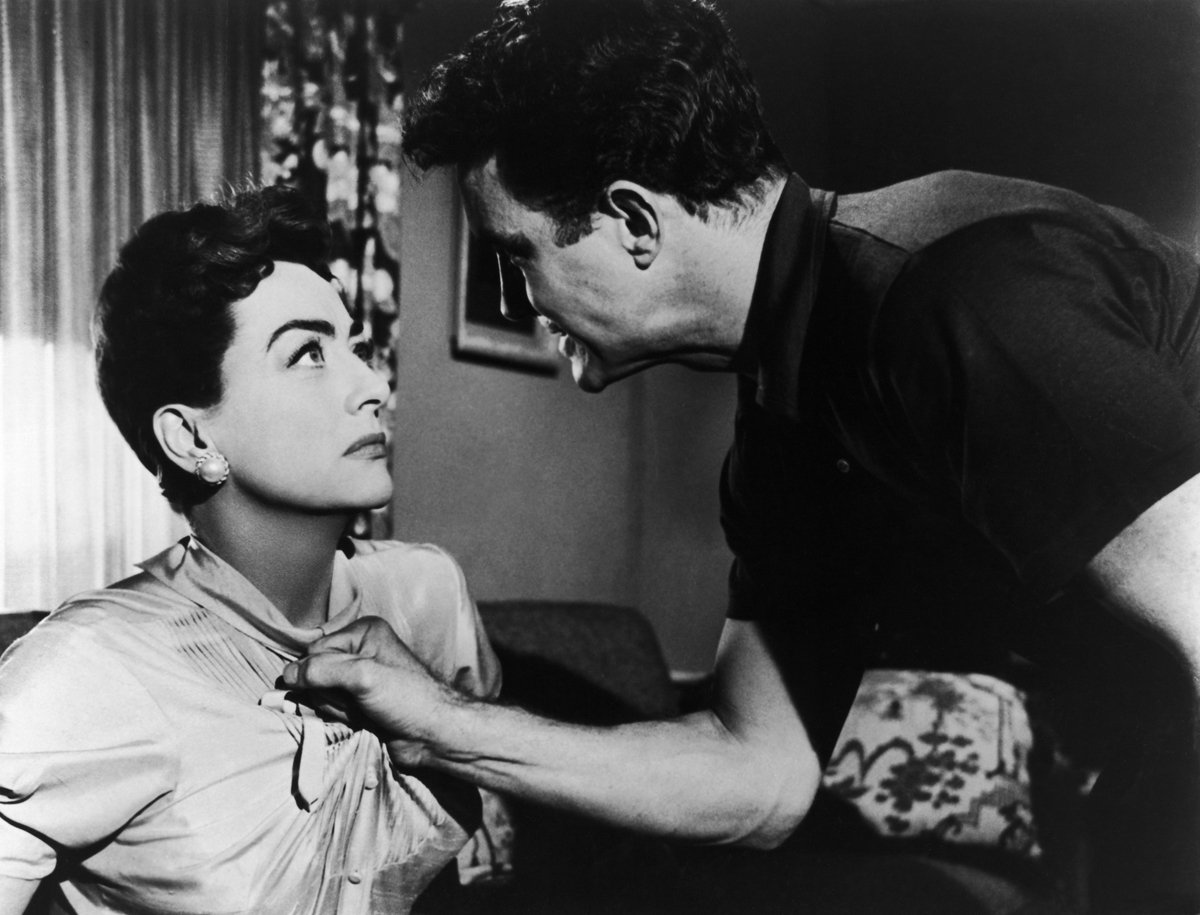
Joan Crawford as Millicent “Milly” Wetherby and Cliff Robertson as Burt Hanson in Autumn Leaves. Courtesy Sony Pictures Entertainment.
Autumn Leaves, directed by Robert Aldrich, screening January 31 and February 2, 2026, Museum of Modern Art, 11 West Fifty-Third Street, New York City
• • •
A film in the throes of seasonal affective disorder, Robert Aldrich’s jaggedly tender 1956 melodrama Autumn Leaves commences not in the fall but midsummer, when its May–December lovers first meet. The younger member of the couple is headed for a crack-up; the older is played by a Hollywood legend who, then at the onset of the winter of her long career, gives one of her last great performances.
Aldrich’s movie—which screens as part of MoMA’s “To Save and Project,” an essential annual showcase dedicated to recently restored films, currently underway and running through February 2—was originally called The Way We Are. That more plaintive name was ditched to capitalize on the popularity of the dolorous, frequently covered song that provides the title, crooned by Nat King Cole over the opening credits. Later, we hear an instrumental version of “Autumn Leaves”: it’s what the single, middle-aged Millicent “Milly” Wetherby (Joan Crawford)—an always-in-demand freelance typist who works from her Los Angeles bungalow—selects on her tabletop jukebox at the booth where she sits alone, about to enjoy an austere meal of chicken salad, no bread. Following through on her determination to treat herself to a night on the town, the self-conscious woman has stopped by this crowded eatery after an outing to the symphony, where the pianist’s Chopin piece triggered a flashback to a much younger Milly, seen canceling a date with a beau so she could take care of her ailing father. Her unwavering commitment to duty, whether filial or work-related, we gather, explains the lonely predicament she finds herself in now.
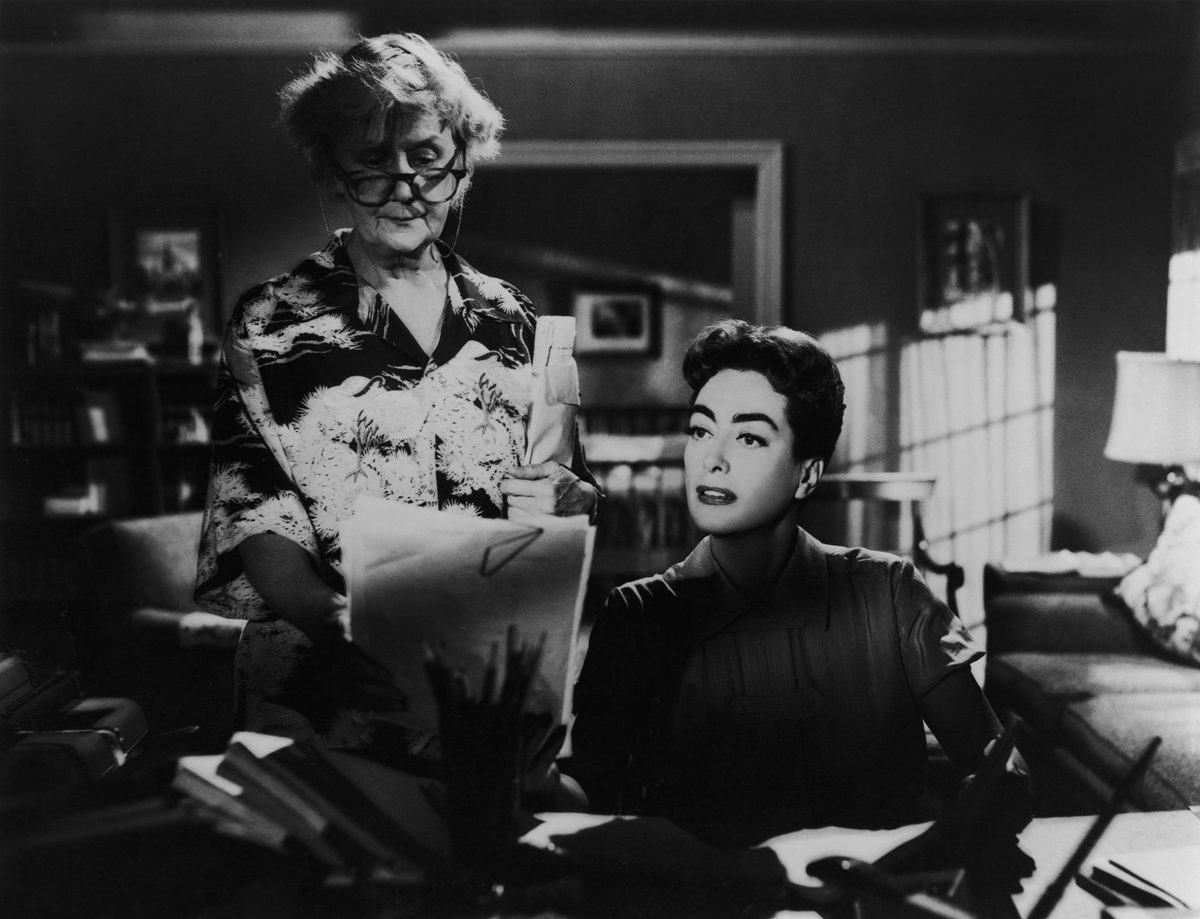
Joan Crawford as Milly Wetherby (right) in Autumn Leaves. Courtesy Sony Pictures Entertainment.
But her isolation ends when boyish Burt Hanson (Cliff Robertson) sits at her table, immediately pitching woo: “You look like somebody I’d like to talk to. To listen to.” He walks her home and proposes a beach outing the next day. Soon they’re lying in the surf, kissing passionately, instantly recalling Burt Lancaster and Deborah Kerr’s lusty oceanside clutch in From Here to Eternity, released three years earlier. Turned on yet terrified of being hurt, Milly demands Burt find someone his own age and never contact her again. (Though we never learn how old the characters are, Crawford was at least fifteen years Robertson’s senior—a precise number is impossible to give, since the actress’s birth year has never been verified. She claimed it was 1908; her daughter Christina, in the matricidal 1978 tome Mommie Dearest, insisted it was 1904.) But a month later, they marry, enjoying conjugal bliss—until Virginia (Vera Miles), Burt’s never-before-mentioned ex-wife, pays a visit to Milly. In time we learn of a sordid alliance between Virigina and Burt’s father (Lorne Greene), a traumatic wound that Burt had tried to repress but which has now been reopened, leading to his being carried out of Milly’s house by two mental-hospital attendants as he cries out to his weeping second wife, “I’ll get you! I’ll cut your guts out! I didn’t do anything wrong.” Mewled more than shouted, that last claim is uttered multiple times, the repetition emphasizing the scene’s unrelenting agony.
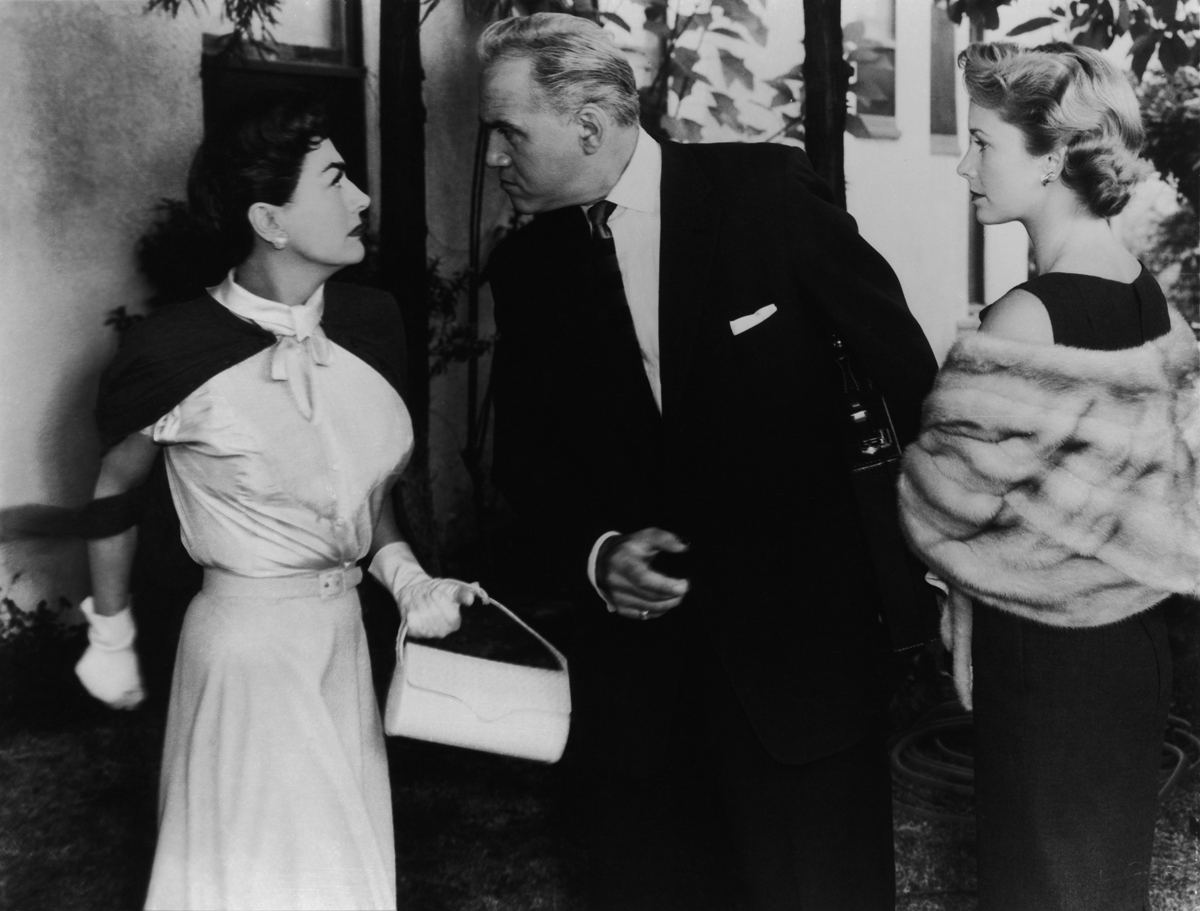
Joan Crawford as Milly Wetherby, Lorne Greene as Mr. Hanson, and Vera Miles as Virginia Hanson in Autumn Leaves. Courtesy Sony Pictures Entertainment.
Autumn Leaves was released in the first decade of Aldrich’s career as a solo director (after years assisting such titans as Jean Renoir and Charlie Chaplin); his varied oeuvre would include brutal war epics, revisionist Westerns, apocalyptic noirs, caustic portraits of stardom (including his other collaboration with Crawford, the garish What Ever Happened to Baby Jane? from 1962), and lurid weepies like this one. The thread running through his diverse filmography is fury, an unleashing of rage, however impotent, in the face of abominable treachery, evidenced in Burt’s anguished outbursts. (Sometimes these protests are monosyllabic, almost prelingual, as seen in Aldrich’s enduring sapphic cult classic, 1968’s The Killing of Sister George, about another intergenerational couple. When the older of the pair loses both her twentysomething girlfriend and her job owing to a conniving executive, the dumped woman can only let out a plaintive Mooooooooo!)
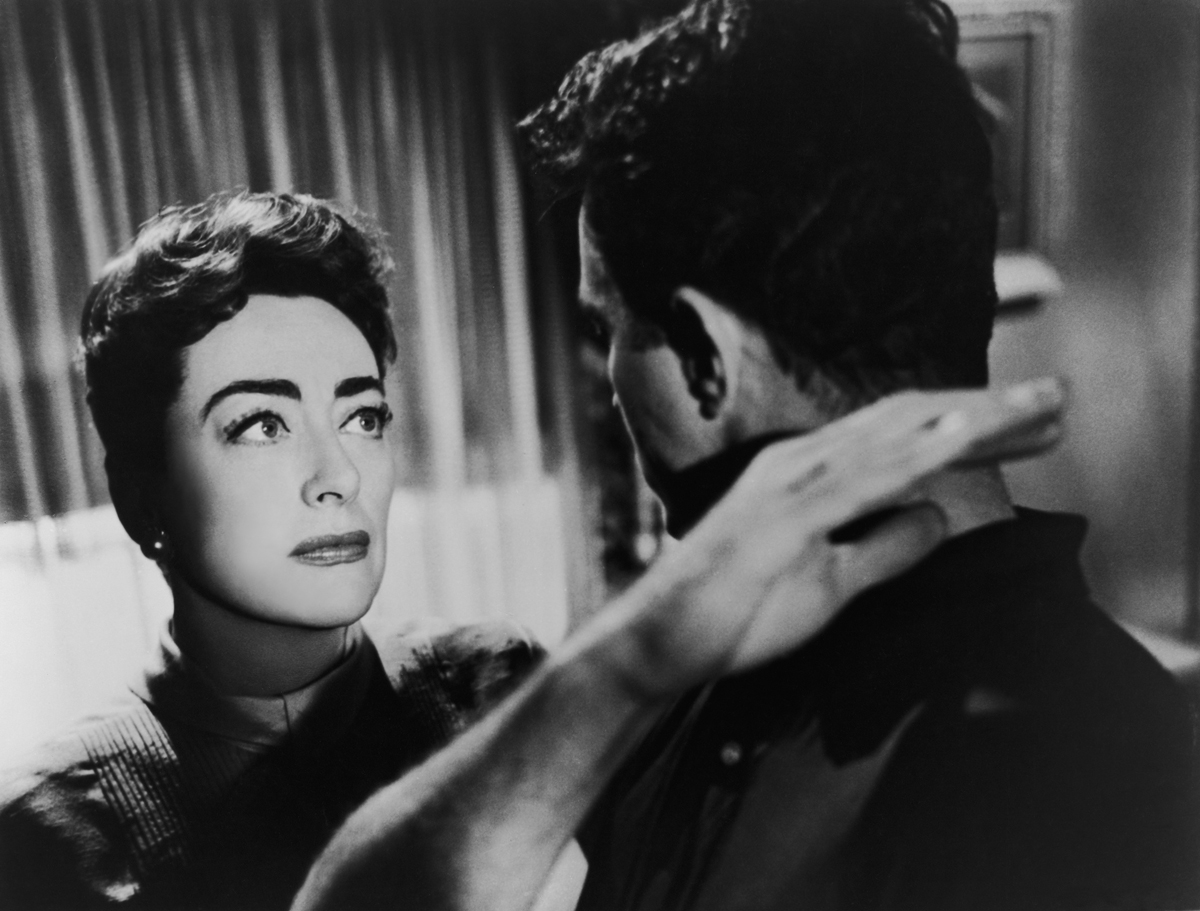
Joan Crawford as Milly Wetherby and Cliff Robertson as Burt Hanson in Autumn Leaves. Courtesy Sony Pictures Entertainment.
A year before Autumn Leaves was released, Jacques Rivette, writing in Cahiers du Cinéma, hailed Aldrich as a filmmaker who “achieves harmony through a precise dissonance.” Discordance, not only in the age gap between Milly and Burt but also in the acting styles of Crawford and Robertson, animates and deepens what might otherwise be dismissed as a tawdry tearjerker. As Scott Eyman notes in his recent biography of the actress, before production of Autumn Leaves began, Crawford—who made her screen debut in 1925, two years after her costar was born—asked to screen several movies that, in Aldrich’s words, “would help her orientate herself with just what is going on in films now.” Among the titles requested was Elia Kazan’s East of Eden (1955), the first of three films to star James Dean in his too-abbreviated life, then as now a paragon of a wounded, emotive masculinity, a sharp contrast to the reticence and self-possession that was the standard for much of the male acting during Crawford’s prime.
Dean remains one of the most famous alums of the Actors Studio—that hothouse of Method training and the institution where Robertson studied, eventually becoming a lifelong member. Robertson’s performance in Autumn Leaves, which gave him his first lead role, recalls the torment and vulnerability that are the hallmarks of Dean’s style. In the grips of psychosis, Burt roars to Milly, “I know it and I know it! You’re all against me!” The cry echoes with the signature lament of Dean’s Jim Stark in Rebel Without a Cause: “You’re tearing me apart!”
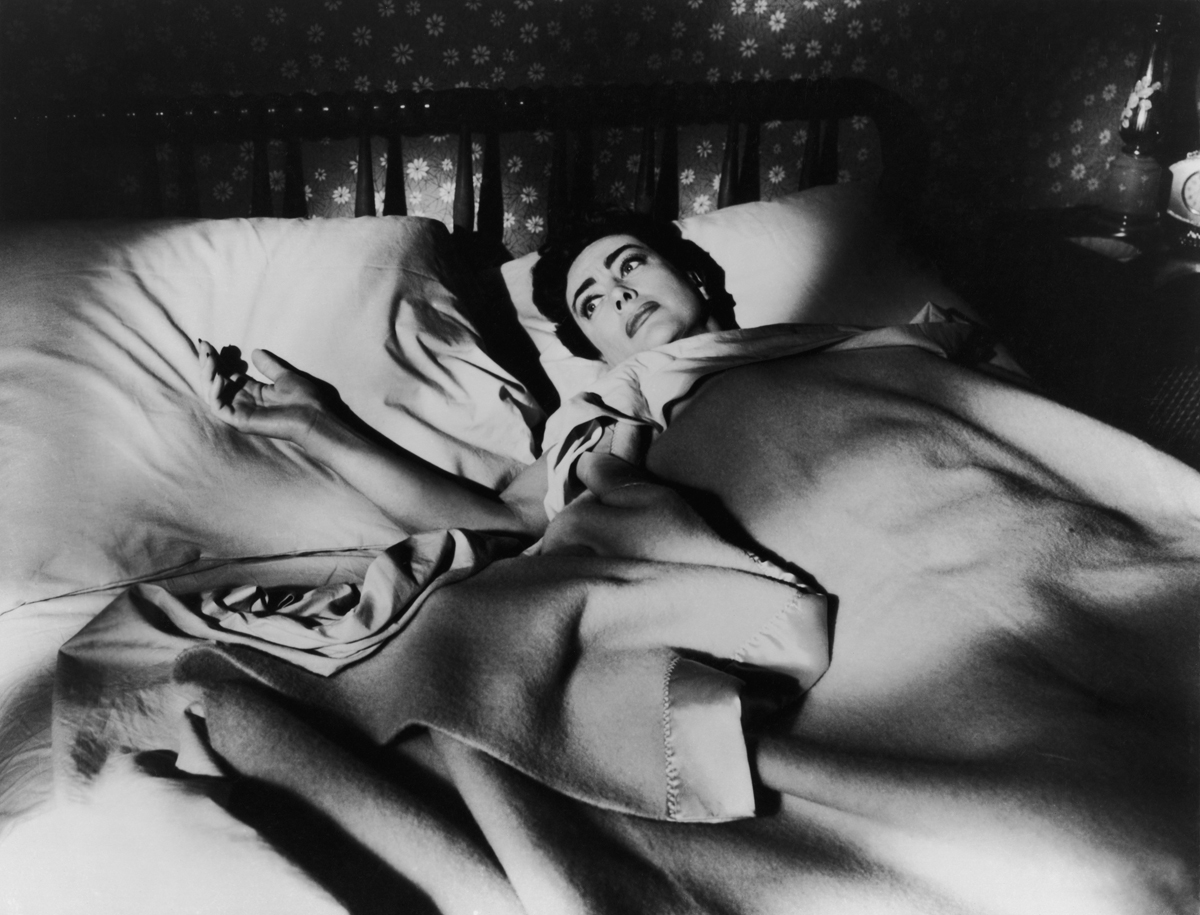
Joan Crawford as Milly Wetherby in Autumn Leaves. Courtesy Sony Pictures Entertainment.
While Burt may be the one who is psychically rent and shattered, a broken man who will ultimately be repaired by a long clinic stay (depicted in a montage replete with episodes of electroconvulsive therapy), Milly’s grief and worry over the sick man she loves is no less harrowing to witness. Her suffering is made all the more poignant by the sheer intensity of Crawford’s labor in the film, her iron discipline similar to that of Milly as she completes another rush typing job. Her acting is at once immoderate and fiercely controlled; her face, as stylized and exaggerated as a Kabuki mask, still conveys a vast repertoire of intricate moods and responses. Burt’s descent into madness chills. The extreme close-up of Milly’s terrified eyes devastates.
Melissa Anderson is the film editor of 4Columns and the author of a monograph on David Lynch’s Inland Empire from Fireflies Press. A collection of her film criticism, The Hunger, is now available from Film Desk Books.