


 Melissa Anderson
A river of bodily emissions runs through it: in Lucio Castro’s new film, the flow of erotic energy proves to be a mystical power.
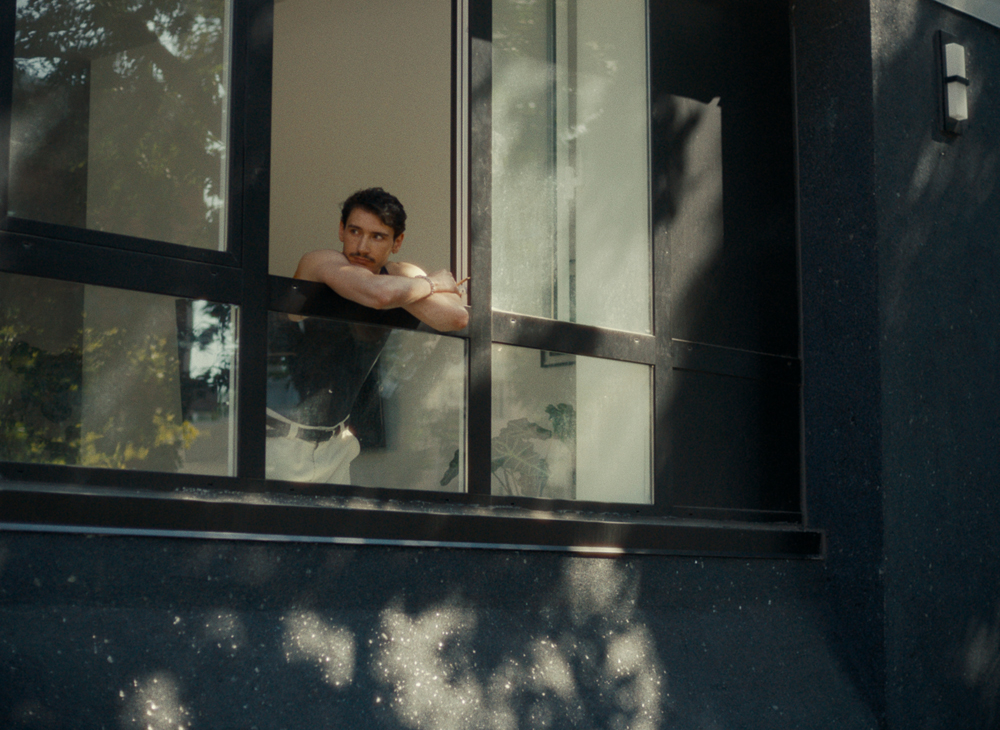
Laith Khalifeh as Adnan in Drunken Noodles. Courtesy Strand Releasing. © Lucio Castro.
Drunken Noodles, written and directed by Lucio Castro, now playing at IFC Center, 323 Sixth Avenue, New York City
• • •
Gay is good, as the old slogan has it, and sometimes gay is serendipitous. I first saw Lucio Castro’s loose, libidinous Drunken Noodles last fall, when it screened as part of the New York Film Festival. To write this review, I revisited the movie on June 11, the day David Hockney died. The spirit of the great English painter—who was never not out, whose most famous canvases from the early decades of his career are erotically charged tributes to man-on-man love, whose life motors Jack Hazan’s supremely sexy docufiction A Bigger Splash (1973)—infuses Castro’s feature, which is similarly carnal in a casual, playful way.
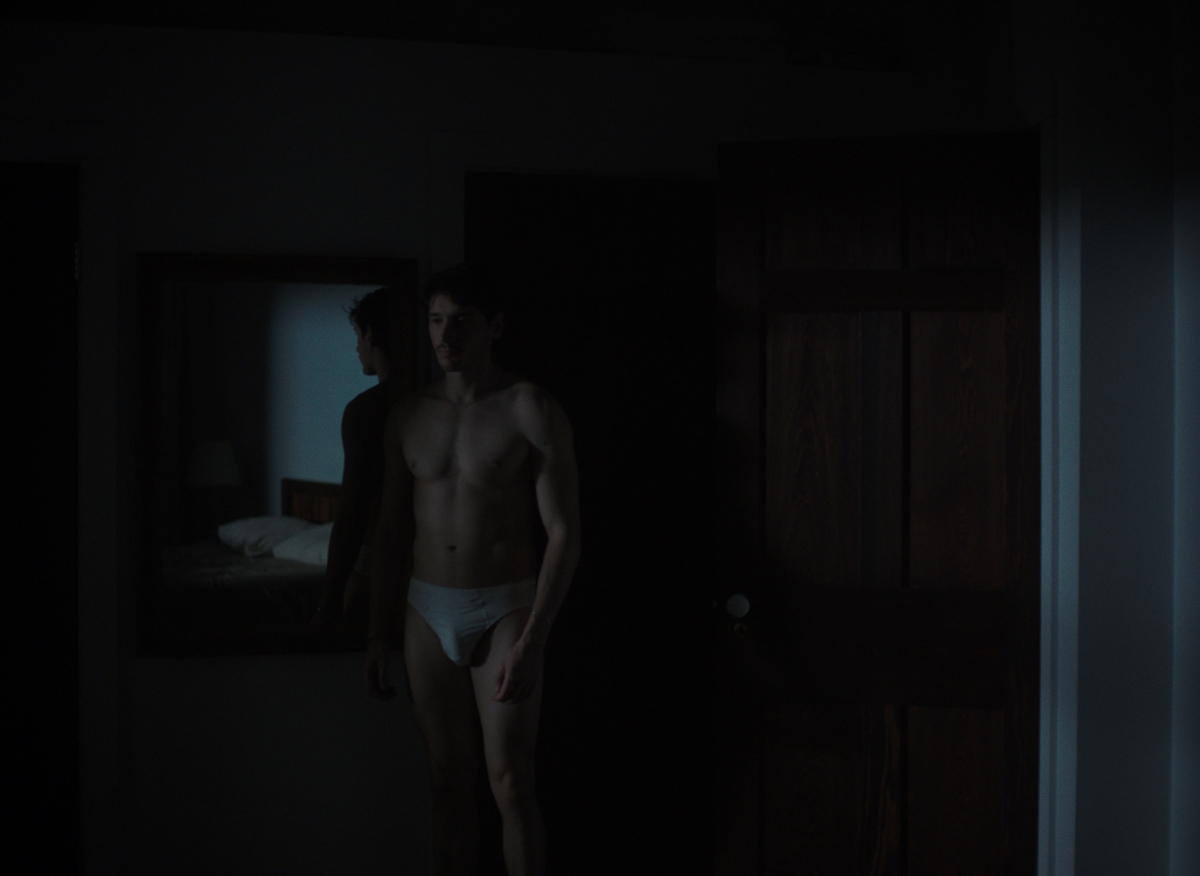
Laith Khalifeh as Adnan in Drunken Noodles. Courtesy Strand Releasing. © Lucio Castro.
Like the most memorable sexual experiences, Drunken Noodles continuously surprises and delights. And fittingly, for a movie filled with ejaculate and other bodily emissions, time is fluid, achronologically toggling between one summer and the one prior. The film centers on Adnan (Laith Khalifeh), an art grad student at Bard who’s apartment-sitting in Williamsburg for his uncle during the hot season and interning at a small storefront gallery. The works about to go on view at the space are needlepoint “thread paintings” depicting heavily populated BDSM dungeons and other XXX scenarios created by Sal, an artist in his seventies whom Adnan met in the Hudson Valley the summer before. (The lubricious embroidered pieces—which might be thought of as the much raunchier descendants of Hockney’s Domestic Scene, Los Angeles, from 1963—are by Sal Salandra; he is played by Ezriel Kornel, a neurosurgeon IRL and the artist’s near polar-bear doppelgänger.)
Although a professional opportunity has brought Adnan to the city, scant scenes are devoted to his hours at the gallery. Instead, the film emphasizes what the lithe, angular, handsome young man does during his downtime: reading, smoking while staring out the living room window, tending the cat, jogging along the East River, enjoying an al fresco beverage by the same. Yet these solo, wordless pursuits, shown fleetingly, are dwarfed by having (and pursuing) sex, whether made possible by geolocating or sheer happenstance. (As gay guys have demonstrated for millennia before Hockney was even born, occasions for sex exist anytime and anywhere.)
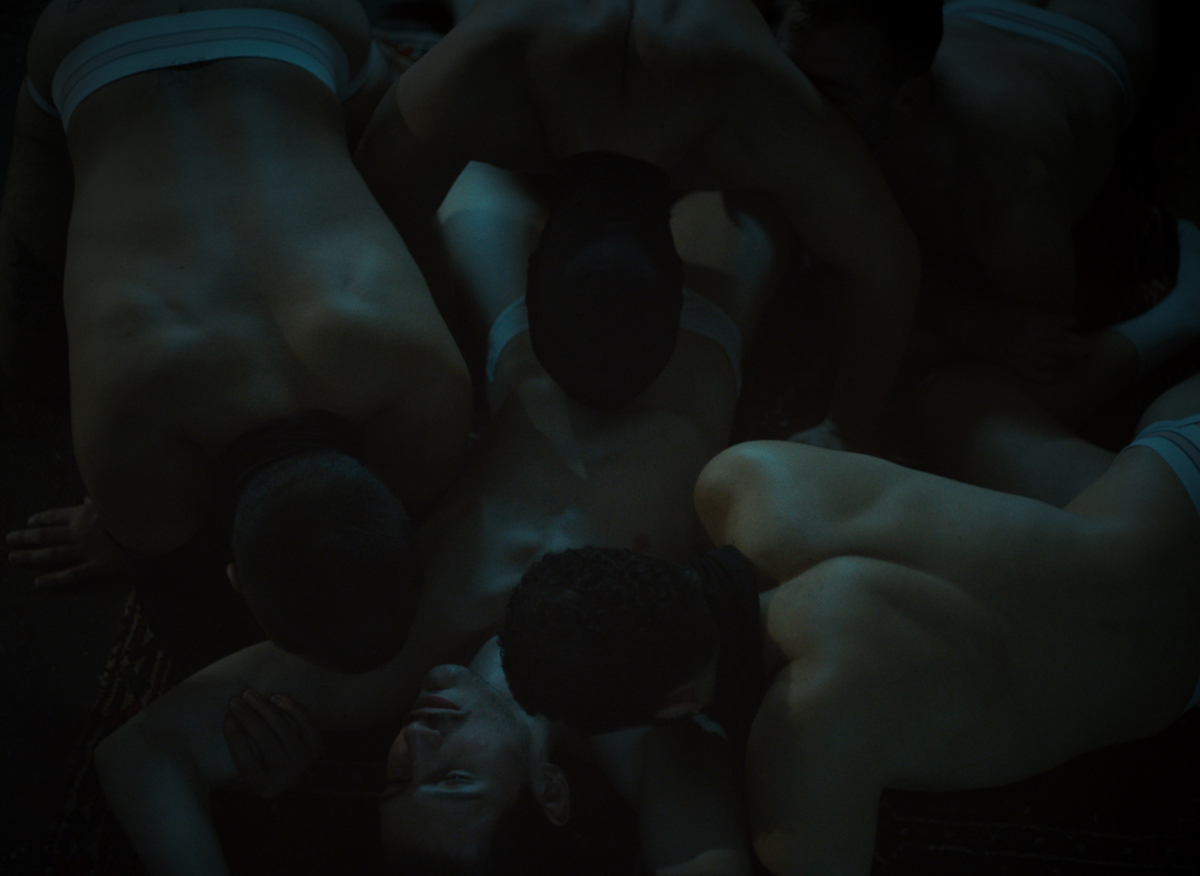
Laith Khalifeh as Adnan (center) in Drunken Noodles. Courtesy Strand Releasing. © Lucio Castro.
Much like the French filmmaker Alain Guiraudie, Castro is ever alert to the humor to be found in the stilted formality and strange etiquette of cruising-ground fucking. After orally servicing a stud in McCarren Park, Adnan mishears his question: “Did you say ‘gum’ or ‘cum’?” (The answer: both.) Assured that Adnan does not need him to reciprocate, the tall hunk pauses for an awkward moment or two before departing with an incongruous “Take care.”
Other hookups arise more unexpectedly, as when Yariel (Joél Isaac), the food-delivery guy who had brought Adnan his dinner a few nights earlier, suddenly arrives at the playground where the grad student is enjoying a late-night cigarette and they get it on. Even more coincidental circumstances set in motion Adnan’s meeting of Sal and their lusty afternoon together upstate (Adnan’s gerontophilia, as we learn later during a droll anecdote he shares, has a peculiar origin). Each of these sensual encounters, in turn, is followed by a charmed event: Yariel reveals himself to be a poet, handing Adnan a chapbook with an ode to their liaison (the name of which gives the film its title); Sal shows the young man something magical in the woods—an otherworldly segment that evokes similar enchantments in the films of other homo auteurs past and present, such as Kenneth Anger, Apichatpong Weerasethakul, and João Pedro Rodrigues.

Laith Khalifeh as Adnan and Matthew Risch as Iggie in Drunken Noodles. Courtesy Strand Releasing. © Lucio Castro.
But the connections to Hockney, and specifically A Bigger Splash, seem more profound (at least in my mind), particularly in the chapter of Drunken Noodles that explores Adnan’s relationship with his older boyfriend, Iggie (Matthew Risch), a writer. Despite all the steamy escapades in Hazan’s film, melancholy hangs over it, for A Bigger Splash began production shortly after Hockney’s breakup with Peter Schlesinger, the subject of some of the painter’s best-known works, notably 1972’s Portrait of an Artist (Pool with Two Figures)—the creation, destruction, and re-creation of which is chronicled in the quasi-documentary.
Hockney was Schlesinger’s senior by a decade. The same number of years, if not more, separate Iggie from Adnan. And though they are still together as we observe them on vacation in some paradisial, pastoral spot near the Hudson River, the end seems nigh: Iggie, still grieving after a recent loss, has no interest in sex, and Adnan is growing weary of having his overtures spurned. Yet the two men, each dejected in his own way, are still capable of immense tenderness, never more so than during an outing to a swimming hole. As he did with Sal, Adnan will later share a supernatural experience with Iggie.
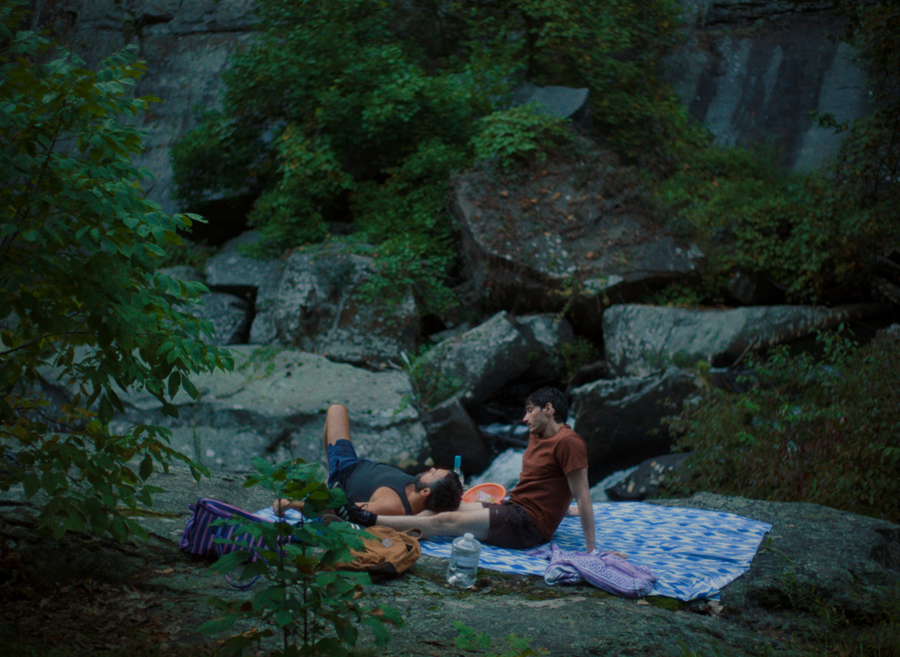
Matthew Risch as Iggie and Laith Khalifeh as Adnan in Drunken Noodles. Courtesy Strand Releasing. © Lucio Castro.
Both A Bigger Splash and Drunken Noodles are protean in nature. Hazan’s film, portraying Hockney and his wider circle, captures a gay coterie in flux: onetime lovers who are now friends, friends who are not yet lovers, ex-lovers who have yet to become friends. Castro’s movie, unpredictable from scene to scene, examines comparable morphing, such as when a stranger becomes a sex partner or a long-term boyfriend an acquaintance. These quotidian transformations, Drunken Noodles suggests, make possible more spectacular occurrences: a portal that leads to an ancient dynasty, for example, or a performance by a faun.
The flights of fancy, which could so easily have been disastrous, fit seamlessly into Drunken Noodles, further advancing the idea that erotic energy, constantly waxing and waning, is itself a mystical power, drawing from and feeding into other invisible currents. That notion is present in A Bigger Splash, too: Hockney assuages his heartache after his split with Schlesinger by spending long hours in the studio, toiling on Portrait of An Artist—his loss transformed into a magnificent homage to the young man, then struggling to be recognized for his own talents, who had left him. In the concluding scene of Drunken Noodles, Adnan leaves the whole world behind. He has entered another realm, carried along by an indestructible mode of transport: his élan vital.
Melissa Anderson is the film editor of 4Columns and the author of a monograph on David Lynch’s Inland Empire from Fireflies Press. A collection of her film criticism, The Hunger, is now available from Film Desk Books.