


 Sasha Frere-Jones
In her final collection, Fanny Howe witnesses the same world we all see.
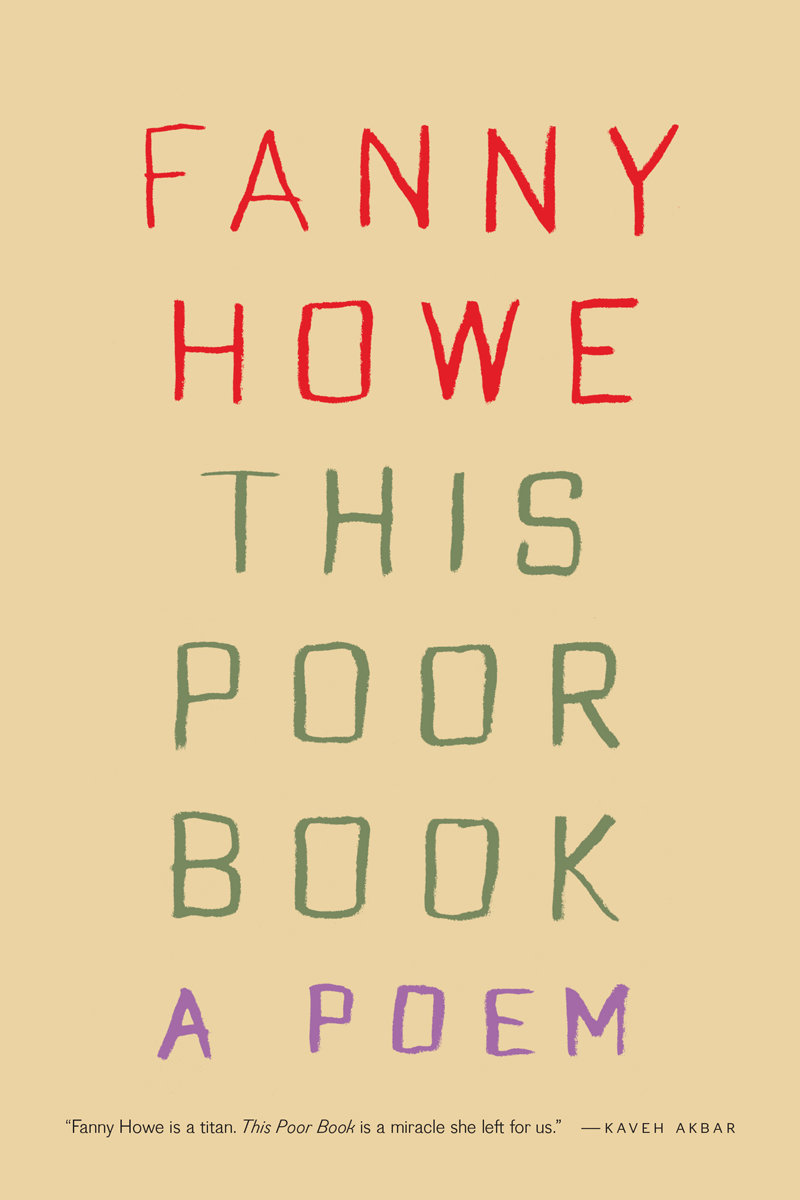
This Poor Book: A Poem, by Fanny Howe,
Graywolf Press, 132 pages, $18
• • •
“I don’t think I have written a book without a child in it,” Fanny Howe told an interviewer in 2020, five years before her passing in July of 2025. God also sat with her, next to the children. In This Poor Book, her final, posthumous collection of poems, she writes that “your soul is just a length of baby,” an axiom fusing these two devotions. And is there a poet who isn’t her child? Which of us did not see God anew through Fanny? At the Poetry Project in April, a group of writers gathered to talk about Howe’s role as spiritual mentor, grandmother, friend, hero, running partner, prankster. Friend and collaborator Peter Gizzi, while describing how Howe took him under her wing and introduced him to Simone Weil and Tarkovsky, extrapolated back and forth between Howe and the community she helped sustain. “The best of what we have is our love for another’s poetry,” Gizzi said. “It’s the work and the love of fellows.” Ariana Reines told the crowd that Howe “made me feel like there wasn’t anything wrong with me,” a feeling every poet needs at least once a week. Mark Patrick Hederman, a monk of the Glenstal Abbey in Ireland, said via prerecorded FaceTime that the author “claimed to be a Marxist but all her friends were highly aristocratic.” He went on to say that Howe was “the most exquisite taster of every luxury” who liked “living it up” in castles while simultaneously making herself “suffer with every person in the world that was enduring some kind of very hideous persecution.” In other words, a poet.
Born to an alcoholic Irish playwright and Boston Brahmin civil rights lawyer, Fanny saw her older sister, Susan, as the more literary one. (Susan’s poems and essays are in fact just as miraculous as Fanny said they were.) She saw herself “a drop-out and an independent reader,” an avatar of the “weakness” she would spend her life championing. But contradictions abound—she would write more than fifty books of poetry, fiction, and essays, and her aversion to traditional schooling did not prevent her from teaching poetry at universities for decades, on both coasts.
Howe had three children and six grandchildren, and made her loyalties clear. “If you keep on the side of the teenager, then you are actually resisting something that is brutal in the world,” she said in a 2016 interview. Is the mother also the teenager though? How do we solve that? As she said once, “free-floating doubt wouldn’t trigger the lightning that contradiction does.” These knots propel her writing, dead serious cornering into goofy, personal gnostics sliding into pools of what Eileen Myles called “tremendous anonymity,” language that reflects the great shared plains, not always accessible to poets mired in the first person. Which Howe also was, though it never slowed her speed.
This Poor Book blends lines written just before her death with excerpts from books Howe had been publishing with Graywolf and the University of California Press since 1997, and it is a coherent quilt, tracking a loose coalition of children across Ireland and California and back. A boy is on a boat with his father, and then, after a page or so, Howe makes one of her greatest entrances: “I have humiliated myself / so I can participate in the city. / I have smothered my own cries / in order to survive. / I have tied myself down / to the number system / so I can disappear into the stream / of the economy.” She turns her attention to spiriting two kids into a dark forest, both of them “bright of eye” because they are escaping, “not dying.”
Stanzas pile up into a long chain interrupted only by one interstitial section break, “WOOD,” which precedes the last twenty pages or so. Aside from four paragraphs of prose, this is a journey told with enjambment and continuity. One announcement gets its own line: “Where is the child I came here to save?” She has the answer already: “Then the boys and girls lift / Their arms over their heads: / (Hands up! Don’t shoot!).” These could be her own children, but they don’t have to be. In 1993, during a reading in La Jolla, she talked about “the mothers of the children who are being shot and destroyed in the streets of our country as we sit here.” She is describing the process behind This Poor Book thirty years ahead of time when she says, “everything I write really has these mothers in mind.”
“I don’t blame the children for anything. / Their century is like a director who prefers his script to his actors.” This feels like the permeating love Reines spoke of, an acceptance that indicates Howe’s deep sense of responsibility that somehow never bleeds into grandiosity. “I had healthy children and they did too. So what’s the complaint?” There is, in fact, a complaint. “For one thing my psychic didn’t tell me I was a poet.”
In interviews, Howe has a directness much like her beloved Weil, a philosopher not for the academy but for the everyday. The poems have room for that voice, though Howe would not have been as precious to so many of us without her effortless command of the actually poetic, the words curling around things beyond reason. “When I was a girl there was an orange pearl / That turned the butter yellow / With four strokes of a wooden spoon,” she writes. The lyric winds through her work as it does in Auden and Thomas, though her commitment to voices always feels more like the point. She dreams so that she can come back and tell the children what she dreamed. “Children need sugar. / Especially in danger.” The lines slowly rattle down to one fairly traditional stanza: “Elderberry jam and honey? / Cloud berries soaked in brandy? / Golden jelly, sugar cane / For one little law-breaker.”
Howe’s magnanimity is such that we feel like that rascal before remembering it might easily be her. Her eye is always pointed outward first and taking in the view from higher up than the comfortable tone suggests. Right after this scenario, straight out of Beatrix Potter, we get a few extra lines of blank space, room to breathe, and then the truncheon: “Pepper spray brings tears / pain and temporary blindness.” Two blank lines, then, “It’s made of the fruit of plants and chilies / ground into powder by a pestle / and soaked in ethanol.” We are no longer serving tea in the garden to our stuffies: “That spray is the way it feels / to be violated by your guards / sharp and hard.” This is the Irish in her—“guards” a particularly Northern term for the cops.
Though she described herself as so firmly from Boston, and affected a slightly provincial air perhaps as a defense, she was local only in tone. Her spirit was international. “A Palestinian flag waves / In this small Irish town, / The correspondence being / Children throwing stones.” Her grounding was often the same nature that calls to all great poets: “The Shannon River / Is erased by fog like white flowers / Perpetuating the best honey.” She is there, witnessing the same world we all see. “Wasps and bees tick on the glass. / I have already made a mess.” It sounds like she might be with her friends at the abbey this time. “Flanked by monks my fear of men recedes. / But I am just a guest, a woman of the road.” Can she even become what she suggests? “I have been dispatched to become fretless / And transparent, someone needing no one.” The blending of anxiety and music—“fretless”—is setting up some deeper, final transition, a thing she could not be on earth. Needing no one? This is not the Howe we ever read or saw or felt. A guest must never outlive her welcome. “Die, or leave—before they want you gone.” Gone, the title of possibly my favorite Howe collection—a clever way to distract her children from the inevitable, which nobody wanted. The last word must come from another child of Boston, Myles, who told us in April that “Fanny remains about the least dead person I know, you know?” I thank God that I do.
Sasha Frere-Jones is a musician and writer from New York. His memoir, Earlier, was published by Semiotext(e) in 2023. His first book of poems, Pistachios and Frames, will be published by Fonograf Editions in winter 2027.