


 Aruna D’Souza
Art in a time of war: an exhibition of paintings, sculptures, drawings, and collages at 52 Walker.
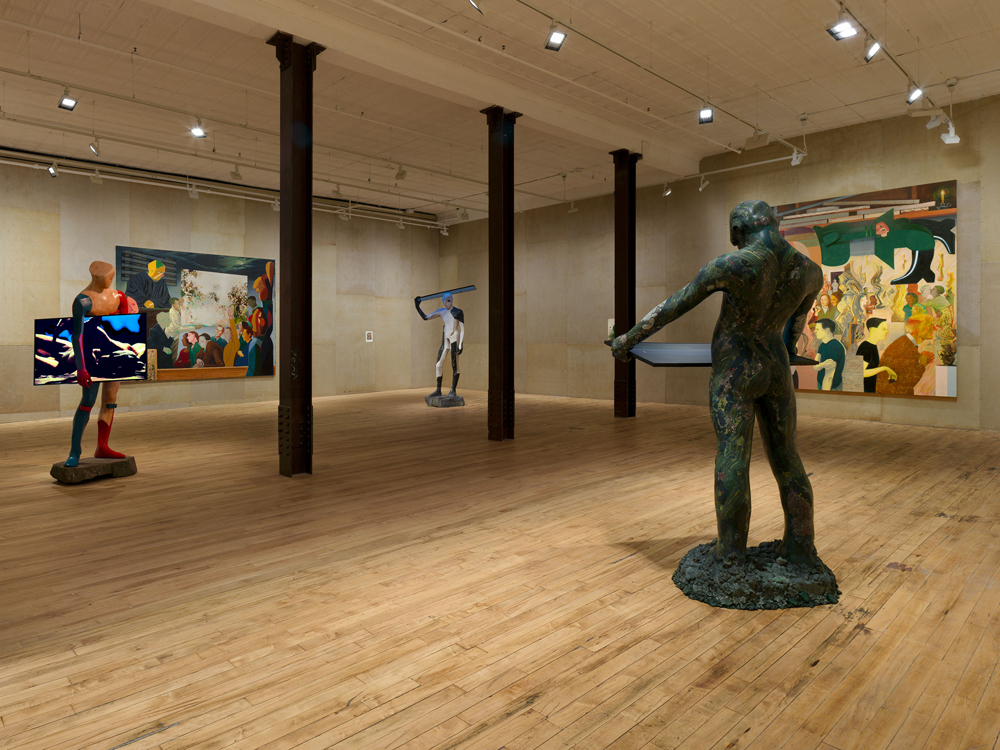
Nicole Eisenman: STY, installation view. Courtesy 52 Walker.
Nicole Eisenman: STY, 52 Walker, curated by Ebony L. Haynes, 52 Walker Street, New York City, through January 10, 2026
• • •
A year ago, as the Trump administration was initiating its assault on immigrants, trans people, free speech, the rule of law, the Constitution, and a whole lot else besides, I was talking to a friend about how completely incapacitated I was, how unable to put a thought together, write a full sentence, or really function at all. “Remember, we’re living through a time of war,” he said. “It would be weird if you were able to go on like normal.” That simple statement of fact—that we are living through a time of war—was strangely freeing. It granted permission to not be okay. But it also raised the question of how to live under siege, especially when, if privileged enough, one’s everyday conditions look superficially the same as before.
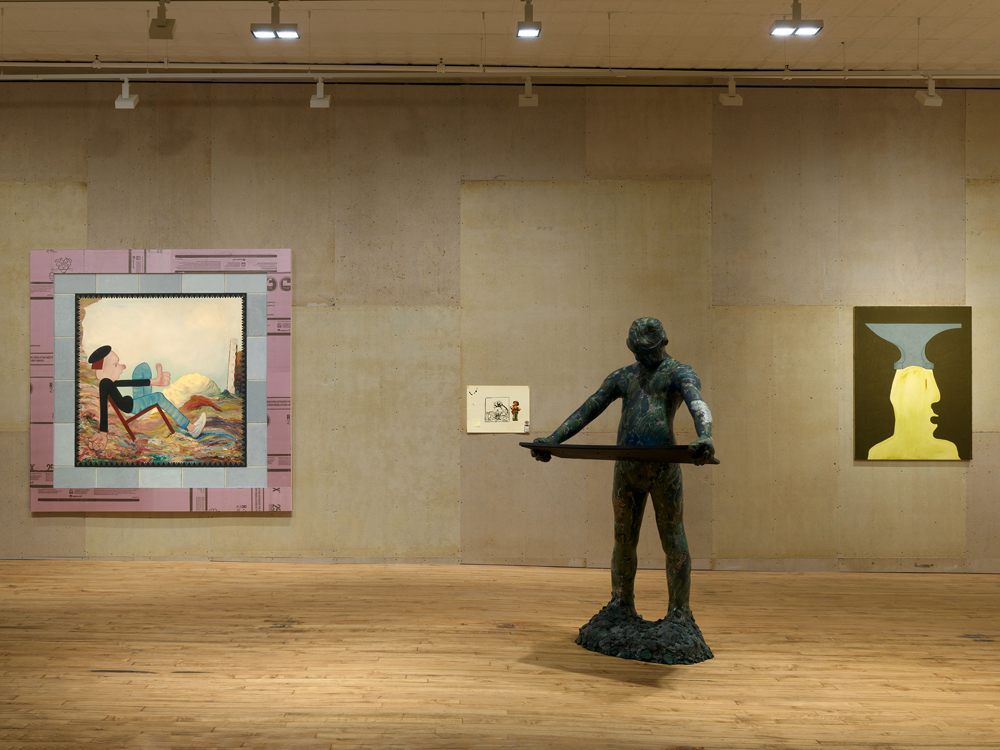
Nicole Eisenman: STY, installation view. Courtesy 52 Walker. Pictured, far left: The Bunker, 2025.
Nicole Eisenman has clearly been pondering this conundrum, too, as demonstrated in STY, her current solo exhibition at 52 Walker. The show is installed in a built-out gallery within a gallery, its walls covered in Homasote board, commonly used to line artists’ studios so pictures can be hung and rehung without damaging drywall. The beige panels, each a slightly different tone and textured like concrete, along with the wood floor, give the monochromatic space a bunker-like feel. Inside, five paintings, a handful of drawings and collages, and a trio of figurative sculptures offer thrilling insight into Eisenman’s brain as she figures out what it means to be an artist operating in an industry that runs on dirty money and is thus inextricably linked to violence. This is not a new problem for Eisenman, who famously pulled out of the 2019 Whitney Biennial to protest the presence of Warren Kanders (a munitions dealer) on the museum’s board, and who has been outspoken about the ways she’s been punished by collectors and colleagues over her opposition to Israel’s genocide. The pieces on view are from 2024 and 2025—some, that is, predate Trump’s second inauguration, but the wartime vibe predates it, too.
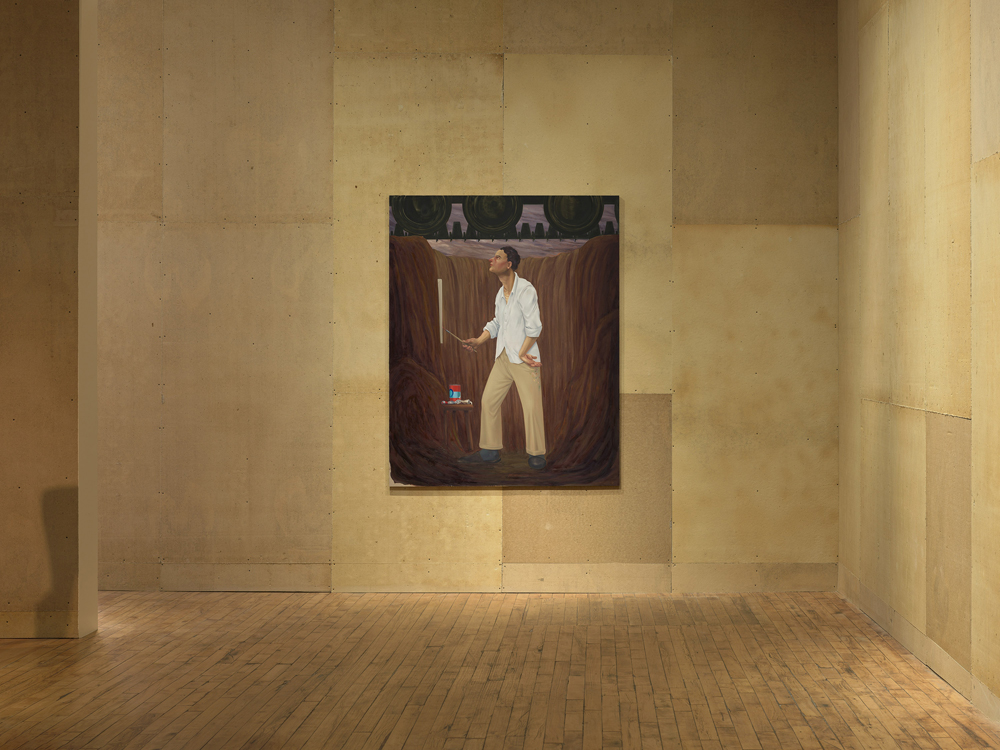
Nicole Eisenman: STY, installation view. Courtesy 52 Walker. Pictured: Fiddle V. Burns, 2024.
Brain, studio, bunker. All of these come together in The Bunker, an oil painting that measures over eight feet square and is nestled in a frame made of painted cinder blocks and pink insulation board. Here we find, sitting in a cave, a cartoonish, mildly potbellied artist straight out of central casting—black turtleneck, beret, tiny cigarette held loosely in one comically oversized hand, holding out a thumb to check the scale of something on a canvas. The artist is so absorbed that they ignore the limpid blue sky beyond. This artist is not one of Plato’s cave-bound prisoners, fearfully trapped in the darkness, nor are they intrepidly seeking the light of truth outside. They are fully comfortable in their liminal position, content, focused on their task, heedless of the conditions in which they do it. (It feels ridiculous to invoke Greek philosophy in relation to this painting, which, in its style, seems extremely unserious, but that is often the case with Eisenman’s work—the collision of opposites.) Likewise, the painter in Fiddle V. Burns is trapped, or perhaps ensconced, this time in a hole in the ground, toiling away while wheels—black, abstracted discs running across toothy tracks—roll ominously overhead. The invocation of Holocaust trains is unmistakable. In the face of this, the title suggests, the painter has to decide his role: Is he going to emulate Nero, blithely going about his cultural activities while society collapses around him, playing the revolutionary, or will he, on the contrary, be an actual revolutionary and burn it all down?
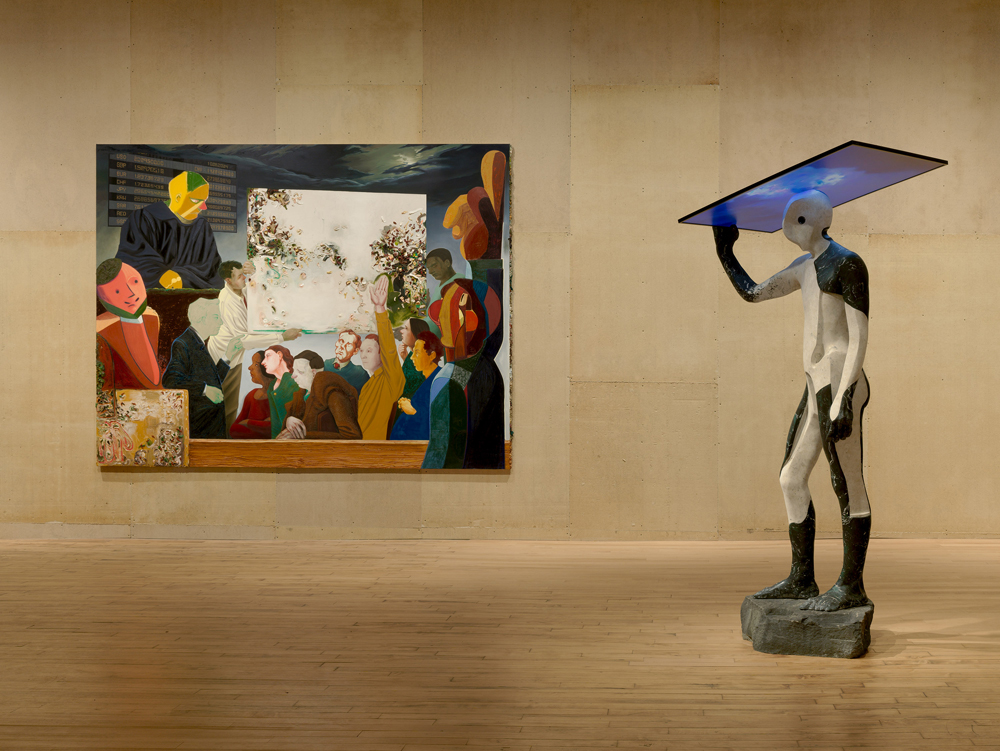
Nicole Eisenman: STY, installation view. Courtesy 52 Walker. Pictured, left: The Auction, 2025.
With The Auction and Archangel (The Visitors), questions of philosophy and ethics become entangled with materialist concerns. In the former, which is grand in scale at around nine by eleven feet, two art handlers hold up a painting—landscape-y, abstract-y, with gloopy lumps of pigment adhering to the surface—that a clutch of buyers is bidding on. Only one attendee actually bothers to look at the object being sold. The auctioneer is dressed in judicial robes, and behind him appears an electronic board displaying up-to-the-minute currency prices; the painter, depicted in a jaunty Cubist fashion, looks nervous as he grasps another canvas in his hand. It is as if Eisenman were laying bare all that goes studiously unmentioned at places like Sotheby’s and Christie’s: the way judgments of aesthetic and monetary values become blurred in the marketplace, the way collectors are often indifferent to the works they’re buying, the way artists are reduced to a signature style (note how the artist’s hand is rendered in the manner of the painting he’s holding, rather than that of the rest of his body). Eisenman’s proclivity for juxtaposing many different styles on a single canvas—a little AbEx, a bunch of Neue Sachlichkeit, some Futurism and Precious Moments for good measure—here reads as a reflection of the radical contradictions and disjunctions of life under whatever this stage of capitalism is (apocalyptic capitalism?). We are living in a moment that feels fully and completely bonkers—what use is (stylistic) logic in the face of it?
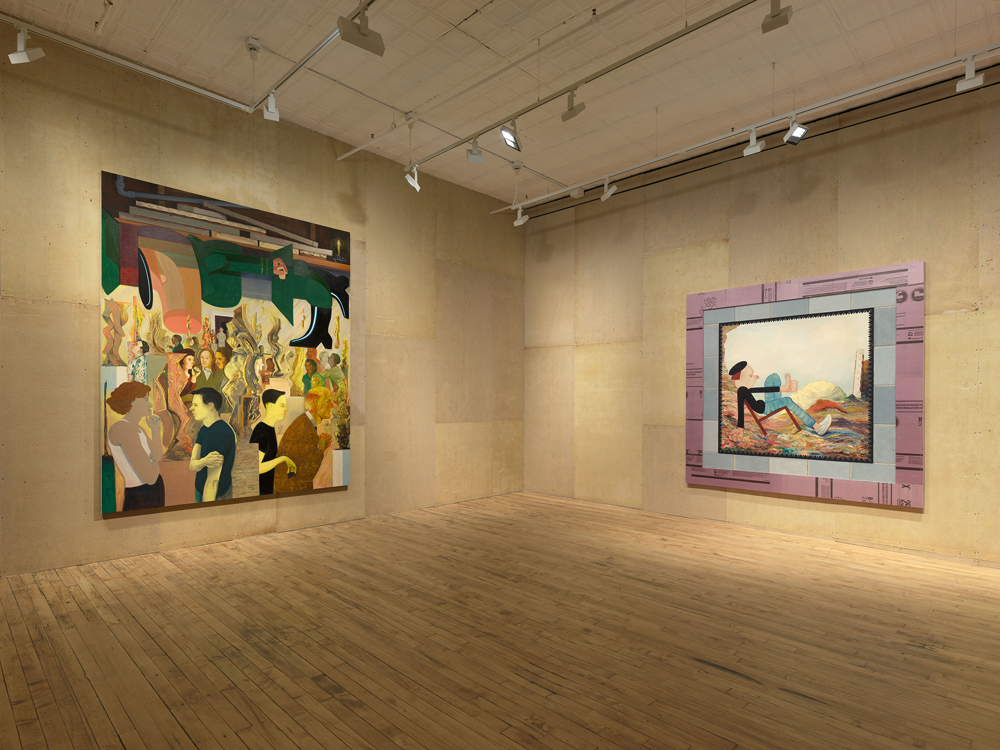
Nicole Eisenman: STY, installation view. Courtesy 52 Walker. Pictured, left: Archangel (The Visitors), 2024. Right: The Bunker, 2025.
And then there is Archangel (The Visitors), an image of an art opening in which figures (some based on Eisenman’s own circle of friends and kin) mill and converse around sculptures on pedestals. A crusty balding art critic or collector rubs his hands together like a movie villain as he peers at a work, oblivious to the artist—Eisenman herself, presumably—picking his pocket. In the very back, a man in a trench coat enters the room flanked by two companions—a quotation of a historical photograph of Joseph Goebbels, Hitler’s chief propagandist, entering the 1938 Degenerate Art Exhibition in Berlin. From the ceiling hangs a massive pig dressed in a German military uniform—another quotation, this time of Prussian Archangel, a papier-mâché effigy that appeared at the First International Dada Art Far in 1920, also in Berlin. These specters—of fascism, and of artistic anti-fascism—haunt the opening, but the guests don’t seem to notice. It’s business as usual at the gallery.
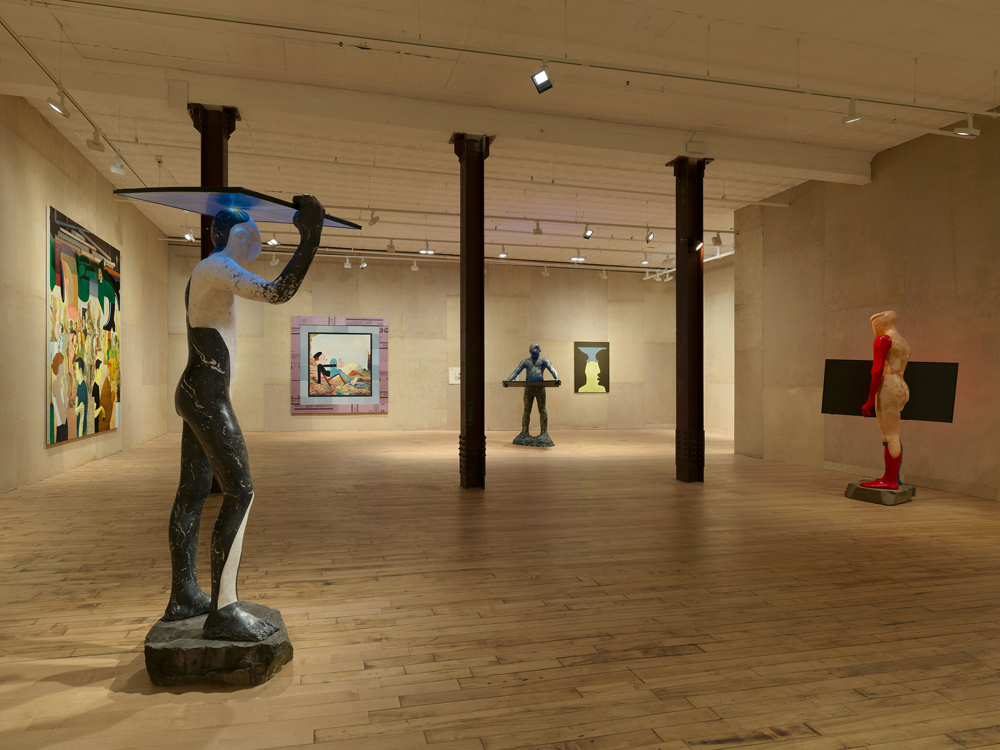
Nicole Eisenman: STY, installation view. Courtesy 52 Walker. Pictured, left foreground, center background, and far right: There I Was, 2025.
At the center of Eisenman’s installation is a trio of three larger than life-size sculptures made in scagliola—a form of trompe l’oeil plasterwork that the Medici family was especially fond of in the Italian Renaissance—their marble-like veining echoing the violent brushwork of the artworks depicted in Archangel (The Visitors). Two of them look like automatons, aliens, dress dummies, or those little wooden articulated figures artists keep in their studio; the third resembles a slightly more humanoid Teletubby. Each holds a flat-screen: one balances it on its head, another hoists it under its arm, and the third holds it outstretched, head tilted down as if watching intently. They play videos cut together from iPhone footage, sci-fi and horror movies, and AI-generated imagery. I think of these sculptures as yet more iterations of “the artist” in this show, by turns enraptured by and uninterested in the world in their hands—oblivious to the wonders and horrors unfolding on the screens, or so invested in them that they forget to look at anything else.
These proxy artists, like all the others represented here, appear to be the ones who refuse to leave the not-exactly-blissful, but at least unchallenging, ignorance of the cave—or the bunker, or the studio. They are one and the same in the end. Eisenman’s offering is not a lesson in how to live in a time of war so much as an offering of negative examples, a fierce and canny and witty articulation of the dangers of remaining complacent, bellies and pockets full, while fascism rolls right over us.
Aruna D’Souza is a writer and critic based in New York. She contributes to the New York Times, 4Columns, and Hyperallergic. Her new book, Imperfect Solidarities, was published by Floating Opera Press in 2024.