


 Reinaldo Laddaga
In Karl Ove Knausgaard’s latest, the tragicomic tale of an artist’s unwitting Faustian bargain.
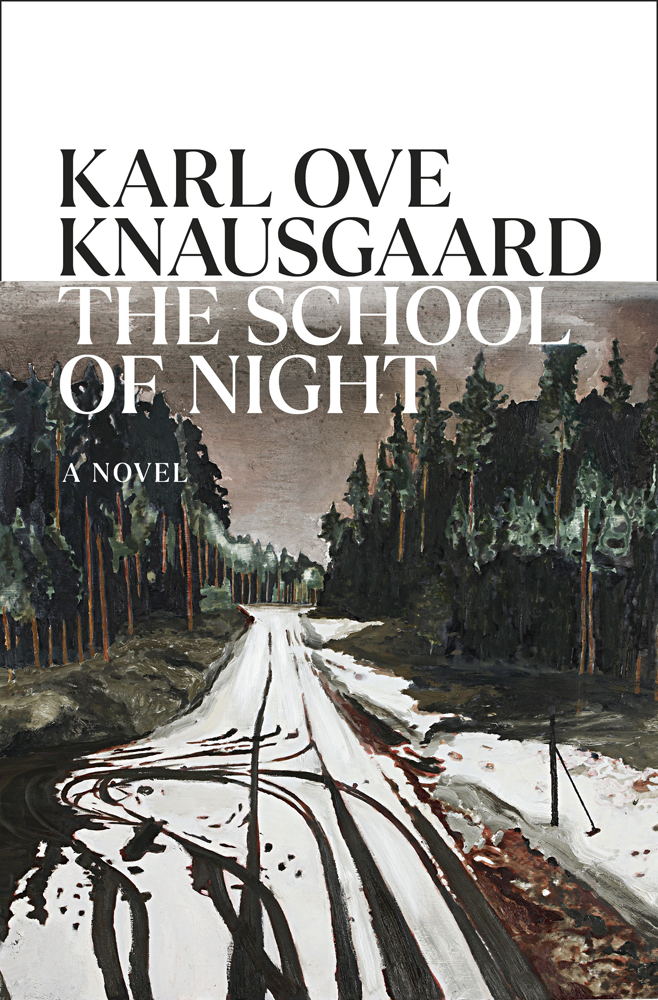
The School of Night, by Karl Ove Knausgaard, translated by Martin Aitken, Penguin Press, 503 pages, $32
• • •
The School of Night, Karl Ove Knausgaard’s latest novel published in English, translated by Martin Aitken, is the fourth volume in a still-unfinished cycle with the overall title The Morning Star. It is the most ambitious endeavor by this extraordinarily ambitious writer since the conclusion of My Struggle, the autofictional series that made him famous. For now, each of these new books is presented as a freestanding narrative, though perhaps they will take on a different weight and significance when the project is complete.
The School of Night begins in 1985, the heyday of the occult-themed rock music favored by Kristian Hadeland, the narrator, a young man who grew up on a remote farm in Norway and whose talent for photography has earned him admission to an art school in London. This talent, however, is not evident in the work he produces, and in school evaluations his teachers criticize him very harshly (in his opinion, they’re blind). Around the same time, he meets Hans, a mysterious Dutch artist who is the center of a small circle that meets at the pub Hadeland frequents. This clique includes a theater director who is preparing a production of Marlowe’s Doctor Faustus. Hadeland becomes the director’s lover (although he finds her physically unattractive), and she invites him to be the company’s photographer.
The major turning point in the plot occurs when Hadeland kills a beggar one night, apparently by accident. To avoid spoilers, I will say no more about this incident, which becomes the occasion for a mysterious rescue from the hands of the law by Hans, whom we have already understood—through the book jacket copy and Knausgaard’s continuous allusions to Marlowe’s play—to be the Devil of legend. But it is unclear whether it is because of Hans that the photographs Hadeland subsequently takes are so much more intense that his former critics become great admirers.
The bulk of the novel recounts the young artist’s tortuous path from the modesty of his student days to artistic and commercial success; toward the end, the story skips twenty-four years of Hadeland’s life and career, jumping to 2009, when the protagonist is an artist of international renown at the very pinnacle of his fame, with a retrospective at MoMA and tidings of financial success. But then a brutal debacle ensues, which causes him to lose everything he had acquired and retreat to a remote Norwegian island with the intention of taking his own life. There we find him on the first page, announcing that the book we are about to read is his suicide note.
The plot is a variation on one of the most common themes in European literature: the man who gives up everything for the object of his ambition (power, fame, or money—glory in all its forms), leaving a trail of broken relationships and discovering, at the end of his journey, that his accomplishments are insignificant, his trophies pathetic, and his life an immense void. In this case, the protagonist gives everything to be recognized as the great artist he is certain he is. The people around him are objects of his contempt, women in particular, especially those who adore him. He finds his family vulgar and the students at his school mediocre. His view of the world is systematically cruel: it is merely the miserable stage for his triumph or failure.
The narrator of My Struggle also suffers from many of these ills. Some of the series’ best pages are devoted to the conflict triggered by an overgrown artistic ambition that leads the narrator to publish a text doomed to hurt those he loves, knowing they will pay the price for his eventual success. In an interview with the Guardian, Knausgaard himself points out that “it wasn’t like I found [Kristian Hadeland] outside myself. I took him from within. It’s not that I’m like him, but there are some elements of myself that I magnified and put in him.” This sounds right: in the figure of Hadeland, attributes of the narrator of the autofictional cycle have been magnified so much that they crowd out every other aspect of his character. Indeed, the Karl Ove of My Struggle is considerably more complex than the protagonist of The School of Night, who truly lacks nuance: he is a man with only one face, and this face is horrible in a way that is not difficult to recognize. This is the type of person who has been christened in recent years with a moniker: the “art monster,” an individual devoted to the lofty mission of his work and career and indifferent to everything else, especially sexual and romantic partners, whom he discards as soon as he has obtained the momentary benefits they can offer him. But Hadeland’s traits are so exaggerated, his vileness so profound, his close-mindedness so great, that often, rather than horrifying me, his actions made me laugh.
Perhaps this was Knausgaard’s intention (although the book concludes on a note of soaring melodrama that tends to cancel the voluntary or involuntary humor of the first sections). After all, tonal instability, the combination of tragedy and comedy, is characteristic of some of the best versions of the Dr. Faustus myth that the book constantly references. Where Hadeland’s tale differs from that of the canonical Faustus is that the artist does not know he has sealed a pact; he does not even know that the mysterious Dutch friend he has met in a pub is the Devil. Apart from getting him out of serious trouble with the police, we do not know for sure what this presumably supernatural being does for the emerging artist. At a certain point, the pretentious provincial photographer composes—through a mix of brilliance, chance, and incompetence—a powerful image, and this opens the way to more powerful work and the recognition he craves. Did the Devil dictate that image to him? If so, it was subliminally, because the narrator thinks that the triumph is due to the genius he always possessed. When disaster strikes, it is hard for the reader not to attribute it to his profound lack of emotional intelligence, which translates into equally profound immorality. Everything seems to happen for natural reasons in a purely mechanistic universe. The absence of an explicit pact, together with the indeterminacy of the supernatural intervention, renders the hypothesis of the Devil quite inoperative.
Knausgaard has repeatedly said that he never plans and hardly ever corrects his books. I suppose this favors the production of the massive amounts of text that he publishes. This method results, in the best cases, as in the pages of My Struggle, in passages of writing whose immediacy and energy are enough to hold the reader’s attention, but it is less effective when it comes to building a lucid and compelling imaginary world. Despite the length of this book, I was left with the impression that it is a barely laid-out sequence of loosely woven scenes featuring nebulous characters seen through the eyes of a narrator whose perspective is desperately narrow, linked through a plot whose overall arc is rather conventional. Perhaps when the Morning Star cycle is complete, this trunk will find the missing parts and the definition that eludes it; the five hundred pages of narrative prose that make up The School of Night have, for now, the feeling of a sketch, a fragment. Knausgaard’s work of the last few years can be read as an extended attempt to emerge from the shadow of the autofictional cycle that singlehandedly brought him to literary stardom. After essays, chronicles, and this new series of novels, that project is still far from being complete.
Reinaldo Laddaga is an Argentine writer based in New York. The author of numerous books of narrative and criticism, he taught for many years in the Romance Language Department of the University of Pennsylvania. His latest works are Los hombres de Rusia (The Men from Russia), a novel; Atlas del eclipse (Atlas of the Eclipse), a book about walking in New York at the height of the COVID crisis; and El coleccionista de cabezas (The Head Collector), on Andy Warhol.