


 Alex Kitnick
Confederate statuary takes on new meanings in a history-making show at MOCA and the Brick in LA.

MONUMENTS, installation view. Courtesy the Museum of Contemporary Art and the Brick. Photo: Fredrik Nilsen.
MONUMENTS, cocurated by Hamza Walker, Kara Walker, and Bennett Simpson, with Hannah Burstein and Paula Kroll, the Museum of Contemporary Art, Los Angeles, 152 North Central Avenue, Los Angeles, and the Brick, 518 North Western Avenue, Los Angeles,
through May 3, 2026
• • •
A strange thing happens when a monument enters a museum: it becomes a lot less sure of itself. Typically anchored to its site, in the museum—the context of no context—the monument steps onto shaky ground. No longer can it rely on open skies and leafy trees for easy grandeur; white walls cast a cold light instead. Separated from their pedestals, museum monuments look lost, wandering, missing their lift. Scale and proportion go sideways, too; suddenly these sculptures look comically small, other times hysterically inflated. The way the museum collects and reorganizes objects is typically considered a strike against it, but in the case of MONUMENTS, a history-making exhibition at the Museum of Contemporary Art in Los Angeles, the museum’s ability to decontextualize looks like its true power. This is the function of the museum, the exhibition claims—not to honor, but to look at things differently.
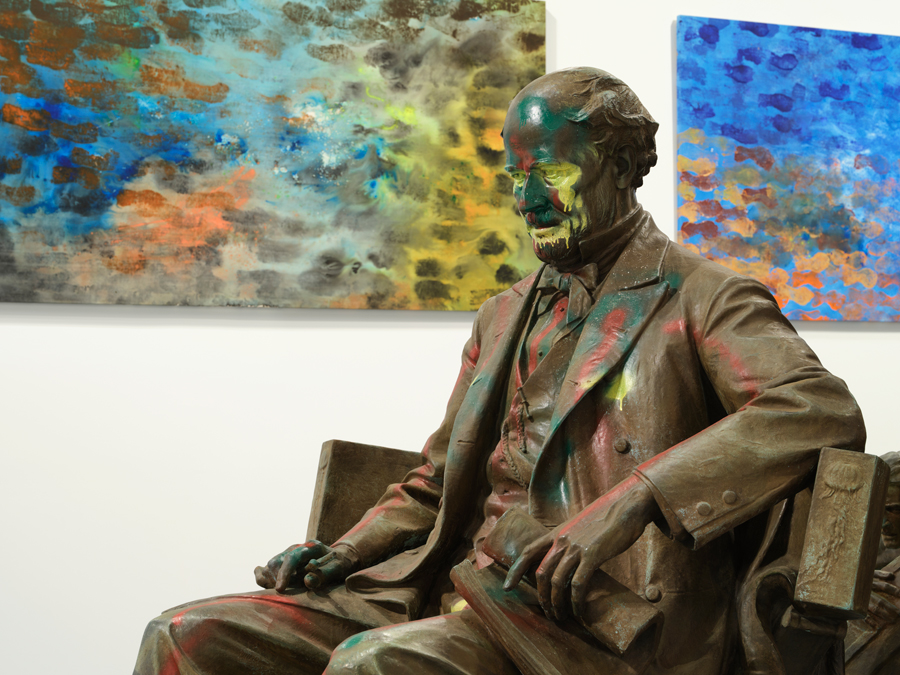
MONUMENTS, installation view. Courtesy the Museum of Contemporary Art and the Brick. Photo: Fredrik Nilsen.
MONUMENTS is a response to recent events, namely when a number of Confederate memorials (the majority of which were erected well after the fall of the Confederacy) began to come down across the country. Some were removed righteously in the wake of racist violence, as happened in Charlottesville, Virginia, after the Unite the Right rally in 2017, while others were hauled off by city officials who didn’t want to deal with bad PR. But what to do with them after? MONUMENTS began with a simple yet bold proposition from the curator Hamza Walker—to gather some of these toppled monuments, bring them into a museum of contemporary art, and see how they fare when surrounded by a host of counter-monuments made by artists today. (Much of the Confederate statuary here has been amended, melted, knocked over, and spraypainted, making it look like contemporary art itself.) In a sense, the exhibition is both an act of rebellion and a first attempt at measuring the aftermath of one, as well as an Olympian feat of bureaucracy and logistics. While some may argue that the show historicizes the struggle for Black lives too soon, and others that it comes too late after a fierce moment of public debate, it’s hard to imagine a time in America when this exhibition would not be relevant. Questions of power, race, and violence seem evergreen here.
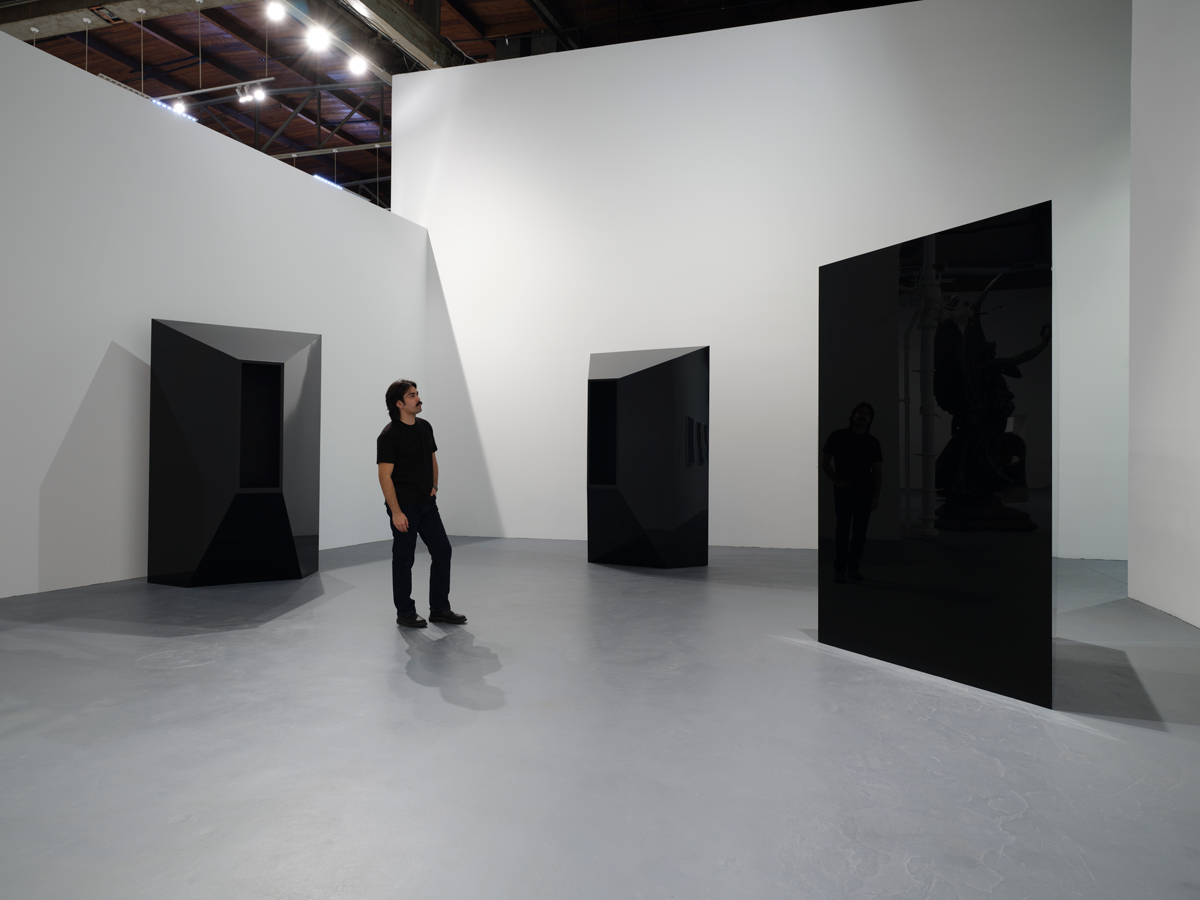
MONUMENTS, installation view. Courtesy the Museum of Contemporary Art and the Brick. Photo: Fredrik Nilsen. Pictured: Torkwase Dyson, Rate of Transformation, Distance, 2018/2025.
While MONUMENTS revolves around Confederate statuary—both its symbolism and passage through time—it’s also very much an exhibition about sculpture, and how we confront things in real space. Walking through the Geffen’s vast galleries, some lines from art historian Rosalind Krauss’s 1979 essay “Sculpture in the Expanded Field” echoed in my head: “The logic of sculpture . . . is inseparable from the logic of the monument,” Krauss writes.
By virtue of this logic a sculpture is a commemorative representation. It sits in a particular place and speaks in a symbolical tongue about the meaning or use of that place. . . . Because they thus function in relation to the logic of representation and marking, sculptures are normally figurative and vertical, their pedestals an important part of the structure since they mediate between actual site and representation sign. There is nothing very mysterious about this logic; understood and inhabited, it was the source of a tremendous production of sculpture during centuries of Western art.
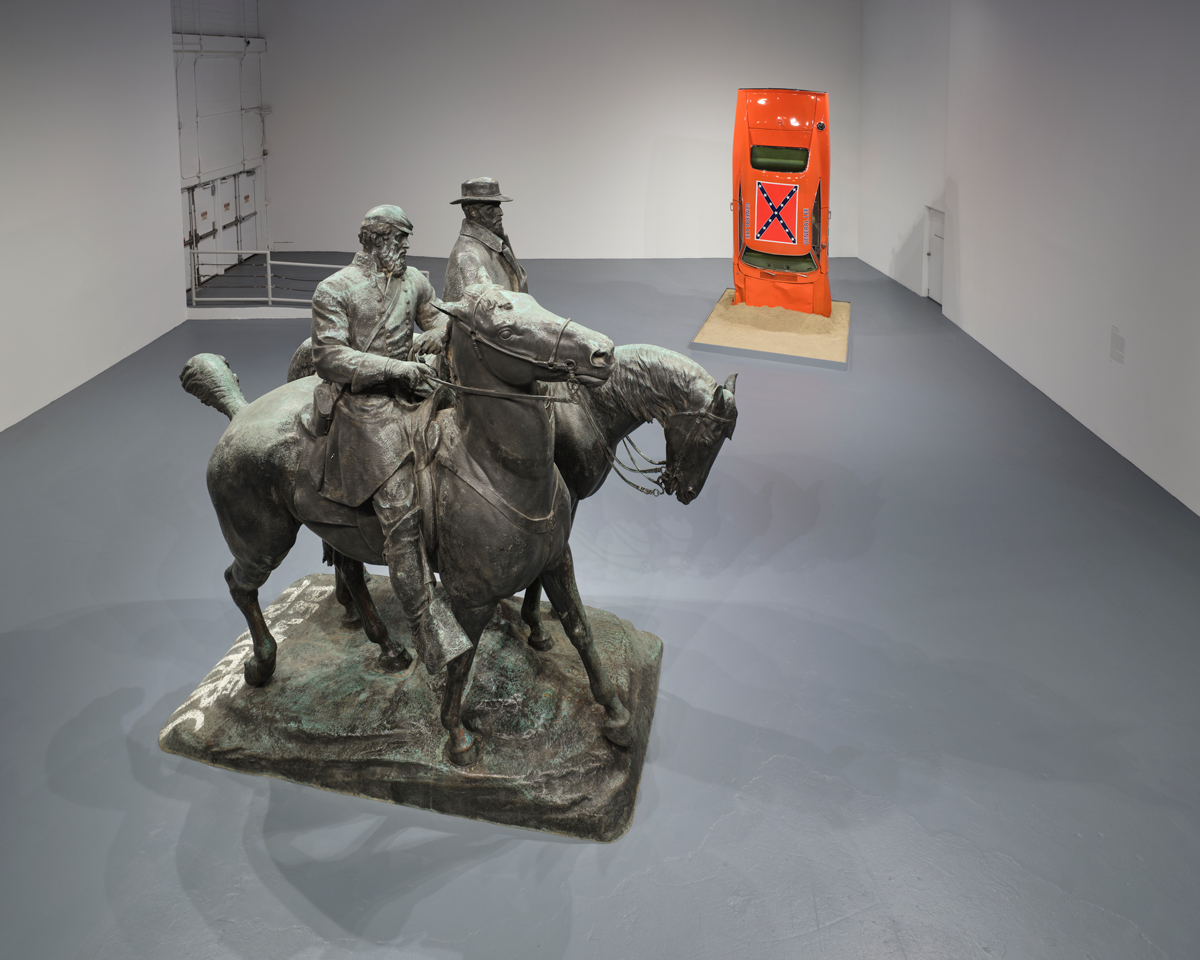
MONUMENTS, installation view. Courtesy the Museum of Contemporary Art and the Brick. Photo: Fredrik Nilsen. Pictured, left foreground: Laura Gardin Fraser, Robert E. Lee and Stonewall Jackson, 1948.
The large majority of work in MONUMENTS belongs to this tradition, including a colossal sculpture of Stonewall Jackson and Robert E. Lee on horseback, which was first installed in Baltimore in 1948. But standing in front of it in Los Angeles in 2025, the connections—and disconnections—between pedestal, sculpture, and site articulated in Krauss’s essay became palpable to me as if for the first time. Parked on flat gray ground, this monument looks alternately desperate and heroic—in other words, almost Koonsian in its banality. (At the sculpture’s rear is the tag Beware Traitors, transforming the triumphant totem into a warning sign to anyone who might stand in liberation’s way.) A whole heritage enters the void.
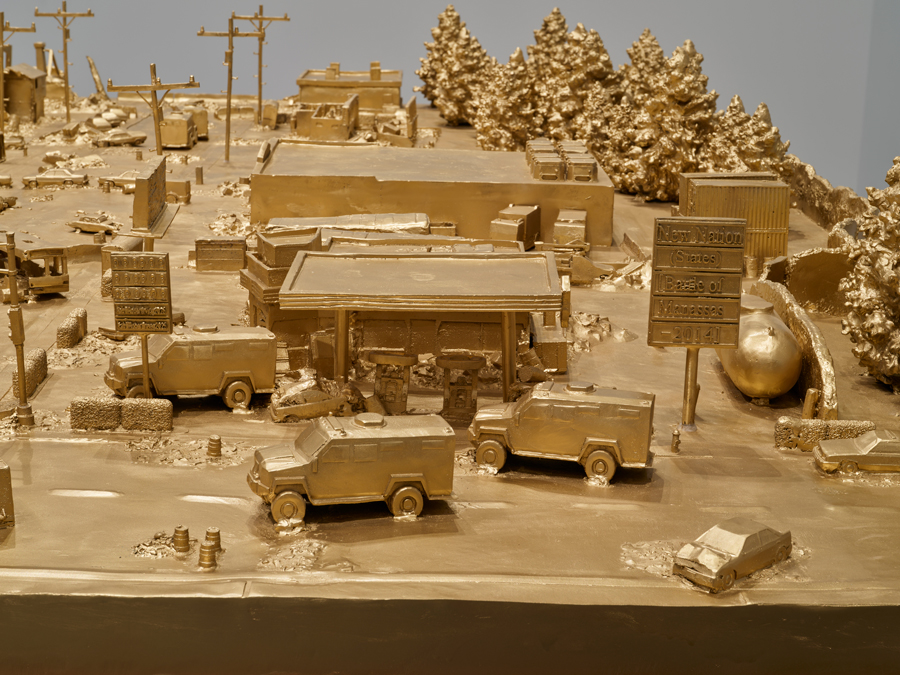
MONUMENTS, installation view. Courtesy the Museum of Contemporary Art and the Brick. Photo: Fredrik Nilsen. Pictured: Kahlil Robert Irving, New Nation (States) Battle of Manassas - 2014, 2024–25 (detail).
Perhaps this sculptural tradition is too compromised; maybe this is why many artists in the exhibition turn to film and video to speak their truth. Julie Dash and Davóne Tines deliver a wide-screen tribute to victims of the 2015 AME church shooting; Kevin Jerome Everson pays homage to a man who scaled a San Francisco flagpole to remove the Confederate flag; and Stan Douglas splinters the 1915 Birth of a Nation into five screens, scrutinizing its sympathy for the Lost Cause. As intriguing as these works are, the most powerful pieces step out of the black box and directly confront the monumental tradition: Kahlil Robert Irving delivers an enormous—and horizontal—bronze model of Ferguson, Missouri, the day Michael Brown was shot, and Torkwase Dyson offers impenetrable onyx-colored monoliths that refuse to interpret events; they are somehow both opaque and full of depth—in other words, completely vertiginous—at once. Off-site at the nonprofit art space the Brick, Kara Walker, one of the exhibition’s co-organizers (along with LA MOCA’s Bennett Simpson), presents Unmanned Drone, which is the only sculpture in the show that dis- and reassembled an extant monument. Retaining the vertical structure of a statue to Jackson and his trusty ride, Little Sorrel, Walker cut up the couple like a surgeon, reassembling their flayed parts in the style of Hans Bellmer or Hieronymus Bosch, Jackson’s faceless head now dangling above the horse’s ass, reins around his neck. It is somehow both an extremely satisfying image and a proper picture of hell.
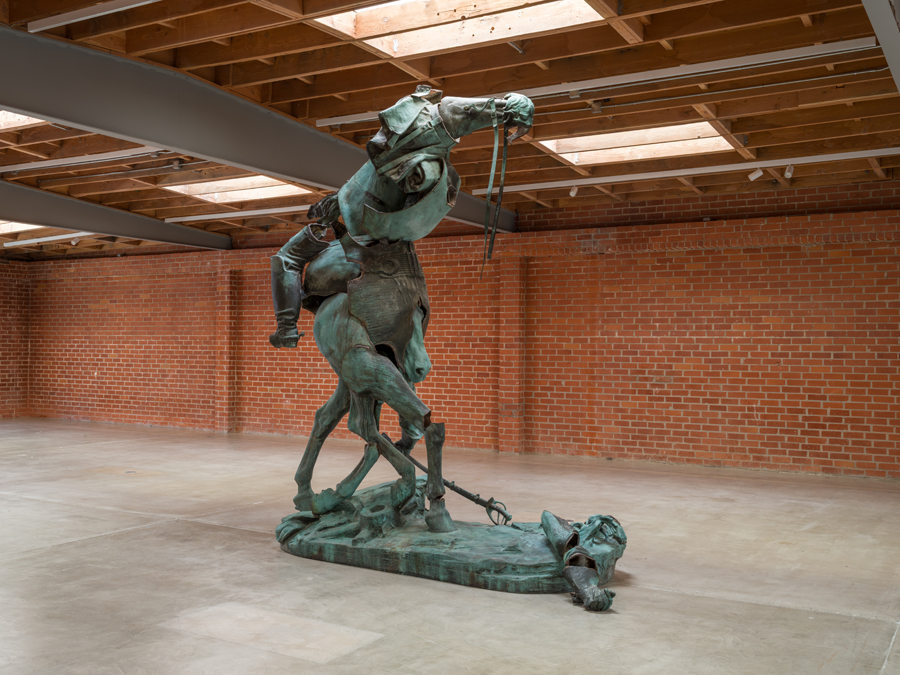
MONUMENTS, installation view. Courtesy the Museum of Contemporary Art and the Brick. Photo: Ruben Diaz. Pictured: Kara Walker, Unmanned Drone, 2023.
Walker’s contribution is an instant classic, and rightly so, but one of the most unnerving works in the exhibition operates more surreptitiously, combining sculpture and video to surprising ends. The Los Angeles artist Cauleen Smith began with an actual monument, too—the Vindicatrix, a metonym for the Confederacy—but instead of manipulating it directly, she put her allegorical female figure in a dark back corner of the Geffen, as if giving it a time-out. The busted base the figure previously stood on in Richmond is stationed nearby, emblazoned with the slogan Deo Vindice (alternately translated as “with God as our defender” or “God will avenge”), one of the koans of the Confederacy. The figure’s face to the wall, its right hand ostensibly pointed toward heaven, she is washed—garishly—in red and blue lights. Later, I spotted flat-screen TVs around the exhibition presenting footage of a raised hand. I wasn’t sure what these were at first—artworks or way-finding signs pointing nowhere good—until I looped back to Smith’s gallery and noticed a closed-circuit camera trained on the sculpture’s extended arm.
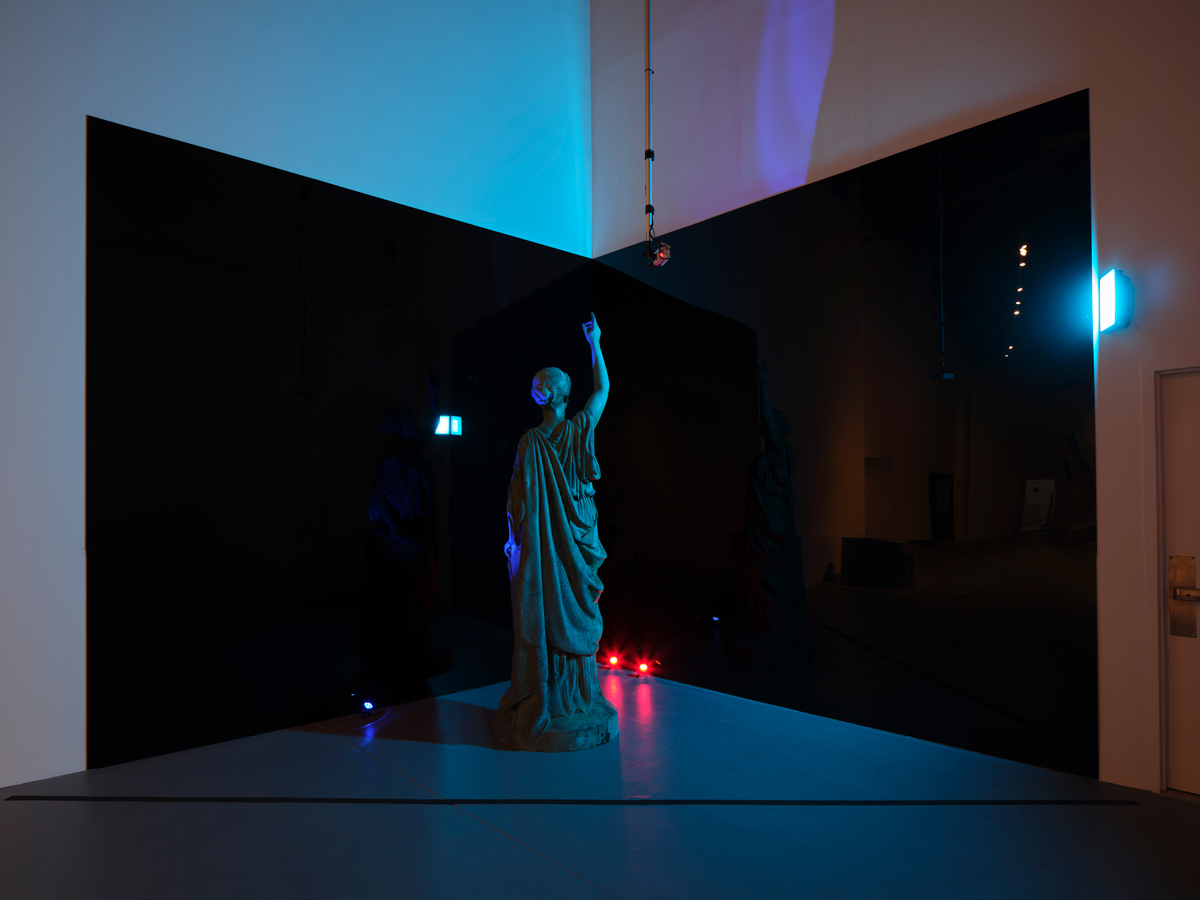
MONUMENTS, installation view. Courtesy the Museum of Contemporary Art and the Brick. Photo: Fredrik Nilsen. Pictured: Cauleen Smith, The Warden, 2025.
The way that Smith starts with sculpture and tracks its diffusion into surveillance suggests how these monuments first functioned within the structure of white supremacy: they were antennae beaming a message outward, both monitoring and holding ideology in place. They posed a threat—and Smith maintains this feeling in her installation, which she has titled The Warden, a figure that enforces but that might also extend care. The work’s power is connected to its dispersed nature—it haunts better that way—and because it refuses blunt negations and quick catharses. Smith knows the era of monuments is far from over. An American Reflection, an instructive video produced by the Philadelphia-based Monument Lab, tells us the majority of Confederate monuments are still standing in the world beyond the museum today. Smith’s raised hand—calling for a moment of silence?—is both encouragement and warning, asking which way history might bend.
Alex Kitnick teaches art history at Bard College in Annandale-on-Hudson, New York.