


 Beatrice Loayza
Rebecca Zlotowski’s film starring Jodie Foster takes the form of a wry murder mystery with a side of mystical melodrama.
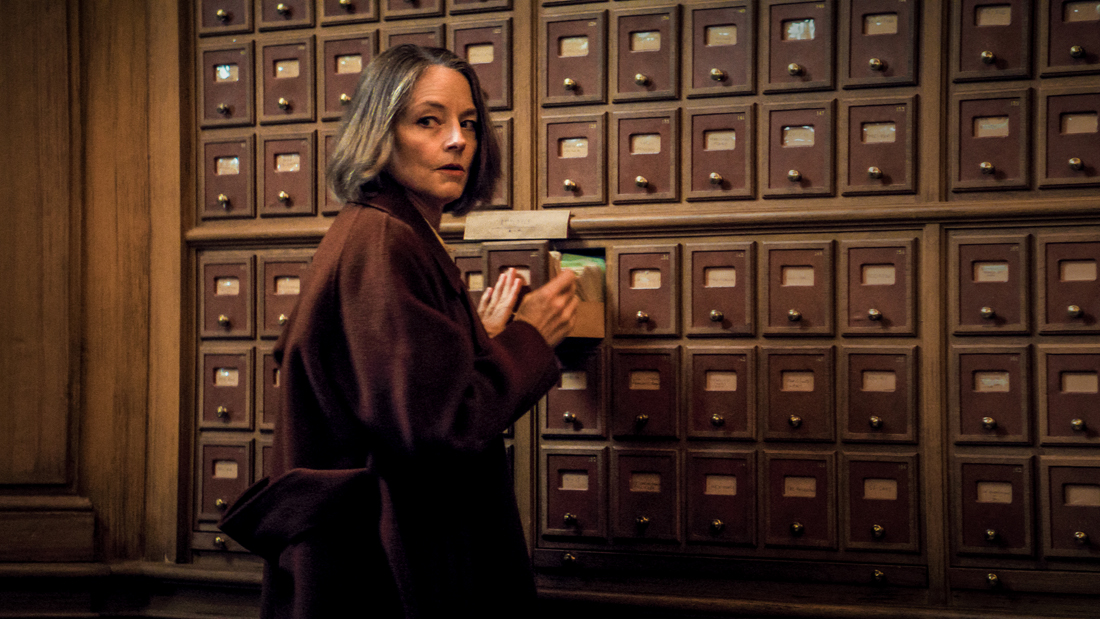
Jodie Foster as Lilian Steiner in A Private Life. Courtesy Sony Pictures Classics.
A Private Life, directed by Rebecca Zlotowski,
now playing in theaters
• • •
Everyone hates the American. She’s rude. Entitled. Addicted to meds. She can speak French all she wants, but the Parisians will always know she’s not one of them—even if she’s played by Hollywood legend Jodie Foster, deploying her fluency in the language for the first time onscreen in more than twenty years. As Lilian Steiner, a grinchy psychiatrist and longtime American in Paris in A Private Life, Foster is immediately subjected to hostile behavior: her upstairs neighbor slams the door when she complains about noise; a patient shows up unannounced, claiming that a hypnotist has cured him of the cigarette addiction that Lilian had been treating him for, unsuccessfully, over the past several years. He’s finally “freed” from her, he declares with contempt. That same evening, Lilian receives a call informing her that another of her regulars, Paula (Virginie Efira), has died unexpectedly by suicide. When Lilian goes to pay her respects the next day, Paula’s husband, Simon (Mathieu Amalric), kicks her out in a rage: Paula’s death, he believes, was her fault.

Jodie Foster as Lilian Steiner in A Private Life. Courtesy Sony Pictures Classics. Photo: Jérôme Prébois.
Such a grave accusation sends Lilian into a spiral, especially since she may have been in love with Paula. In Lilian’s memories, her former patient appears in skin-grazing close-ups or bathed in celestial white light. Directed by Rebecca Zlotowski—purveyor of knotty women-centered dramas about dating in midlife (Other People’s Children, 2022) and coming of age in the influencer era (An Easy Girl, 2019)—A Private Life has a title suitably generic for the filmmaker’s latest trip through the female psyche. But for a director whose classy realism can often feel like art-house vanilla, the movie unfolds with a much-warranted wink and a nudge. A Private Life takes the form of a wry murder mystery with a side of mystical melodrama, the latter element mercifully toned down from Zlotowski’s previous collaboration with an American A-lister (the soporific Natalie Portman–starring Planetarium, 2016).
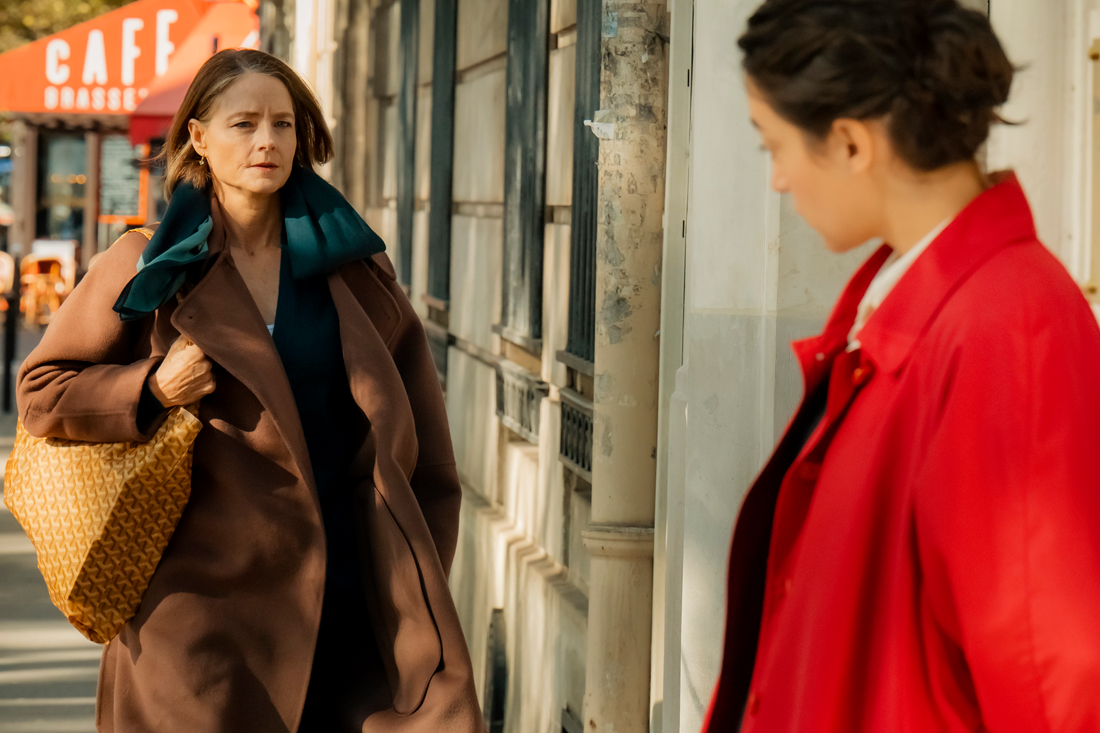
Jodie Foster as Lilian Steiner and Luàna Bajrami as Valérie Cohen-Solal in A Private Life. Courtesy Sony Pictures Classics. Photo: Jérôme Prébois.
Refusing to believe that Paula could take her own life, and eager to establish her innocence, Lilian ventures down the conspiratorial rabbit hole, finding easy scapegoats in Paula’s daughter, Valérie (Luàna Bajrami), who she knows suffers from borderline personality disorder, and philandering Simon, who might be angling for Paula’s inheritance. But as Lilian joins forces with her ophthalmologist ex-husband, Gabriel (a plump and genial Daniel Auteuil, who might seem wildly unworthy of Jodie should you be unaware that the French actor was once an upscale-cinema heartthrob), her quest for the truth, in typical policier fashion, reveals itself to be an introspective voyage.
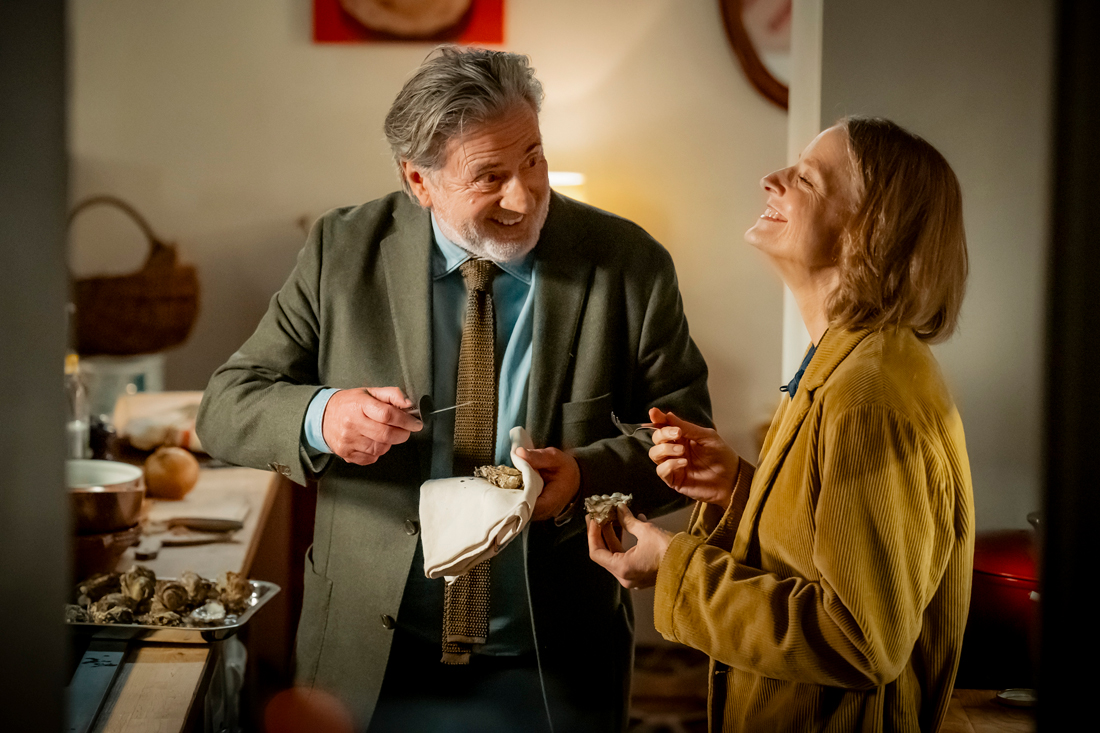
Daniel Auteuil as Gabriel Haddad and Jodie Foster as Lilian Steiner in A Private Life. Courtesy Sony Pictures Classics. Photo: Jérôme Prébois.
Upon seeing Paula’s corpse in her casket, steely Lilian starts to shed tears uncontrollably; she leaks drops on a stranger on the bus and cries throughout sessions with her patients. She wipes away her tears in a huff, scoffing at the audacity of her body as if it constituted a separate entity from herself. Foster is a natural at playing know-it-alls: she’s taken on engineers (Flightplan, 2005), scientists (Contact, 1997), and crackerjack detectives—her signature—beginning with Clarice Starling in The Silence of the Lambs (1991) and most recently Liz Danvers, a no-nonsense butch, in the fourth season (2024) of True Detective (one of her few meaty roles since coming out in 2013). Yet there’s a reason why Hannibal Lecter remains her most formidable enemy. The way he picks at Clarice’s vulnerable interior also gets at what Foster, over the course of her career, has conveyed as a flawed force of femininity—a cerebral woman whose clenched self-composure masks a flurry of roiling emotions. In his second cameo for Zlotowski (in Other People’s Children, he plays a gynecologist), the legendary documentary filmmaker Frederick Wiseman appears here as Lilian’s mentor and immediately calls out his intransigent one-time trainee: “You’re still so sure of yourself,” he sneers.
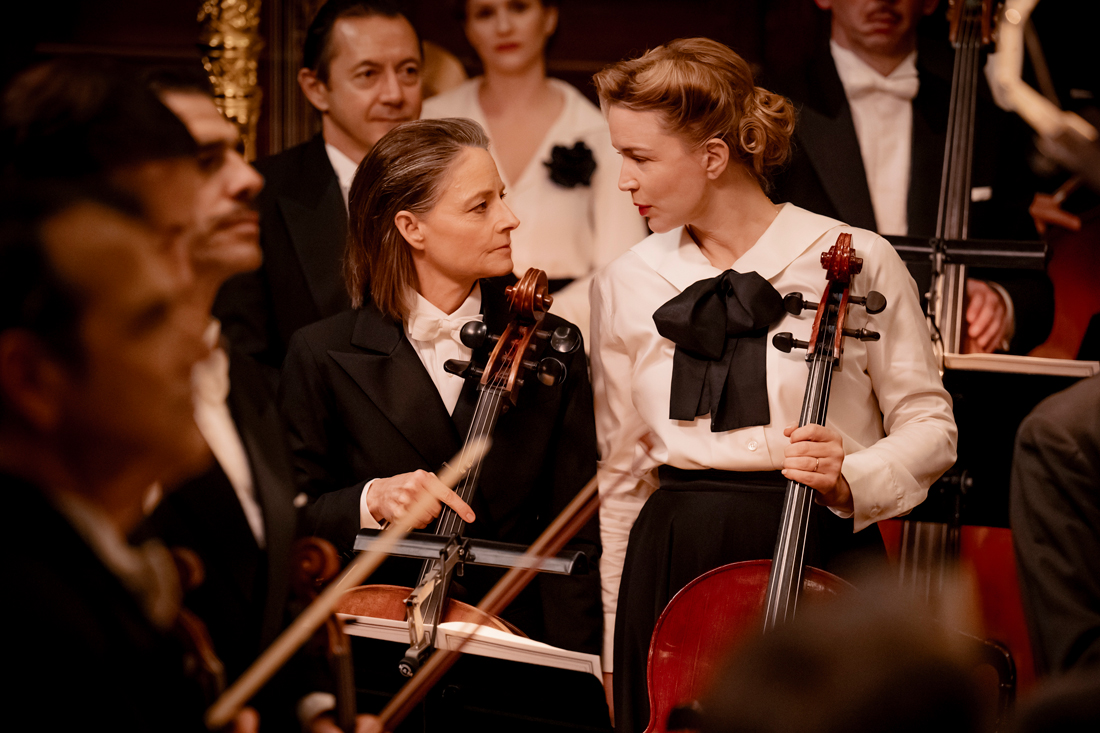
Jodie Foster as Lilian Steiner and Virginie Efira as Paula Cohen-Solal in A Private Life. Courtesy Sony Pictures Classics. Photo: Jérôme Prébois.
And so it’s something of capitulation when Lilian, fed up with her tears, pays a visit to the hypnotist (Sophie Guillemin) who supposedly rid her ex-patient of his cigarette addiction. What’s worse, her woo-woo methods, which stand in stark contrast to Lilian’s medically licensed pedigree, actually work. Under the mesmerist’s spell, Lilian is submerged into her unconscious, depicted as a liquid-red realm with what appears to be portals to her past lives. In one of these psychic chambers, Lilian is thrust into Nazi-occupied Paris, where she materializes as a debonair cello player on the eve of a public performance. Her secret lover is Paula, another string musician, while Simon and Julien (Vincent Lacoste), Lilian’s son, are Fascists out to tear her and Paula apart.
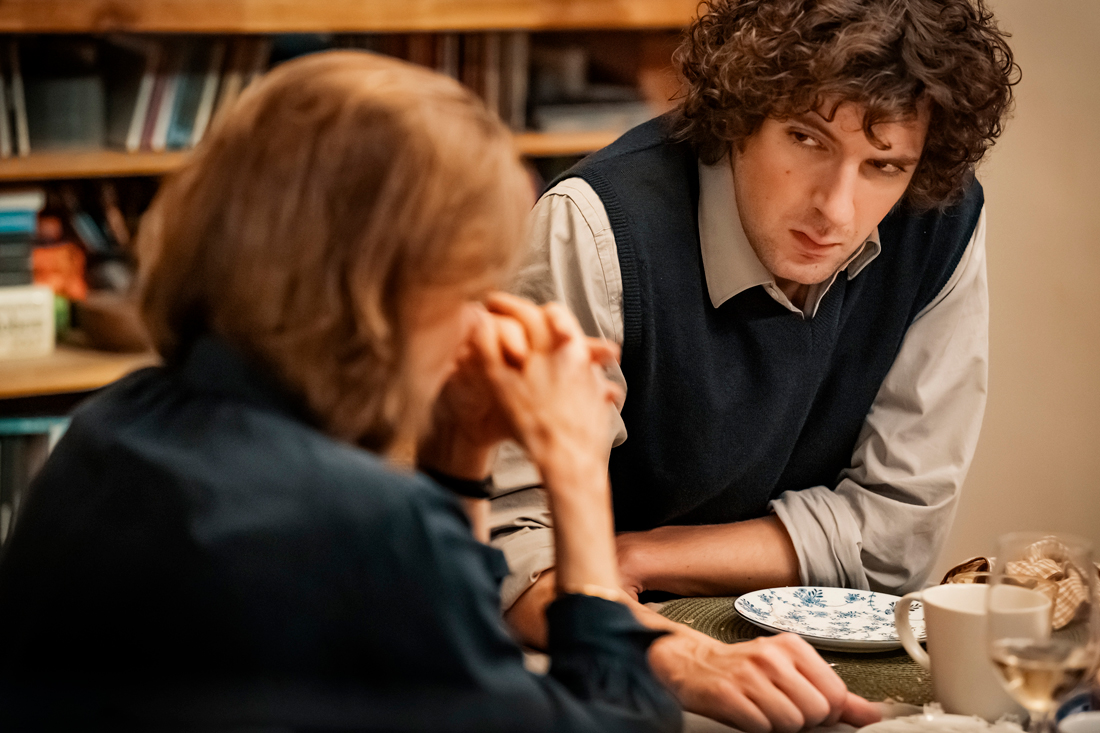
Jodie Foster as Lilian Steiner and Vincent Lacoste as Julien Haddad-Park in A Private Life. Courtesy Sony Pictures Classics. Photo: Jérôme Prébois.
During a dinner at the home of Julien and his wife, Vanessa (a virtually dialogue-less Park Ji-min, shamefully underused considering her virtuoso performance in Davy Chou’s Return to Seoul, 2022), Lilian breaks, spewing her suspicions about what she believes to be Paula’s murder and its connection to her vision from the past. There’s no denying she’s lost it, but the scene reaffirms the estrangement she feels from her own lot. Julien complains that she’s always been cold and distant; Lilian confesses that she’s never felt at ease with her own family. Lilian’s Jewish identity makes her other, but so do her sapphic longings, her immutable Americanness. In a moody transition scene, Lilian takes a nocturnal drive around Paris, her brows furrowed, jaw locked, like a stoic antihero looking for clues in a gritty neo-noir. Sure enough, the shrink treats her dream as though it were a cipher, its decoding the key to unraveling some grand master plot. Ironically, the truth reveals itself to be much simpler in the film’s final act, which allows A Private Life to end on a charming, if feeble, note. Deranged by angst, spellbound by love, Lilian had betrayed her own professional calling in the same way that she had relentlessly deceived herself. She refused to listen.
And as horrified as we might feel for Foster, even now forced to canoodle as a straight woman when Lilian rekindles her romance with Gabriel, we get the sense that the psychiatrist is too slippery for such categories. None of her make-out scenes with her former hubby match the heat of Lilian leaning her head back, eyes closed, puffing her cigarette as she lounges in a slinky velvet robe listening to tape recordings of her sessions with Paula. When Gabriel asks which character he played in her World War II fantasy, Lilian shrugs. He wasn’t in it.
Beatrice Loayza is a writer and editor who contributes regularly to the New York Times, the Criterion Collection, Film Comment, the Nation, and other publications.