


 Sasha Frere-Jones
In thirty-two pieces by Walter Benjamin, a recollection of moments at the confluence of individual memory and collective history.
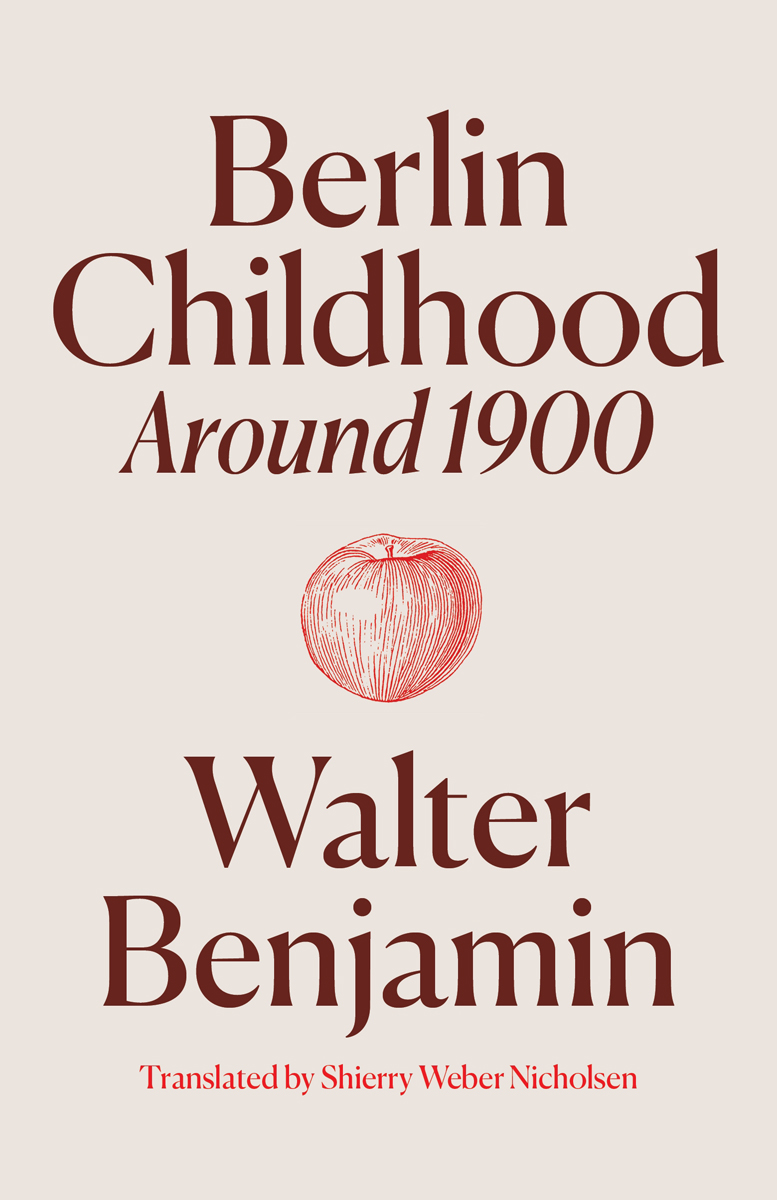
Berlin Childhood Around 1900, by Walter Benjamin, translated by Shierry Weber Nicholsen, Verso, 115 pages, $24.95
• • •
On November 10, 1932, Walter Benjamin wrote to Theodor Adorno, “I am bringing with me a new manuscript—a tiny book in fact—which will amaze you.” Benjamin read parts of that text, which would become Berlin Childhood Around 1900, aloud to his friend, who found it “wonderful and entirely original.” He worked on the project for the next six years, much of it while in exile. A few of the brief entries were published in German literary journals in the early 1930s before Benjamin handed over a manuscript in 1938 to Georges Bataille, who hid the text in the Bibliothèque nationale. It remained there undisturbed until Giorgio Agamben discovered the pages in 1982—that text is now known as the “author’s final version.” Verso has just published a new translation of these thirty-two passages by Shierry Weber Nicholsen, who took care with Benjamin’s “tone and diction” and the “great abundance of highly specific verbs.”
In the original foreword to Berlin Childhood, Benjamin writes, “In 1932, while abroad, I began to realize that I would soon have to take a fairly long and perhaps permanent leave of the city in which I was born.” Before he was in actual exile, when he had to protect his own flâneur at every moment, he was theorizing a pedestrian with great powers. 1928’s One-Way Street was one of Benjamin’s earlier attempts to fuse cities and memoir, though not focused on a single city and less anchored in walking than the The Arcades Project would be. One-Way Street was an attempt to defeat “the pretentious, universal gesture of the book” and instead mimic the “literary effectiveness” he found in “leaflets, brochures, articles, and placards.” Short texts, in short, an approach Benjamin kept close to hand until his premature end.
What Adorno describes as the “archaic mythology” of One-Way Street he later also calls “bourgeois psychology,” referring to the dreams Benjamin was so fond of channeling. Such airy activities were not for Theodor. As he wrote to Benjamin in November 1938: “The materialist determination of cultural traits is only possible if it is mediated through the total social process.” Only a reasonably Marxist flâneur would believe, as they did, that an individual subject’s perceptions were less relevant the further they strayed from materialist analysis. Your dreams would never simply be dreams. But the two did not attack the world with the same kind of Marxism. Benjamin perceived the superstructure of the social through personal experience, and Adorno was up in a helicopter trying to see the creeping borders of capitalist assault. As he wrote to his friend in 1939, only a year before Benjamin took his life on the border of Spain, “What will become of human beings and their capacity for aesthetic perception when they are fully exposed to the conditions of monopoly capitalism?” Benjamin answered the question on the pavement, looking into the shop windows and seeing only his reflection.
Where the two found their character was in Baudelaire. In 1938, Benjamin wrote “The Paris of the Second Empire in Baudelaire,” discussed at length in letters with Adorno but unpublished during Benjamin’s life. “In times of terror,” Benjamin writes here, “when everyone is something of a conspirator, everybody will be in the position of having to play detective. Flânerie gives the individual the best prospects of doing so.” Benjamin’s flâneur was able to protect his home city in Berlin Childhood, and Paris in The Arcades Project. Under what Adorno called the “shadow of Hitler’s Reich,” Benjamin depicted in Berlin Childhood a scene they both dreamt about (dialectically, of course): “In panic, the genius of the bourgeoisie comes to self-awareness through the disintegrating aura of its own biographical past: the awareness of itself as illusion.”
In his 1929 essay “On the Image of Proust,” Benjamin wrote that “a remembered event is infinite, because it is merely a key to everything that happened before it and after it.” For Benjamin, these events are valves between eras, which are managed by both the pressure of individual memories and the collective torque of history; in Berlin Childhood, he isolates the moments when god and the social formation collide hard enough to ripple the child’s mind and reveal the valve. He identifies memories that represent their holding substance—the discovery of each representing the discovery of an enduring enzyme or function, a logic that existed long before your one life started.
The poetics here are foliated, evidence of a consciousness that is neither childish nor adult, let loose upon a city: a fully armed flâneur walking through memory and loggias at the same time. The telephone, in the short entry of the same name, is a figure of history. After the chandeliers and potted palms and fire screens disappeared from his childhood home, “the telephone, like a legendary hero put out to die in the mountain gorge, left its dark corridor behind and made its royal entrance into the lighter and brighter rooms now inhabited by a younger generation.” What better way to illuminate the commodity than animating it? The stakes for our Bakelite hero are high: “To the hopeless who wanted to leave this cruel world it beckoned with the light of the last hope.” The telephone wreaks “devastation” within families, allowing his father to hurl threats at the complaint bureau and engage in “orgies” with the crank-handle. The young dreamer, our Walter, feels his heart pounding as he braces to hear his father scream at the operator. Benjamin tells us that he “suffered impotently while it annihilated all thought of my time, my intention and my duty,” eventually yielding to the voice on the phone like a medium surrendering to a figure from the beyond. Who, one wonders, was calling?
The tone here maintains that kind of libidinous anxiety, appropriate to a man on the run from the Nazis while summoning his childhood. When young Benjamin goes butterfly hunting near a brewery outside Berlin, he is the subject of a transfiguration. In order to approach and overcome a Tortoiseshell butterfly, he “would have wished to dissolve into light and air.” He writes that, in his pursuit, “the more butterfly-like I became inside, the more this butterfly in its doings took on the colour of human resolve; and finally it was as though its capture alone was the price by which I could get hold of my human existence again.” Adorno would object to the vulgarizing force of the phrase, though he might understand the historicizing accomplished by pointing out that Benjamin had no chill.
He is haunted by caryatids and asks the fairies for a “position and a secure livelihood,” only to get a baked apple. The sickly child who shared with otters a “secret affinity with the rain” exists in a channel between eras. His grandmother’s home emanated an “almost immemorial feeling of bourgeois security,” and the “genteel” quarter in which she lived had courtyards full of doormen doing their jobs—“something of the tranquility of the wealthy people for whom the work here was performed had imparted itself to the work itself, and a Sunday quality remained as the basis of the week.” When young Benjamin leaves the flat with a sack of Christmas presents, he sees the lamplighter, “who had had to shoulder his long pole even on this sweet evening”—labor and the social process are still in the picture. The piece ends with the fusion of self and place that runs through this active, inspired small book. He looks out across the snow and sees a city “as immersed in itself as a sack that was heavy with me and my good fortune.”
Sasha Frere-Jones is a musician and writer from New York. His memoir, Earlier, was recently published by Semiotext(e).