


 Sasha Frere-Jones
The latest book by Constance Debré explores the horrors and bonds of shared violence and its role as mediating force.
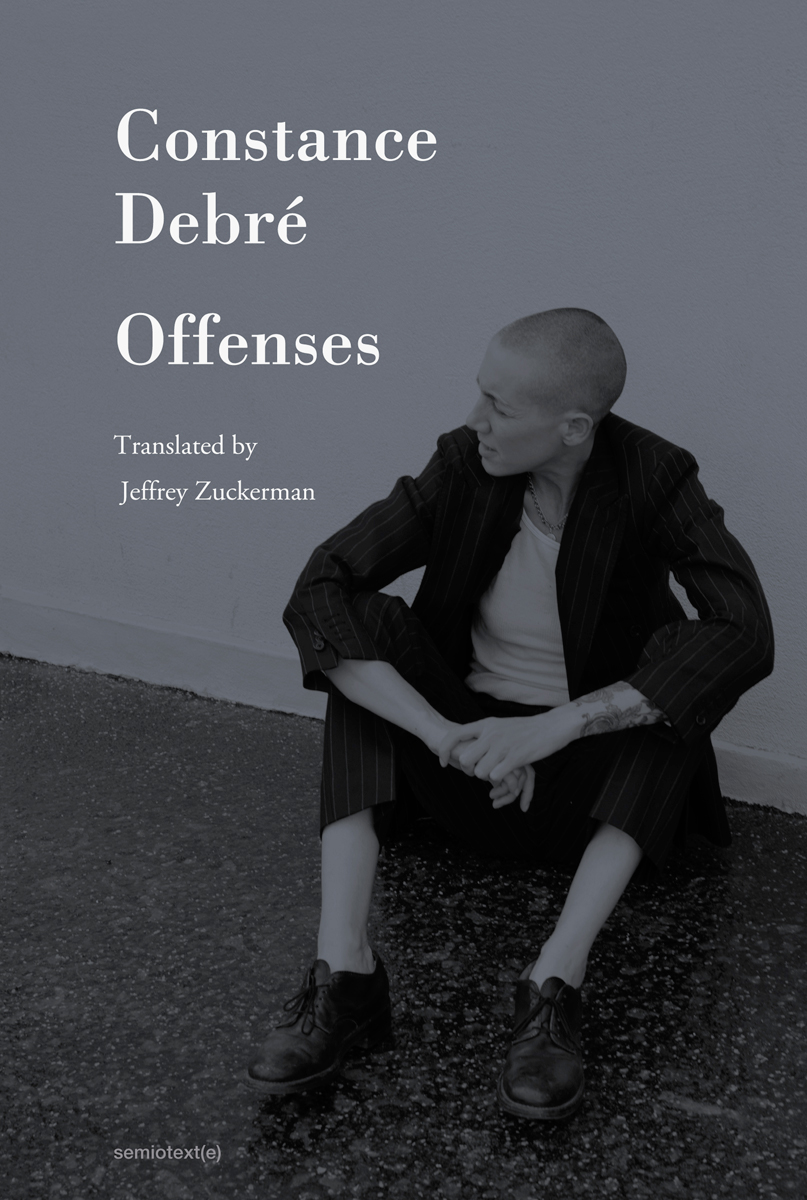
Offenses, by Constance Debré, translated by Jeffrey Zuckerman, Semiotext(e), 91 pages, $16.95
• • •
In her previous three novels (Playboy, Love Me Tender, Name), the French writer Constance Debré built fiction from a distillate of her life: a teenage son, an abandoned law career, an evolving erotics, a shrinking footprint, a decaying family manse, the number of laps in the pool she needs to stay sane. Offenses is a different kind of reduction, a very brief text—ninety-one pages—drawn from a case Debré might have seen in her previous life as a criminal-justice attorney. Jeffrey Zuckerman’s translation pays exquisite attention to rhythm and weight, creating looping phrases more common to scripture than fiction.
Debré usually dodges advocacy or identifiable political commitments, but Offenses feels very much like a cry on behalf of the massive block of workers who are both integral and invisible. To that end, everyone here is presented without proper names. Debré uses the hell out of free indirect discourse, a judge with no power channeling a quickly changing host of voices while floating above the circuit judges. What she looks at here is “a vertical world,” one “made up of worlds.” These circles of killers and judges and friends in tracksuits are “not adjoining but concentric, superimposed.”
The sin at the center of that world and these ninety-one pages is a badly planned robbery. Trying to pay off a debt to a dealer and finally leave town with “the girlfriend fiancée wife he loves,” as well as their two-year-old, a teen decides to steal an old woman’s ATM card. She resists, and he solves this problem by stabbing her ten times with “the small kitchen knife, the same one everybody has, the one every one of us has.” He then waits in place, welcoming the cops.
The players here know each other—everyone in the book, in fact, knows each other. This teen is one of the few who showed the old woman an attention that approached love. “The man who killed her was the only one to talk to her with any warmth, yes, allow me to talk about warmth,” Debré writes.
And the proximate cause of all this harm is also known. The dealer to whom our teen is indebted wears a suit “and they all, the judges and even the cops, call him Monsieur.” The mood is of a mundane surreality, a picture of interlocking cruelties and powerlessness. In court, the dealer confirms that the teen owed him over three thousand euros. Everyone here smokes hash and weed, so his presence feels like another shared behavior classed as a crime for the benefit of the men in ermine. “Didn’t he go a bit too far when it came to recovering his debt, he smiles, of course not,” Debré writes, voicing first the legal and then the civilian positions. “Everyone smiles back, thank you Monsieur they say.”
More than once, the narrating voice becomes the “us all” of the banlieues, the people for whom prison is “the circle right below our own,” those who commit sins “that are no more ours than yours, sins whose root, the reason of effects, lies not in those committing them but in all humanity.” The quick repetitions and shifting modes of address make this novel feel like a secular sermon. The repetition of phrases slows you down and forces you to track the even distribution of failures. At one point, the phrase “no shame” is repeated nine times in a passage about the trial, where the family of the murdered woman exhibit no real grief. “No shame about saying that he the son, the one son, got sick of running her errands.”
Offenses is a brief on the idea of laws as deployed through class, though Debré only uses that word once, in the compound noun “working-class.” There is nothing like the historical materialism of Marx, even as she flirts with that kind of analysis. She is equally happy to nod to Christianity. One of the phrases used repeatedly to talk about the killer is “the man I’m talking about since he’s the man on trial,” a hymnal repetition. When Debré points out the killer is also a bastard who sacrifices himself, she acknowledges the Christian parallel. Our killer is like “Him, yes, the one you’re thinking of,” she writes.
If there is any redemption here, and that’s up for debate, it comes from clarity, seeing the “isness” of any social array and its implied collapse. The man on trial sees the layout of the court itself as a misordering. These men “ought to judge him from ground level, without robes and ermine trim,” but dressed in tracksuits as he is. “The State should do its punishing on its knees,” Debré writes. “And being punished should be nigh on an honor.”
The people of the banlieues who kill each other for less than the jury makes in a day prop up the social order by providing the “evil” that must be measured in order to produce a metrics for “good.” “Us all, perfect little angels, playing our roles,” Debré writes, “working when we can, picking up your trash cleaning your offices or stocking your store shelves, buying your products, filling your prisons, justifying your laws, bent double, the law of the market or the law of the street doesn’t matter.”
The specifics are all the grimmer for their plain presentation. This old widowed woman on the edge of existence didn’t live far from her biological family—they were across the street, in fact, ignoring her. The implausibility of this horror is one of the things Debré returns to, the common bonds of a shared violence and its role as mediating force. “There needs to be some act of violence or else nothing makes sense anymore,” she writes. “If you can’t feel that deep down, if you can’t see what I’m talking about, then you won’t believe the way I do what that means: all of us.”
This is one of the beautiful small inversions of Offenses. The “us all” exists in relation to “all of us,” two ways of arranging the world that Debré highlights by switching person in the middle of a single paragraph. She is, we can assume, the author when she talks about the unfairness of the circles of hell. “If you are reading me then you are on top,” she writes. We are, for a brief moment, talking about capitalism by name, which “offloads risk to those who are losers before they are vanquished.” These circles of hell don’t change, even when we can see them. Then, without warning, the voice of the book changes: “You might go to rehab while we go to prison.” What if murder is not nearly as random as the circle one ends up living in, one missed payment away from a lower circle, as determined from above. As Debré says of the law, “nothing has changed since Joan of Arc,” and Offenses sees the rings of hell as equally permanent. The book opens with a single brief paragraph, maybe in the voice of the killer, maybe one of his friends who hangs out at the stadium, who says to the reader, you on the top, that “you live off of us, we are the price of what you are, you don’t wonder.” You can feel beneath this book another one, under the paving stones, about someone who falls or rises to where they belong, not in the eyes of judges.
Sasha Frere-Jones is a musician and writer from New York. His memoir, Earlier, was published by Semiotext(e) in 2023. His first book of poems, Pistachios and Frames, will be published by Fonograf Editions in winter 2027.