


 Melissa Anderson
The unheimlich maneuver: Christian Petzold’s film pits the cozy rituals of domesticity against the eeriness of family secrets.

Philip Froissant as Jakob, Paula Beer as Laura, and Barbara Auer as Betty in Miroirs No. 3. Courtesy Track Shot Media.
Miroirs No. 3, written and directed by Christian Petzold, now playing in theaters in New York City and Los Angeles
• • •
The films of the German writer-director Christian Petzold are all palimpsests. Many of his movies have explored the traces of historical rifts and traumas, particularly those occurring in or caused by his home country. Specifically, he has investigated how the cataclysmic events of the past century have had repercussions in the current one. Sometimes these historical paroxysms are looked at obliquely, as in 2000’s The State I Am In, his first feature, about a teenage girl and her parents lamming it through Europe. Only later in the movie do we learn, without signifiers like “Baader-Meinhof” ever being uttered, why they’re on the run: Mom and Dad are veterans of an extreme-left cell of the 1970s. Their commitment to igniting class revolution in Y2K Deutschland, however, incites only counter-rebellion from their daughter, who dreams of simpler pleasures, like a fixed address.
Other Petzold projects, such as 2018’s Transit, are more politically explicit. Based on Anna Seghers’s Marseille-set 1944 novel of the same name, that film retains the source’s references to the Nazi occupation of France but takes place in an obvious present day. The labyrinthine and contradictory rules regarding emigration laid out in the book assume a new resonance in Petzold’s movie, which evokes the countless obstacles facing migrants and asylum seekers in the EU today.
But there is another stratum essential to Petzold’s oeuvre: references to his previous films and to those that have inspired him, none more so than Hitchcock’s Vertigo, whose themes of obsessive memory and the compulsion to re-create lost loves have been reimagined repeatedly in the German director’s work. Miroirs No. 3, Petzold’s latest, is entirely devoid of historical allusions. But this chamber piece—which centers on four characters (three family members and a newcomer) and is set primarily in a snug home in a rural hamlet about an hour outside Berlin—has a strange, mesmerizing power. Despite its focus on the domestic, Miroirs No. 3 never feels small. The ghosts and fragments of the past (not least those evoking Petzold’s earlier movies) that drift through the film give it a curious grandeur.
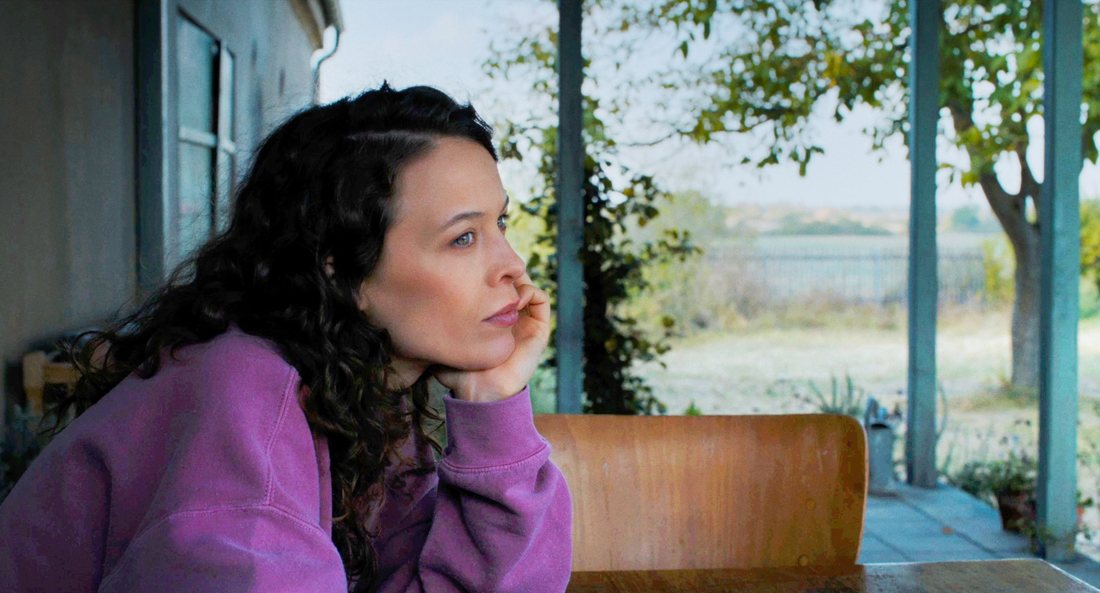
Paula Beer as Laura in Miroirs No. 3. Courtesy Track Shot Media.
The star of Miroirs No. 3 is Paula Beer, here in her fourth feature by Petzold, and the director’s signal actress since Transit. (Beer’s predecessor in this position was Nina Hoss, who made six movies with Petzold; their collaboration ended with 2014’s Phoenix, about the macabre reunion, in the rubble of post-WWII Berlin, of a concentration-camp survivor with her mercenary husband.) Beer plays Laura, an enigmatic figure. As the film begins, she seems to be in some kind of fugue state, first peering down over a bridge near a U-Bahn station, then staring off into the distance on the bank of a waterway.
Laura’s odd behavior continues when, later that day, she and her boyfriend, Jakob (Philip Froissant), leave with another couple on a road trip. She sulks in the back seat, speaking only when asked to identify the key of a song playing on the car stereo (her musical talent will be one of the few things we learn about her; the film takes its title from a Ravel composition). After the foursome reaches their destination, Laura insists that she wants to go back to Berlin. As Jakob drives her to the nearest train station, the car crashes on a country road, close to the home of Betty (Barbara Auer), who rushes to the scene of the accident. Jakob is dead; Laura survives with just a few scratches. Without explanation, she says she wishes to stay with Betty, a complete stranger, a request that the middle-aged woman is only too happy to grant. Their connection and cohabitation seem preordained, as in a fairy tale.
The opening segment of Miroirs No. 3 recalls that of Petzold’s Yella (2007), in which the female protagonist also emerges from a car wreck and sheds her old life. And Auer will be recognizable to those familiar with his films: she played the mom in The State I Am In and has had supporting roles in two other movies by the director. But however pleasing these meta-moments may be to the Petzold enthusiast, no previous exposure to his work is necessary to enjoy the eldritch allure of Miroirs No. 3, a film that pits the cozy rituals of domesticity against the eeriness of family secrets: the heimlich versus the unheimlich.

Barbara Auer as Betty and Paula Beer as Laura in Miroirs No. 3. Courtesy Track Shot Media.
Betty proves to be a most solicitous hostess/nurse, leaving a bottle of water, apple slices, and two thermoses—one with coffee, one with tea—on the table next to the bed where Laura will sleep long and deeply her first night at the house. Mysteriously, the older woman, who is fleshier than her guest, somehow has spare clothes (faded jeans, a red tee with the Babybel logo, a pink sweatshirt with “TEXAS” emblazoned across it) that fit Laura perfectly. The two immediately fall into a seamless rhythm of homey tasks: painting a fence, tending an herb garden, making a plum cake. Are they destined to become lovers, an intergenerational couple living in dulcet isolation in bucolic Brandenburg? Sadly, no. But their relationship takes on a perverse profundity, a closeness structured by a defining absence: a phantom that has lingered in Betty’s house, whose presence is so strong that it has made temporary exiles of her husband, Richard (Matthias Brandt), and son, Max (Enno Trebs, who, like Brandt, is making his third appearance in a Petzold film).
What Betty—and, to some extent, Richard and Max, who cautiously reenter the ménage—needs from Laura becomes evident as the movie progresses. As the title implies, this recent arrival is a mirror of someone, but the reflection will distort Betty’s vision. She, in turn, like so many others in Petzold’s oeuvre, will mimic Scottie Ferguson in Vertigo, trying to fit a living person into the mold of a dead one. Rachel Cusk once acidly described the family as “a cult of sentimentality and surfaces.” Petzold is much more of a humanist than the British writer, but Miroirs No. 3 acutely lays bare the deranging effects caused by the insularity of the nuclear unit. After her country idyll morphs into something more sinister, Laura escapes. Back in Berlin, she is alone, liberated from any ties—free to remake herself any way she chooses, to erase or build upon the traces of her past.
Melissa Anderson is the film editor of 4Columns and the author of a monograph on David Lynch’s Inland Empire from Fireflies Press. A collection of her film criticism, The Hunger, is now available from Film Desk Books.