


 Mark Dery
A collection of poetry by one of Fernando Pessoa’s most gifted heteronyms presents an ode to the antidisciplinarian spirit.
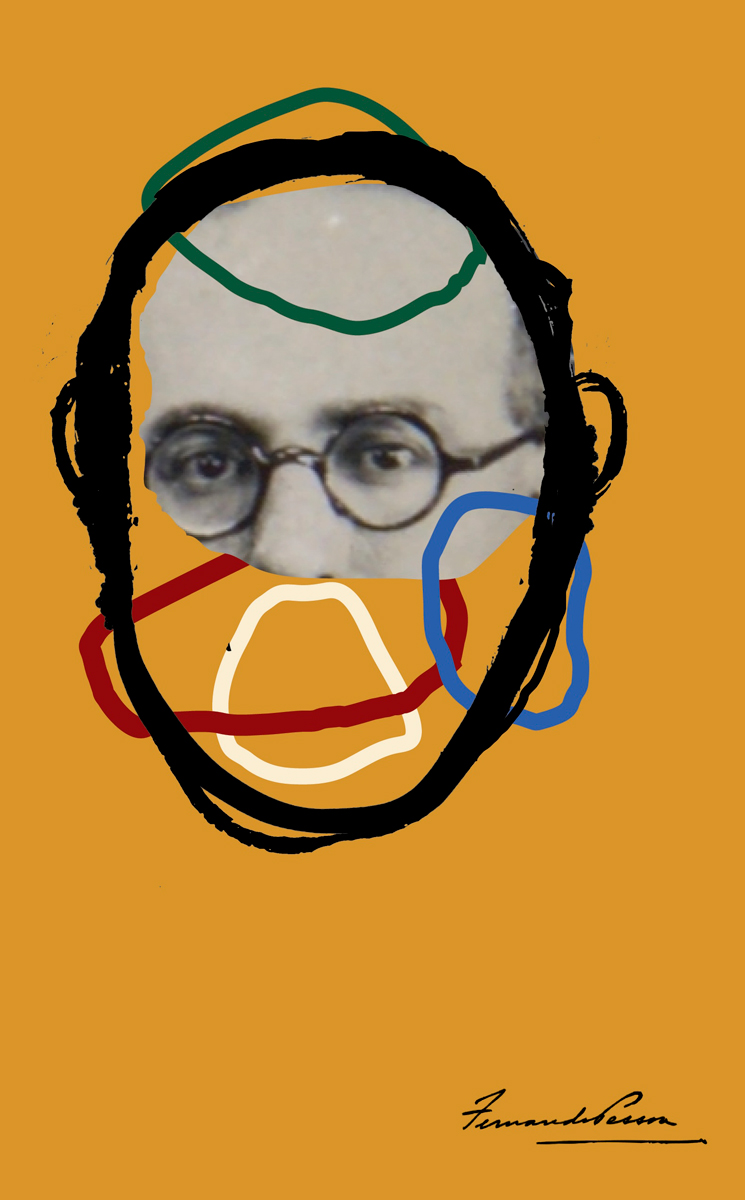
The Complete Works of Ricardo Reis, by Fernando Pessoa, edited by Jerónimo Pizarro and Jorge Uribe, translated by Margaret Jull Costa and Patricio Ferrari, New Directions, 271 pages, $19.95
• • •
When Fernando Pessoa died at forty-seven (from acute pancreatitis brought on by drink, most likely), three of the greatest Portuguese writers of the twentieth century died with him.
Pessoa (1888–1935) was an almost graphomaniacally prolific author of poetry, prose, essays, translations, and plays, only a fraction of which were published during his lifetime. His co-decedents, if you will, were a trio of poets—the most gifted of his “heteronyms,” Pessoa’s term for his literary alter egos, so vividly imagined they stepped off the page and lived lives of their own. All three were conceived in Pessoa’s annus mirabilis, 1914. There was Álvaro de Campos, a bisexual imp of the perverse with a Dionysian thirst for sensation and a Futurist addiction to machine-age modernism; the arcadian anti-philosopher Alberto Caeiro, a shepherd who had no flock (his thoughts, he said, were his sheep) and whose Zen-like teaching that things are exactly what they appear to be charmed the Trappist monk Thomas Merton; and Ricardo Reis, a medical doctor, ardent Hellenist, and composer of odes in the style of Horace. The last believer in the Greek gods, Reis was a fervent “neo-pagan” who welcomed “the company of the satyrs” on his forest rambles.
In The Complete Works of Ricardo Reis—New Directions’ fourth entry in its Pessoa series, following The Book of Disquiet by Pessoa’s “semi-heteronym” Bernardo Soares and the complete works of Campos and Caeiro—Pessoa ventriloquizes the Jesuit-educated doctor, who has exiled himself to Brazil because, true to his name, he’s a royalist at a moment when monarchism is out of fashion in Portugal. (“Reis,” in Portuguese, means “kings.”)
Reis’s politics, of a piece with his neoclassical aesthetic, look at first glance like the usual reactionary wreath-laying at the ivy-clad ruins of an imagined golden age. But his classicism leads him, paradoxically, to excoriate Christianity as the root cause of the Decline of Western Civilization and to prescribe the revival of paganism as its cure.
“Everything since Greece has been a mistake and a deviation,” he thunders, in “The Return of the Gods” (circa 1914), one of a miscellany of prose pieces appended to this collection. “We must return to it.” In another essay, “General Program of Portuguese Neo-Paganism” (you can’t not love the title; it sounds like a PowerPoint presentation to the politburo on Mount Olympus), he lambasts Christianity as “a producer of a degeneration in ideas and feelings from which our civilization’s perpetually morbid state derives.” Make The Parthenon Great Again! (But only if we can relocate it to Lisbon.)
Translated from the Portuguese by Margaret Jull Costa and Patricio Ferrari, Reis’s poetic style is a model of Horatian clarity, elegantly austere as a Doric column. Metrically, the measured tread of Reis’s odes suits the poet’s reflective mood, now bittersweet, now wryly resigned, now tinged with a fatalistic acceptance of whatever the gods decree (a nod to the Stoic philosophers but also to The Rubáiyát of Omar Khayyám, which Pessoa read devotedly). “There is no point / In doing anything,” the poet writes, in an ode dated June 12, 1914. “There is no resisting / The monstrous god / Who devours / His own children.” (The “monstrous god” is Saturn, god of time, the great devourer.)
Reis’s poignant sense of life’s brevity—“Master, how serene / Are all the hours / We waste / If, as we waste them, / We place them in a vase / Like flowers”—is leavened by his “sad Epicureanism,” as his brother Frederico called it, expressed in exhortations to seize the day while hoisting a glass to our mortality: “But let us enjoy the moment, such as it is, / Feeling slightly solemn in our happiness, / While we wait for death / As if we had met it before” (June 16, 1914). At times, Reis sounds less like a “Greek Horace who writes in Portuguese” (Pessoa) than a Japanese monk composing his deathbed poem in the gently ironic Zen manner: “Time passes, / And tells us nothing. / We grow old. / Let us learn, almost / Mischievously, / To feel ourselves leaving” (June 12, 1914).
Shy, soft-spoken, discreetly turned out in his three-piece suit and fedora, Pessoa was famously reserved. On the page, however, he was as iconoclastic as Ezra Pound or T. S. Eliot, though far less showy in his demolition of the Victorian worldview and its stuffy style (alive and well in Portugal’s polite society, even in the prewar twentieth century). Richard Zenith describes him, in Pessoa: A Biography, as the eye of the bomb cyclone of modernism that tore through Lisbon’s literary scene just before the Great War. Hiding under the brim of his signature fedora was a poetic, philosophical intellect with a prodigious capacity, says Zenith, “for thinking and seeing from new angles.” Pessoa showed Portugal’s literary vanguard “how to break with traditional forms of representation,” his biographer notes, “and with the notion of art as a faithful expression of a reliable ‘I.’ ” His weapon of choice in the assault on the complacent, unchanging self of the Belle Époque was the heteronym.
Pessoa coined the term to distinguish the voices he channeled, like a Surrealist automatist taking dictation from his unconscious, from mere pseudonyms. Fully formed personalities with detailed biographies, idiosyncratic psychologies, religious beliefs, and political convictions (at odds, in many cases, with Pessoa’s—and each other’s), Pessoa’s heteronyms seemed to self-generate spontaneously in his febrile imagination.
Radicalizing Whitman’s insight that we contain multitudes and Wilde’s axiom that authenticity is just a mask we wear in the theater of everyday life, Pessoa and his hundred-odd heteronyms whip the rug out from under our assumptions about what it means to be, and at the same time to have, a subjective self. In so doing, they undermine the public-facing persona we call identity.
Read against the backdrop of our moment, when the American Right has weaponized identity politics in the service of its dream of a one-party, patriarchal, white Christian ethnostate, purged of diversity—One People, One Nation, One Leader—Pessoa’s poetic assault on single-mindedness feels quietly radical. He was an unrepentant elitist who, like Reis in his “General Program of Portuguese Neo-Paganism,” disdained democracy and “all forms of non-aristocratic government” (not to mention “soppy anti-scientific trends, such as vegetarianism” and “anti-alcoholism,” hilariously). But he was also a “philosophical anarchist for whom individual freedom was as much a primordial need as oxygen,” says Zenith; a Wildean provocateur who held that “only superficial people have deep convictions” and that any intellectual worth the name “has the cerebral obligation to change opinion . . . several times in the same day” and thus might easily be “a republican in the morning and a royalist at dusk”—a position too perverse for either Right or Left, in our time.
Reactionary yet revolutionary, a monarchist and a vociferously anti-Christian neo-pagan, Reis embodies that sensibility. It’s fitting that his last poem, written on November 13, 1935, just seventeen days before his maker died, can be read as an ode to the “antidisciplinarian” spirit, as Pessoa called it, and a salvo against the notion of a self ruled by a totalitarian “I”:
Inside us live innumerable others;
If I think or feel, I do not know
Who is thinking or feeling.
I am only the place
Where feeling and thinking happen.
I have more than one soul.
There are more I’s than just I myself.
If Pessoa had a motto, it was the exclamation he wrote on one of the thirty thousand pieces of paper he left stuffed in two trunks, to be found after his death: “Be plural like the universe!” Beneath that fedora and behind that little mustache lurked the most radical identity politician of all time.
Mark Dery is a cultural critic, essayist, and the author of four books, most recently, the biography Born To Be Posthumous: The Eccentric Life and Mysterious Genius of Edward Gorey. He has taught journalism at NYU and “dark aesthetics” at the Yale School of Art; been a Chancellor’s Distinguished Fellow at UC Irvine, a Visiting Scholar at the American Academy in Rome, and a fellow at Hawthornden Castle near Edinburgh; and has published in a wide range of publications.