


 James Hannaham
Bonding, blending, and a kinship of aesthetics abound in an exhibition of works by the two artists.
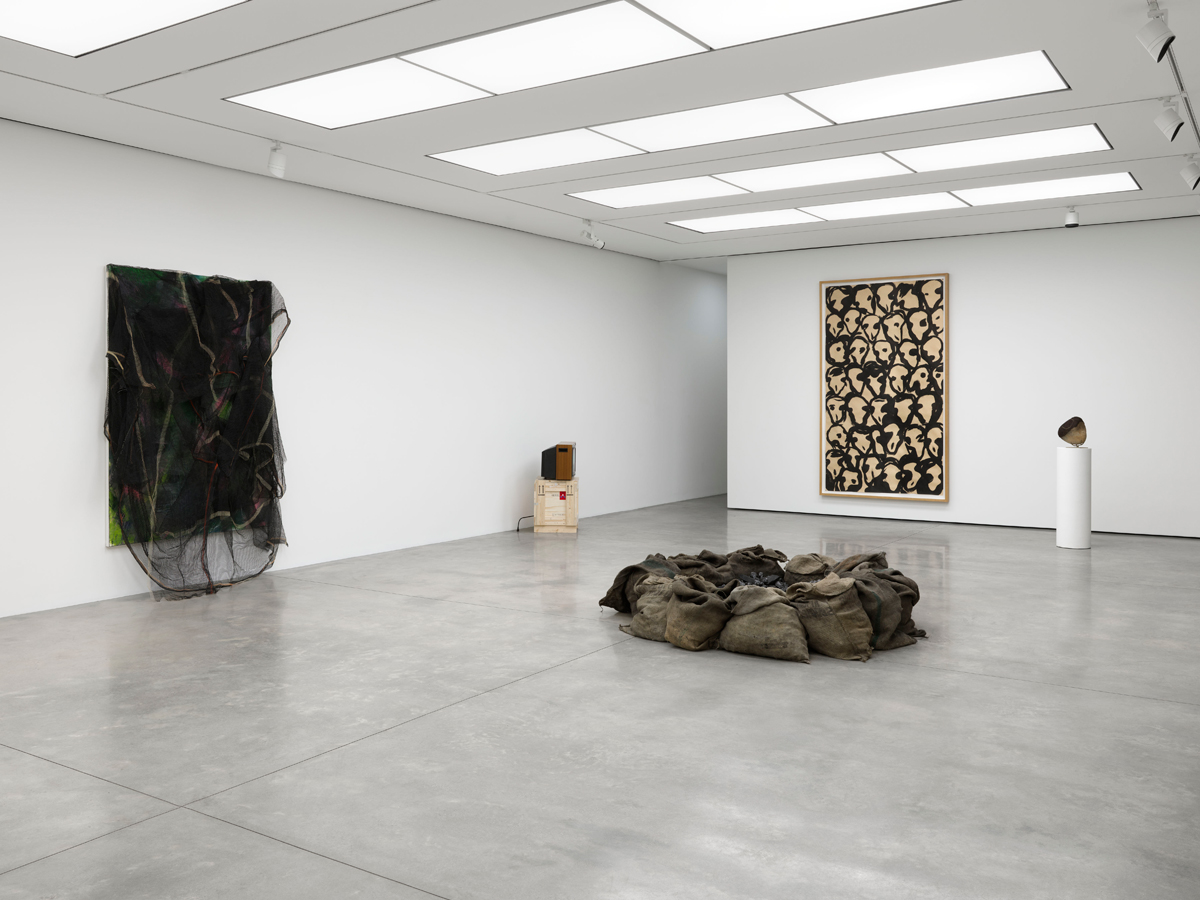
David Hammons and Jannis Kounellis, installation view. Courtesy White Cube. © On White Wall.
David Hammons and Jannis Kounellis, White Cube New York, 1002 Madison Avenue, New York City, through June 13, 2026
• • •
I’ve never curated anything more complicated than a music playlist, but I often feel that the coordination, ingenuity, and stamina required to organize a large, successful art exhibition can be as exciting to consider as the art itself. Of course, I say this as someone with a view to the inside; I also get the impression that the labor of curators shouldn’t overshadow a show, and that beyond the art world, “superstar curators” aren’t really a thing. That said, I know I’m not alone in enjoying a good hard think about everything that goes into putting an exhibition where once there was nothing, especially when the art in question downplays—or even thumbs its nose at—typical values like virtuosity and representational drawing. When those considerations get removed from the table, ample space opens up to imagine the construction of the show itself.
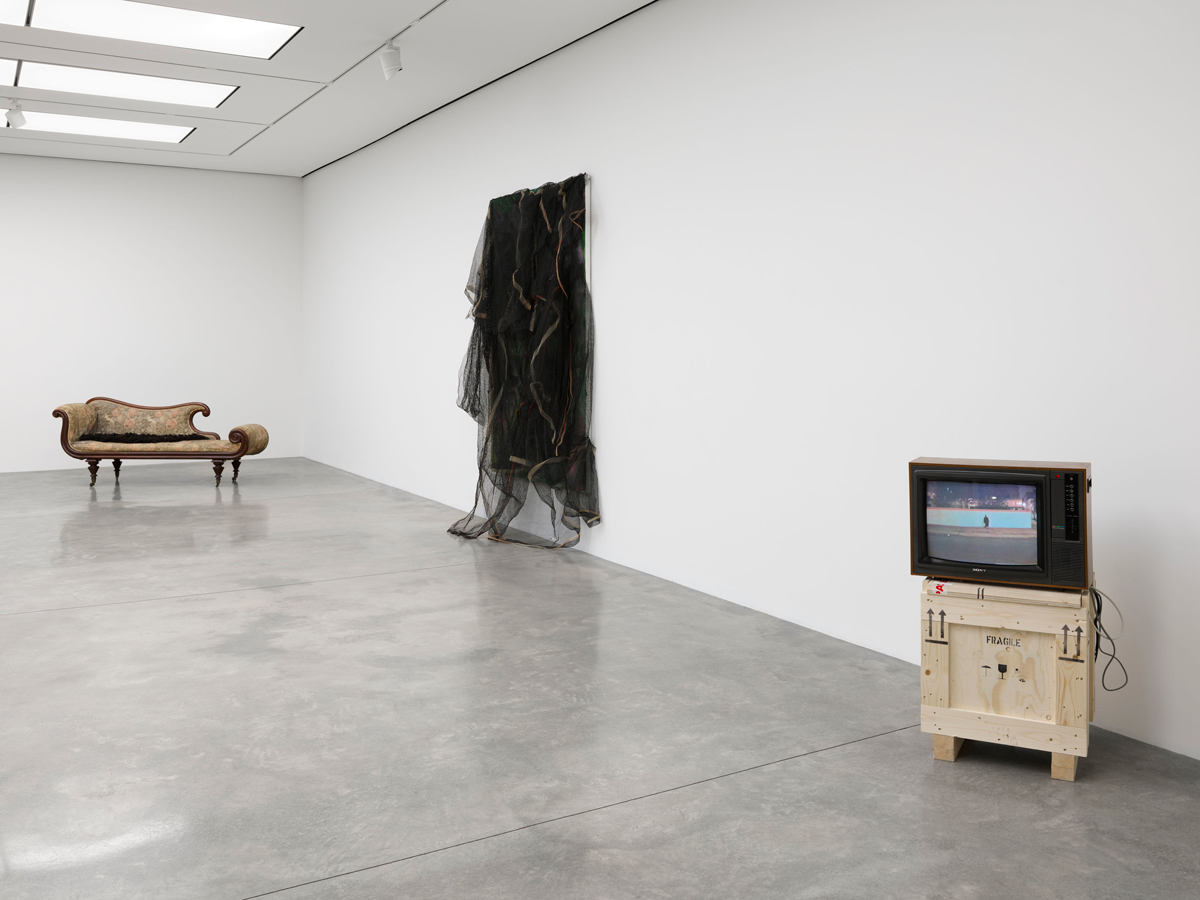
David Hammons and Jannis Kounellis, installation view. Courtesy White Cube. © On White Wall.
Take the example of David Hammons and Jannis Kounellis. This is a two-floor cornucopia of conceptual late-twentieth and early twenty-first-century work by Hammons, the eighty-two-year-old American godfather of Conceptualism whose work has injected the art world with a hot dose of Blackness since the 1960s, and Kounellis, the late Greek figure most heavily associated with Arte Povera. Translating to “poor art,” the post-WWII (primarily) Italian movement helped Duchampify the world, bringing all manner of found objects, bodies, behaviors, and natural forms into the gallery. For Kounellis, the abundance of unusual materials included coffee, meat, live birds, and real horses. (Imagine the mess.)
Between White Cube curators Sukanya Rajaratnam (a rising star in the curatorial world with a track record for exhibiting long-unsung Black heroes like Sam Gilliam and Alma Thomas) and Mathieu Paris (the gallery’s global sales director, who sounds on the page like a sophisticate out of a bygone era), someone noticed that Hammons and Kounellis had met in 1993 during a fellowship at the American Academy in Rome and exhibited side by side there for a month. Wouldn’t it have been cool, any sentient being would wonder, to see that show? Fortunately, Rajaratnam and Paris were in the position to re-create that show, or at least call attention to the fact that it happened. (In 2016, Rajaratnam organized an important fifty-year Hammons retrospective.)
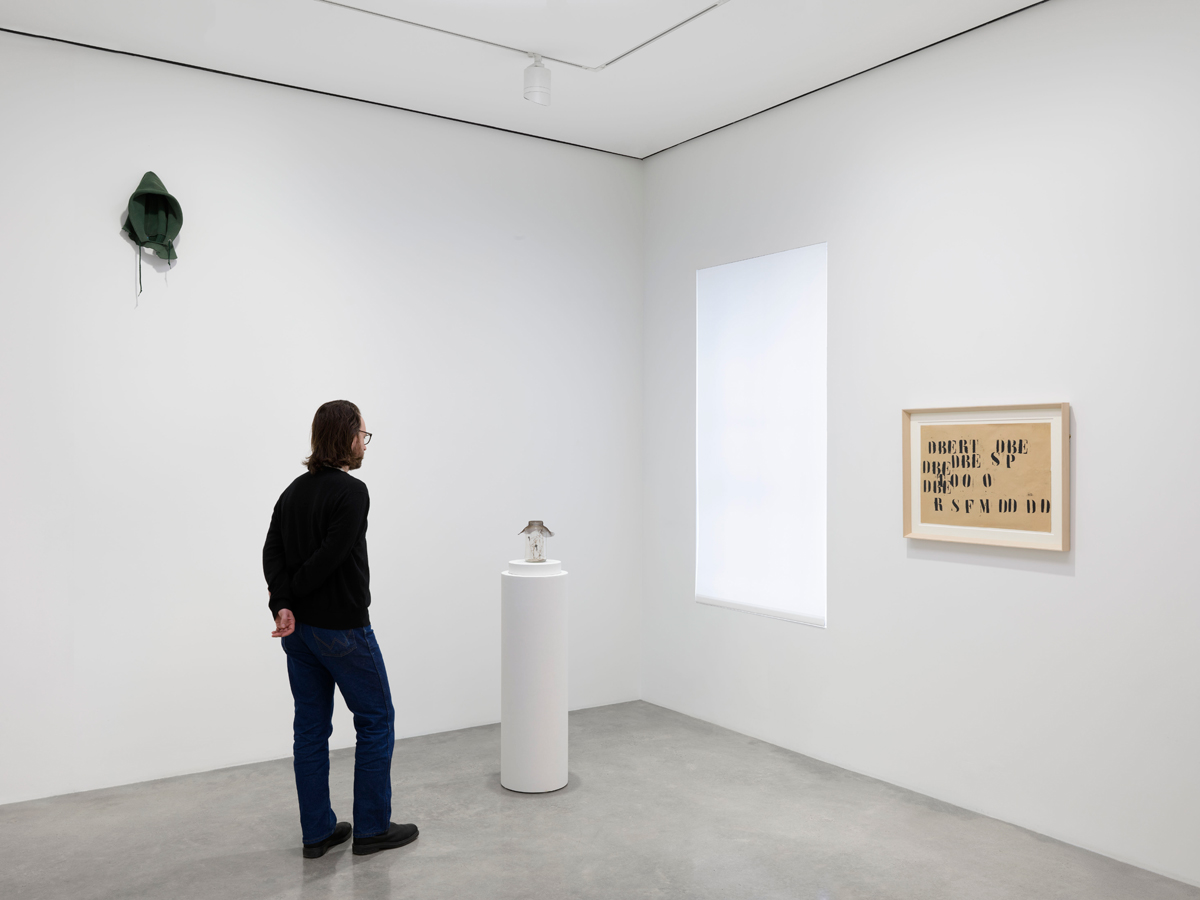
David Hammons and Jannis Kounellis, installation view. Courtesy White Cube. © On White Wall. Pictured, left to right: David Hammons, In the Hood, 1993; David Hammons, Fly Jar, 1999; Jannis Kounellis, Untitled, 1959.
However, the White Cube exhibit does not attempt to duplicate the 1993 show, which divided each artist’s work into a different tent—“separate but equal,” in the unfortunate words of Kounellis. This show does something more radical by juxtaposing their work throughout the space without identifying whose work is whose, or affixing a shred of contextual mumbo jumbo to the walls. There’s not a didactic to be found. You can cheat with the tear sheet if you want, but it’s more fun to guess.
While the historical reference that inspired the show feels like a museum idea, the curators have followed up with a fully artistic gesture: pulling all the context out from under the viewer. If you know you know, says this exhibit. If you don’t know, you’ll be lost. With different artists, the gesture might smack of elitism, but this work is too gritty for that. It’s also nice to have one’s intelligence overestimated for a change.
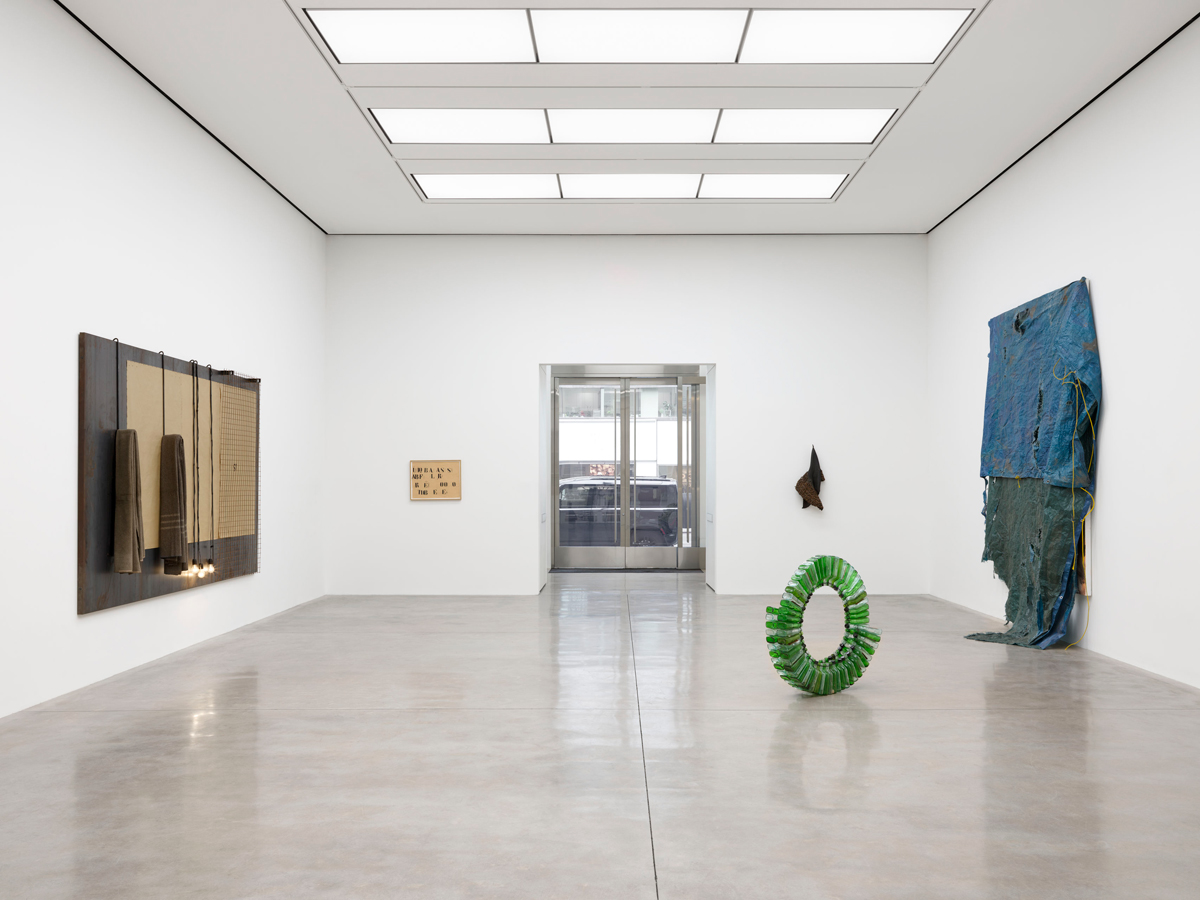
David Hammons and Jannis Kounellis, installation view. Courtesy White Cube. © On White Wall. Pictured, far right: David Hammons, Untitled, 2013.
The points of connection between Arte Povera and what I’ll call “Arte Nero” abound. An untitled Hammons from 2013, a painted canvas almost completely covered in a skanky, ripped-up dark-blue tarp, presides on the lower floor like an announcement that fancy art has been canceled—Here, check out this remnant from a homeless encampment, mofos. If you’re looking for a fuck-you to the gallery’s slick, ultra-wealthy Upper East Side environs—indeed, to the very whiteness of White Cube—you could hardly do better. Reportedly, Hammons enjoys occupying this paradoxical position as the Fred Sanford of Sotheby’s or something. It’s hard not to love that for him. And ultimately, the main difference between Duchamp and Fred Sanford is, like their respective detritus, context.
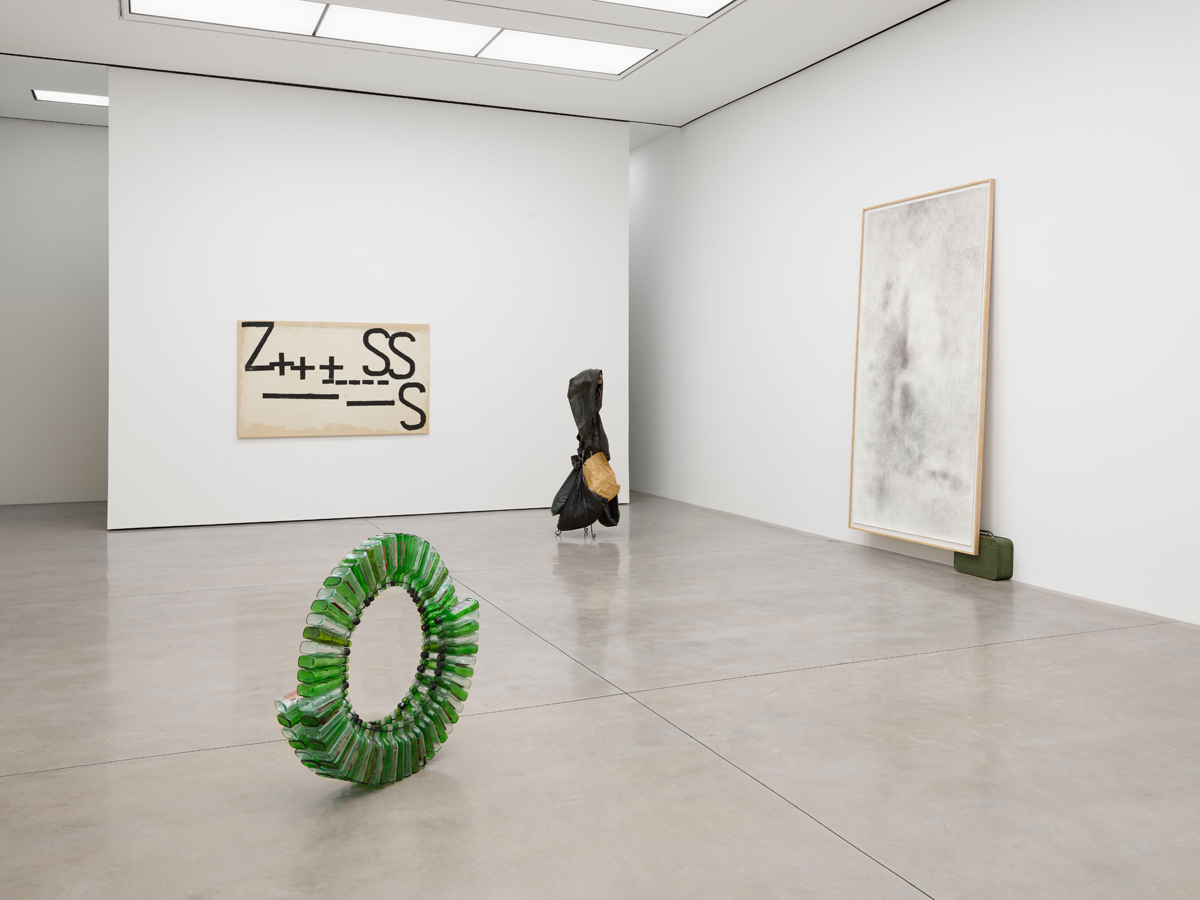
David Hammons and Jannis Kounellis, installation view. Courtesy White Cube. © On White Wall. Pictured, lower left, foreground: David Hammons, Untitled (wine bottles), 1989.
Okay, now we’re looking at a sculpture made from a circle of bottles glued together. Whose piece might that be? This one’s Hammons again, you conclude on closer inspection, only after approaching Untitled (wine bottles) (1989) to find that many of the wine bottles are Thunderbird empties. Just beyond the bottles are four shelves holding burlap sacks full of plaster . . . which artist? It’s another untitled piece, this time by Kounellis (Untitled, 1999).
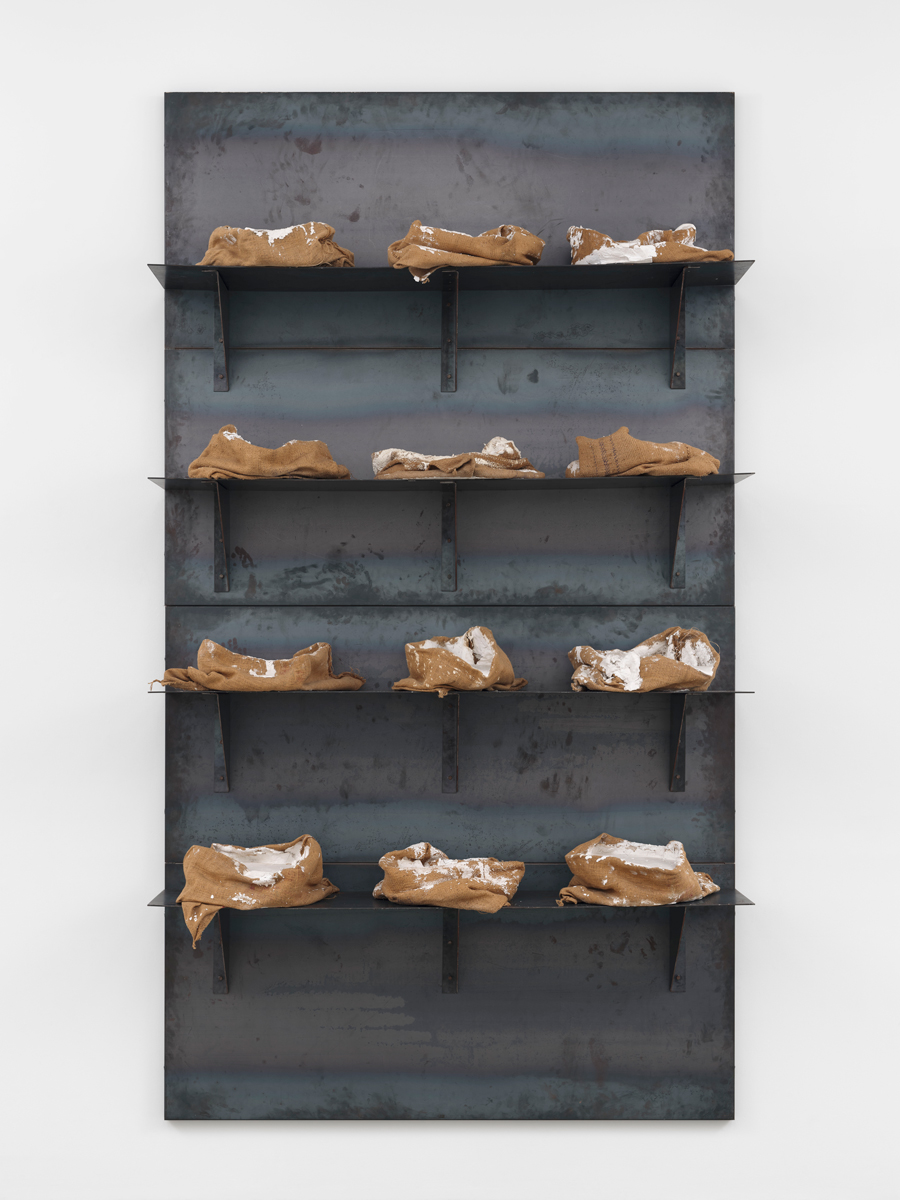
David Hammons and Jannis Kounellis, installation view. Courtesy White Cube. © On White Wall. Pictured: Jannis Kounellis, Untitled, 1999.
You may begin to think that the rule of thumb is to ascribe objects and materials that most heavily indicate cultural Blackness to Hammons and more ambiguous pieces to Kounellis, but then, upstairs, you’ll encounter a sculpture consisting of several jute bags encircling a pile of coal. Not Hammons! Kounellis (Untitled, 1968). It’s tough (and therefore enjoyable) to try to think of two well-known contemporary artists whose work might dovetail so neatly in a two-person show. A layperson might confuse a reasonable number of Bill Viola and Gary Hill video installations for one another. Would Frank Stella’s sculptures jibe with Judy Pfaff’s, maybe? Derivativeness, or even whiffs of unoriginality, have been an art sin for such a long time that most famous artists’ plots of creative territory have wide demilitarized zones around them.
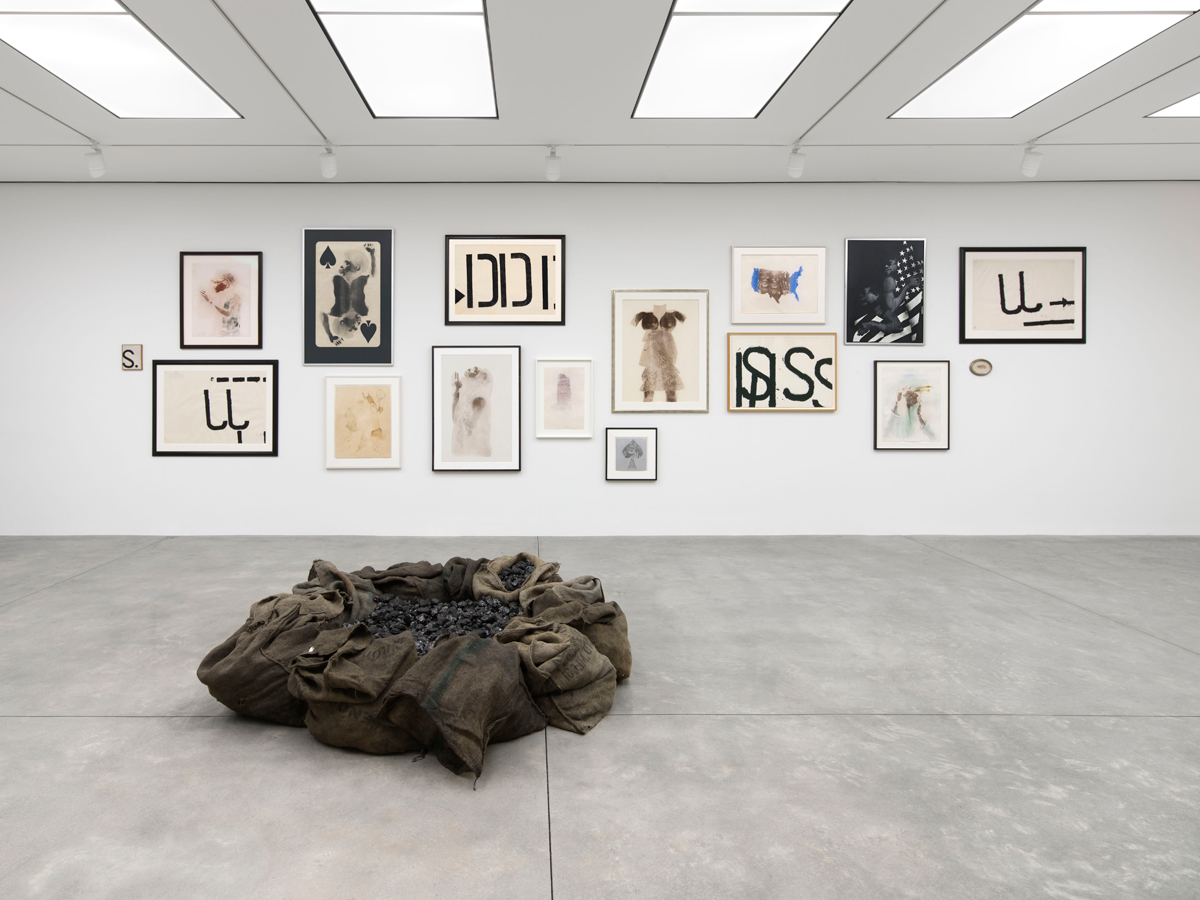
David Hammons and Jannis Kounellis, installation view. Courtesy White Cube. © On White Wall. Pictured, far left, on back wall: Jannis Kounellis, Untitled, ca.1959/1969. Foreground: Jannis Kounellis, Untitled, 1968.
While fiercely guarding one’s gestalt feels like a social nicety hammered into an iron rule, this show gives the viewer a sense that when Hammons and Kounellis met, they acknowledged a kinship, even a similarity, between their aesthetics, which led to a long friendship rather than animosity. Since neither artist is involved with the exhibition—Hammons is legendarily elusive, and Kounellis died in February of 2017—the truth or falsehood of that impression feels less important than the fact that the curators had to form a similar alliance—across gender lines as well as national and racial ones—that echoes the themes of bonding and blending that run through the show. Still, David Hammons and Jannis Kounellis doesn’t feel motivated by a message of racial harmony, even if that’s what one comes away with. Maybe its message is an even stronger one, about obliterating the notion of otherness altogether.
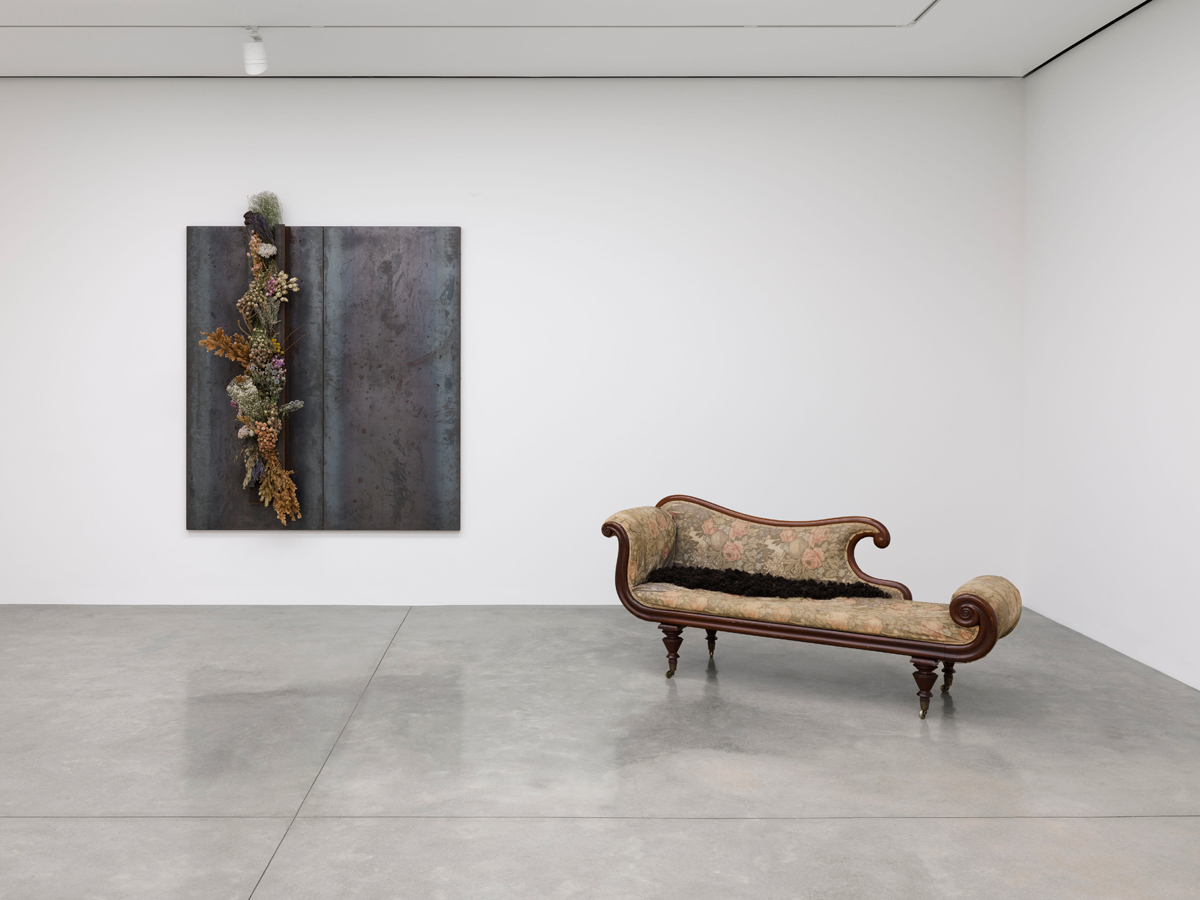
David Hammons and Jannis Kounellis, installation view. Courtesy White Cube. © On White Wall. Pictured, left: Jannis Kounellis, Untitled, 1987. Right: David Hammons, Hair Relaxer 2007–08.
One uncommon thing Hammons and Kounellis share is a sense of humor—is it possible to be a decent conceptual artist without one? Don’t talk to me about Kosuth. Hammons fills a chaise longue with Black hair and gives it the title Hair Relaxer (2007–8). Kounellis paints a letter S followed by a period on a small canvas and nothing else (Untitled, 1959/1969). Both artists introduce materials and processes that confound expectations. Hammons’s In the Hood (1993), made famous on the cover of poet Claudia Rankine’s Citizen (2014), is just a hood separated from its hoodie and held open with a wire, implying some ghostly decapitation scenario. In another fractured nod to portraiture, this show also includes Hammons’s Rock Head (1998), a lump of stone with curly hair glued on in imitation of an Afro, like a Black Chia Head.
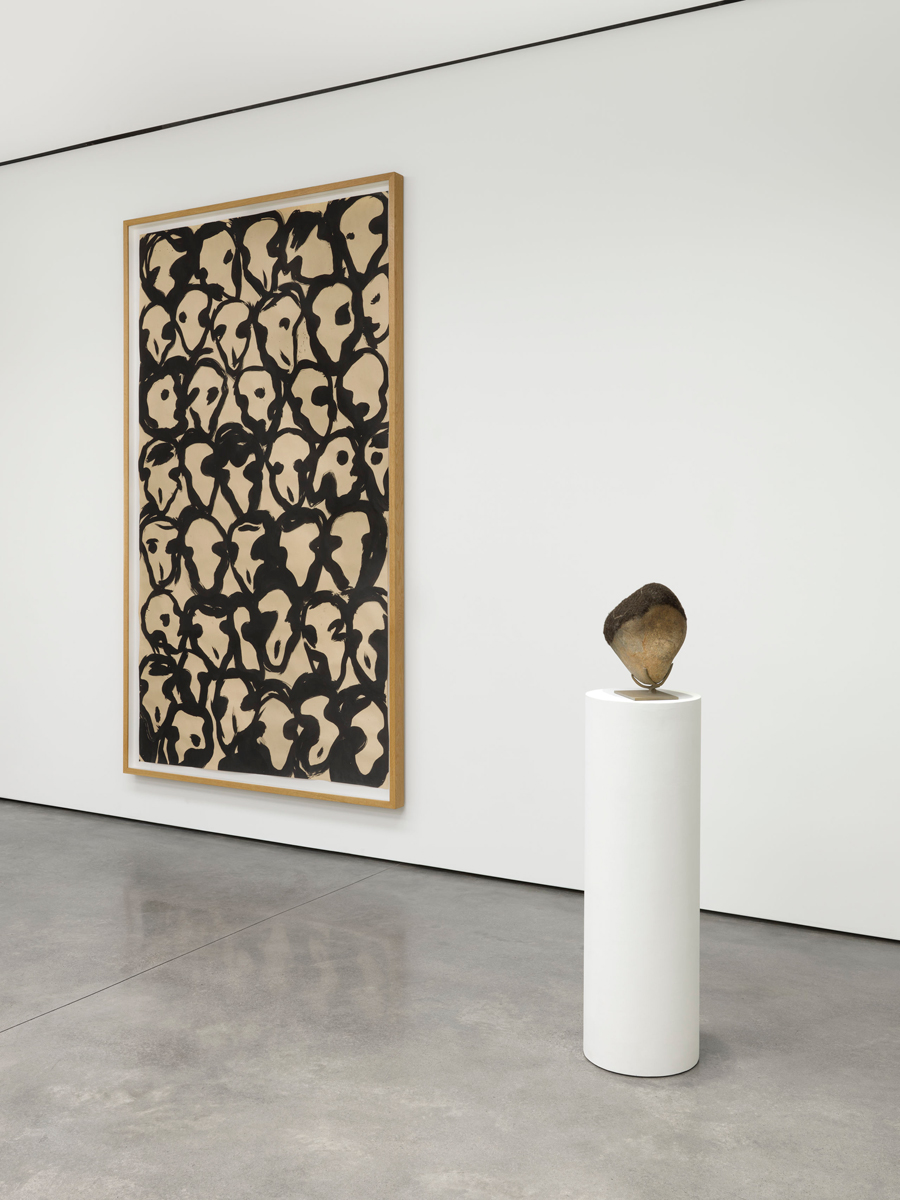
David Hammons and Jannis Kounellis, installation view. Courtesy White Cube. © On White Wall. Pictured, left: Jannis Kounellis, Untitled, 1980. Right: David Hammons, Rock Head, 1998.
Sadly, the breadth of Kounellis’s experimentation with materials isn’t represented as well as it could have been; of the forty works on display, twenty-five are by Hammons and the remaining fifteen by Kounellis, but none of them have quite the audacity or theatricality of his better-known pieces. His 1989–91 Untitled (Coffee), a lead frame filled with coffee beans, or any of its multiple iterations, would have been a terrific inclusion and a definitive intersection between these artists’ work, given the very Black history of that quintessential commodity of the Global South. (It also would have smelled quite nice, for those of us who enjoy a good cup of joe.) Despite this White Cube outpost’s resemblance to a carriage house (actually, it was a bank), no attempt was made to mount or even document Kounellis’s Untitled (1969), the piece consisting of twelve actual horses tethered inside a gallery. But you can’t blame Rajaratnam and Paris for that. That work certainly hasn’t aged well in terms of animal rights. These curators have too much class to risk accusations of abuse, and, considering the lack of contextual hand-holding in this show, an aversion to more than one type of horseshit.
James Hannaham is a writer and a visual artist. He has written three novels and a book of responses to poems by Fernando Pessoa. His accolades include a PEN/Faulkner Award, two Hurston/Wright Legacy Awards in Fiction, and a Guggenheim fellowship. He teaches in the Department of Writing at the Pratt Institute.