


 Harmony Holiday
Antoine Fuqua constructs a biopic as comeback tour starring the King of Pop’s nephew, Jaafar Jackson.
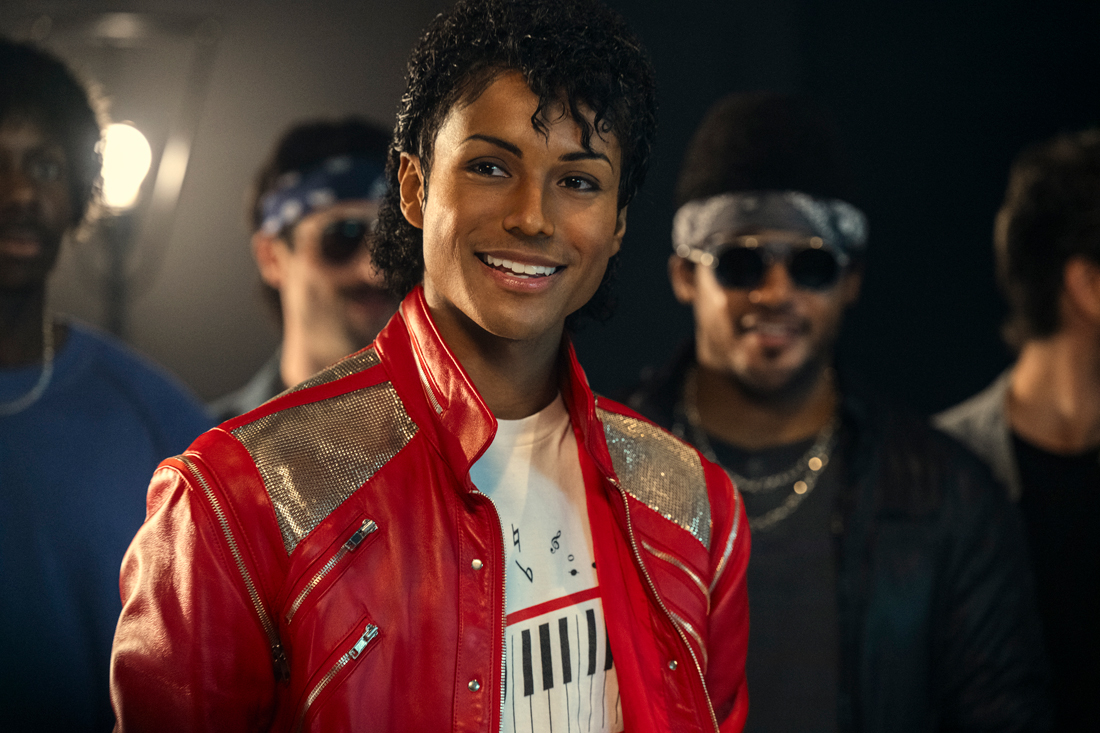
Jaafar Jackson as Michael Jackson in Michael. Courtesy Lionsgate. Photo: Glen Wilson.
Michael, written by John Logan, directed by Antoine Fuqua,
now in theaters
• • •
It is virtually forbidden—as an unpatriotic act—that the American boy evolve into the complexity of manhood. —James Baldwin
You look at the performance until it disappears. —Fred Moten
Having been refused the dignity that is the right to disappear, the black entertainer shape-shifts, making of himself a chimera, so that when we assassinate one version of Michael Jackson, the successor is preemptively activated. All a misleading film about him—one that dissembles by being too literal and too vague—has to do is trap all those characters in one cast that forbids their meaningful integration. Michael’s an eternal child, a teenaged heartthrob, an exotic prodigy, vampire, vampire slayer, slave to the industry, rebel against its mores, venture capitalist who purchases the Beatles’ catalog, stake in all your recorded fantasies, half of Sony/ATV, under siege for it but complicit with codes of conduct in other areas as a compromise, cheerful on the surface, discrete about his grievances, touring in Israel and writing odes to Palestine in the same year. On a recorded phone call, he describes his father, Joseph Jackson, oiling him down so the impending beating with an ironing cord would deliver more acute pain, how he and Janet would picture their manager-handler-father in a coffin and ask one another, would you feel sorry? A stoic no in unison. In the unbearable interim, Michael becomes an aloof Peter Pan reinventing Neverland, androgynous, a gender nihilist, fairy, warlock, siren, committed to saving ailing children with attentiveness, generous donations, and mesmerism, and accused of using those humanitarian efforts as a decoy by which to prey on those same children, acquitted of those accusations in a court of law, never exonerated by public opinion, where he remains a punch line, pawn, pedestalized, punished again. He cannot disperse, he cannot be forgotten.
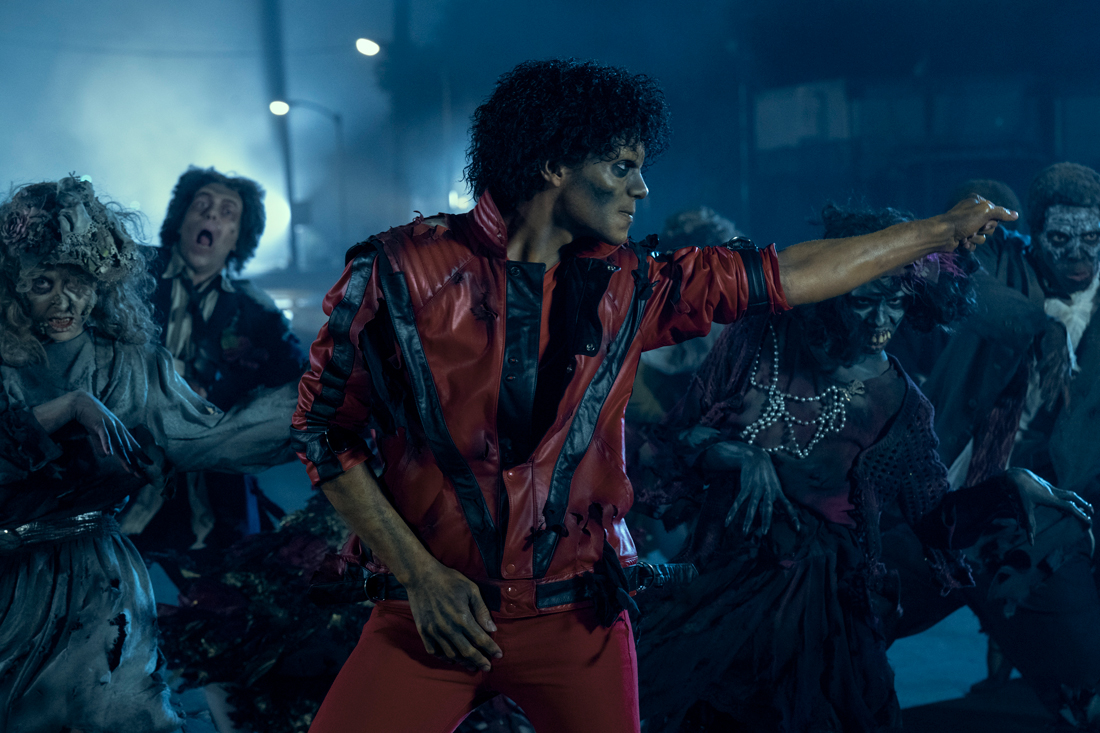
Jaafar Jackson as Michael Jackson in Michael. Courtesy Lionsgate. Photo: Glen Wilson / Lionsgate.
As penance or counter-spectacle, he weds the pseudo King of Rock and Roll’s pseudo girl-next-door daughter, appearing more and more like a white woman beside her, as if they’re a lipstick-lesbian couple during their two-year marriage. And he fathers children who seem to phenotypically deny his paternity, like any royal scrambling for worthy heirs and allies by any means necessary. In the words of Amiri Baraka, If Elvis Presley is King, who is James Brown, God? Who does Michael displace in that triad? Is he archangel’s shadow or his own best rival? Burn scars, vitiligo, lupus, and undisclosed cosmetic techniques camouflage the stigmata that had turned his visage into a mask and vista from which he could gaze out at us grinning like the Joker while sobbing and buckling inside-out lyrics of paranoiac denunciation—not my love. He’s been ’buked and he’s been sold, he’s been talked about sho’s you born, the negro spiritual qualifies, as if anticipating this dizzying trickster-victim-overlord-underdog archetype. Michael, meticulously culled and curated against the herd into this condition of simultaneous ridicule and unconditional worship, condemnation and consecration. Then, finally, proving his blackness endured past every threat against it, he’s a fugitive, attempting a final tour after having fled to Dubai and Bahrain for some semblance of anonymity post–show trial. Our striated Kafka of the Afro-West diaspora, for whom the standard humiliation ritual is internalized as eternal masochism, desperation to be seen as beautiful the more unrecognizable he becomes, our only sustainable diversion from the culture’s cloying black fetish, an abolitionist inverting categories with his flesh, making of himself a beatific obscenity, oversimplified by so many, labeled a mere freak, rather than cyborg, hacker, and supernatural disaster, disrupter of the collective standard of beauty and truth. Toward the end of his time here, he wanted to make a museum for child stars, to immortalize their proper names and his. He wanted to buy Marvel, he wanted, perhaps, to die for his and our sins, meet the crucifixion offered him, and be born again in a dystopian cinematic universe to upend our riffraff of empty-grief with his viciously generative ecstasy of melancholia, his defiance of expectations that makes his spirit docile against the will.
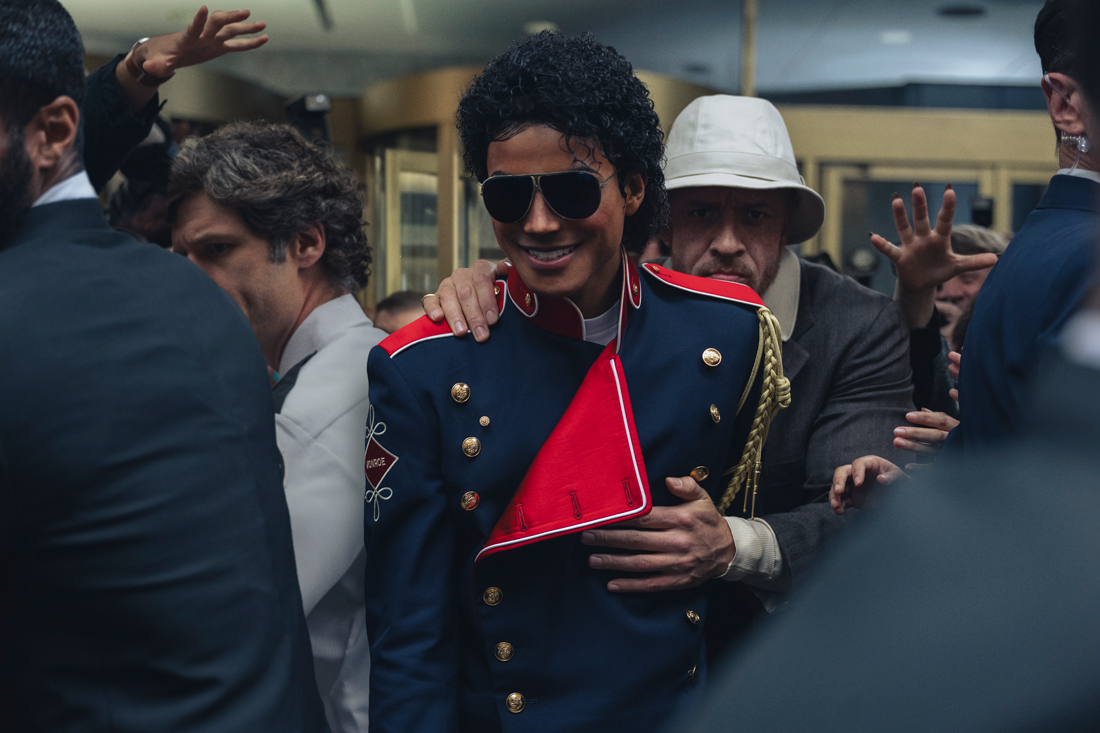
Jaafar Jackson as Michael Jackson and KeiLyn Durrel Jones as Bill Bray in Michael. Courtesy Lionsgate. Photo: Glen Wilson / Lionsgate.
Then he falls asleep, never to awaken again in this realm, an unsolved homicide by fame and euthanasia, by us, colluding to kill off a battered false messiah who had become inconvenient, too tragic, too emboldened by alienation, too shattered and misshapen for our fetish-engine stages. With his reputation so irreconcilable, was it safe to cry for Michael Jackson on June 25, 2009? It wasn’t. His death was met with frenzy, dancing and crying in the streets of Harlem, his name on the Apollo marquis like James Brown’s before him, an appalled and incomplete elegy for an ineffable incident of a life. Now, it’s Michael’s turn to be dismembered and reassembled by the cinema. Director Antoine Fuqua has constructed a biopic as comeback tour starring Michael’s nephew, Jaafar Jackson, who functions as a reanimated MKUltraesque clone of the pop magnate on-screen, or an upscale Vegas impersonator mimicking his uncle so deftly he absolves Michael of any residue of himselves.
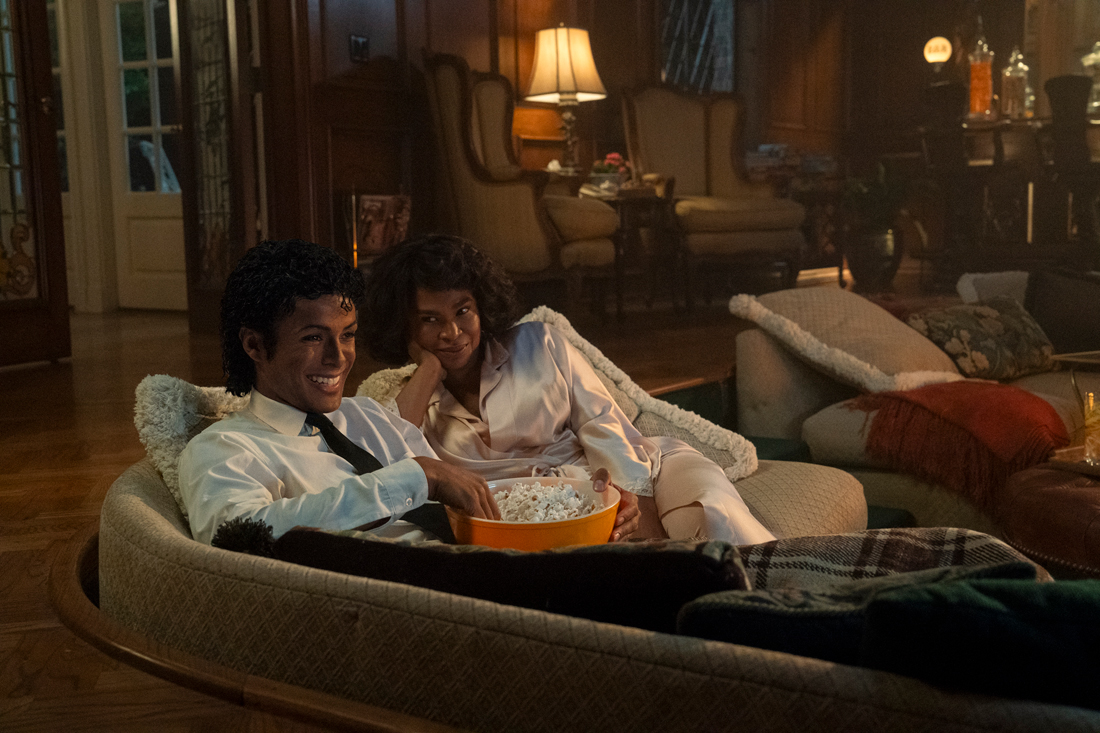
Jaafar Jackson as Michael Jackson and Nia Long as Katherine Jackson in Michael. Courtesy Lionsgate. Photo: Hilary Bronwyn Gayle / Lionsgate.
The biopic is an inherently imperious and extractive genre that mostly fails to deliver plots worthy of their subjects. This one leans into that ritual of gaudy shorthand, crisis-proofing itself in advance. Janet disapproves, so there’s no Janet on-screen. La Toya (Jessica Sula), who Michael once disparagingly called a witch while he was still alive, becomes his close confidant and only sister. Diana Ross didn’t consent, so her parts are delicately excised and replaced with desolation, one absentee groomer. His doting mother Katherine, still alive today at ninety-six, and well honored by Nia Long in the film, and his terrorizing father Joseph (Colman Domingo), plus longtime security guard Bill Bray (KeiLyn Durrel Jones), trusted lawyer John Branca (one of the film’s producers, played here by Miles Teller), Quincy Jones (Kendrick Sampson), who he met on the set of The Wiz (1978), and Berry Gordy of Motown (Larenz Tate) are meant to compensate for the vacancies where the erased subjects belong, which makes for pathos and pulp horror–laden scenes reminiscent of ’90s sitcom reboots, specifically that of Fresh Prince of Bel-Air.
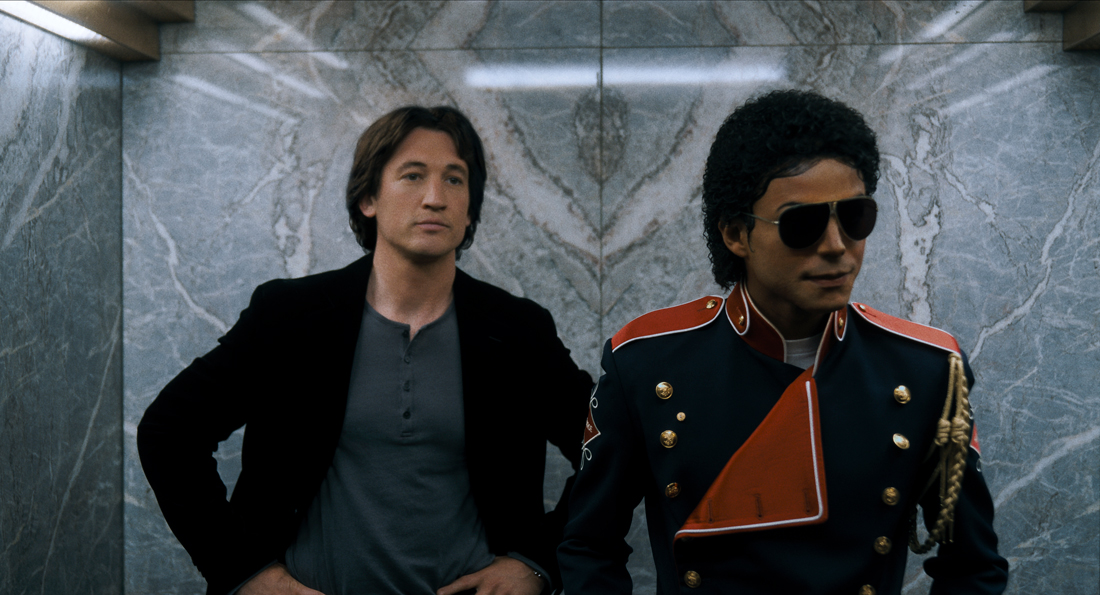
Miles Teller as John Branca and Jaafar Jackson as Michael Jackson in Michael. Courtesy Lionsgate. Photo: Lionsgate.
Every scene is haunted by living and kitsch-artificial ghosts. Michael storms out of the family’s Encino home after a spat with Joe, and his Uncle Phil–esque security guard chaperones him to a lookout point in the hills where he can sulk and bask in the fullness of his dejected exhibitionism. When his hair catches on fire during a Pepsi commercial shoot, the blaze almost killing him, he’s visited in the burn unit by his lawyer with gifts of giant stuffed animals and stalked by his father’s greedy worry he won’t be able to tour with his brothers that year. He uses the rehabilitation time to rehearse, visit sick children, and plot sovereignty—no women, no cry. It’s to the estate’s and the record label’s (which reacquired half of his catalog in 2024) advantage to infantilize Michael in this vacuum-sealed depiction, which begins in 1966 with torment and anonymity in his natal Gary, Indiana, and ends in the year 1988, like a YA novel, as the words his story continues flash on-screen, priming audiences for the already-commissioned sequel.
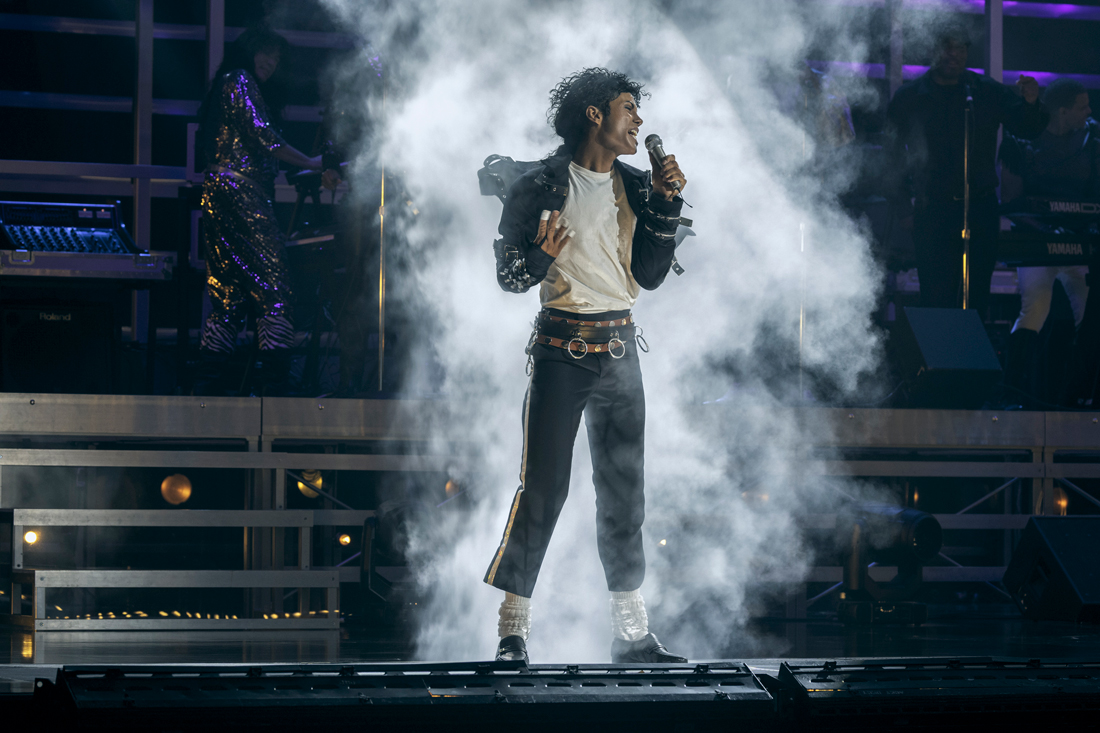
Jaafar Jackson as Michael Jackson in Michael. Courtesy Lionsgate. Photo: Kevin Mazur / Lionsgate.
What should be unabashed gothic surrealism is made as palatable and stilted as annotations in a college thesis in Michael, until we’re sold an abomination with a concert in the middle. We are barraged with redundant quotations of Michael footage already in the commons, threaded together with retro soap opera–style editing, easier to sing along by. And the crowd goes wild. Absolute catharsis has ensued in most theaters, blaspheming the man himself, who would never have approved of being portrayed like the muse of an upscale karaoke booth. A movie made to herald a disgraced and remarkably uncancelable culture hero by producing and reigniting superfans to stand between him and the ever-encroaching tribunal, to extract every penny and tear possible from the ambiguous relay between freak, predator, martyr, and redeemer, where Michael the human being is detained for the sake of his music, robs viewers of the same dignity it denies its subject. Now we’re conspicuous accomplices in every collateral infraction. There they are, proving the circus insurmountable, the manhood illegal, the minstrel deathless.
Harmony Holiday is the author of several collections of poetry and numerous essays on music and culture. Her collection Maafa came out in April 2022, and the extended UK edition was released April 2025. Her book Life of the Party will be out this fall. Her exhibition Spectacular Brooding is open at REDCAT in Los Angeles through July.