


 Jennifer Krasinski
The punniest of them all: SculptureCenter’s career survey spans nearly six decades of the artist’s exuberant work.
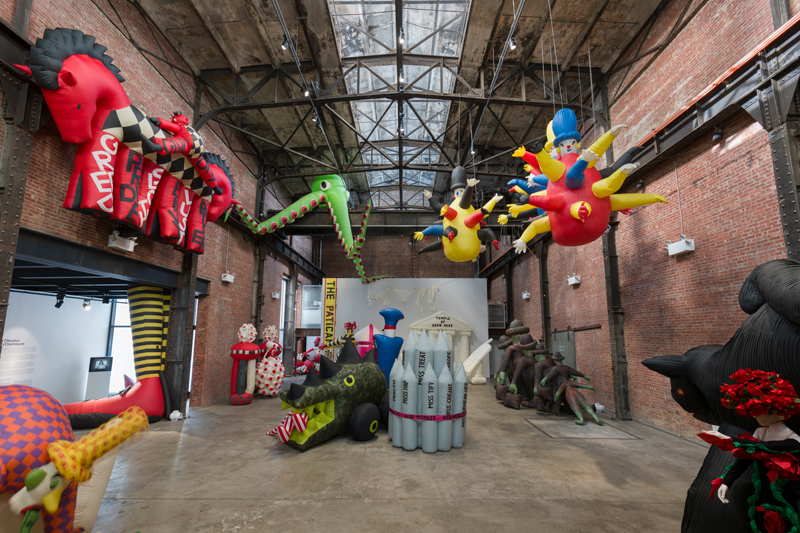
Pat Oleszko: Fool Disclosure, installation view. Courtesy SculptureCenter. Photo: Charles Benton. Pictured, center left: WarUSaurUs, 2007. Center right: Miss Ill Cluster, 2007.
Pat Oleszko: Fool Disclosure, curated by Sohrab Mohebbi and Jovanna Venegas, with Sharion X. Liu and research assistance by Ray Camp, SculptureCenter, 44–19 Purves Street, Long Island City, New York, through April 27, 2026
• • •
Pat Oleszko sure knows how to blow things out of proportion. For proof, look no further than the larger-than-life inflatable sculptures that fill the first rooms of Fool Disclosure, a glorious career survey at SculptureCenter that spans almost six decades of her exuberant work. A Perambulating Performance Artist and Hyper-Activist, not to mention a High Priestess of Puns, she has manufactured and presented so many personae in all manner of public spaces that one might think of her as Meryl Street.
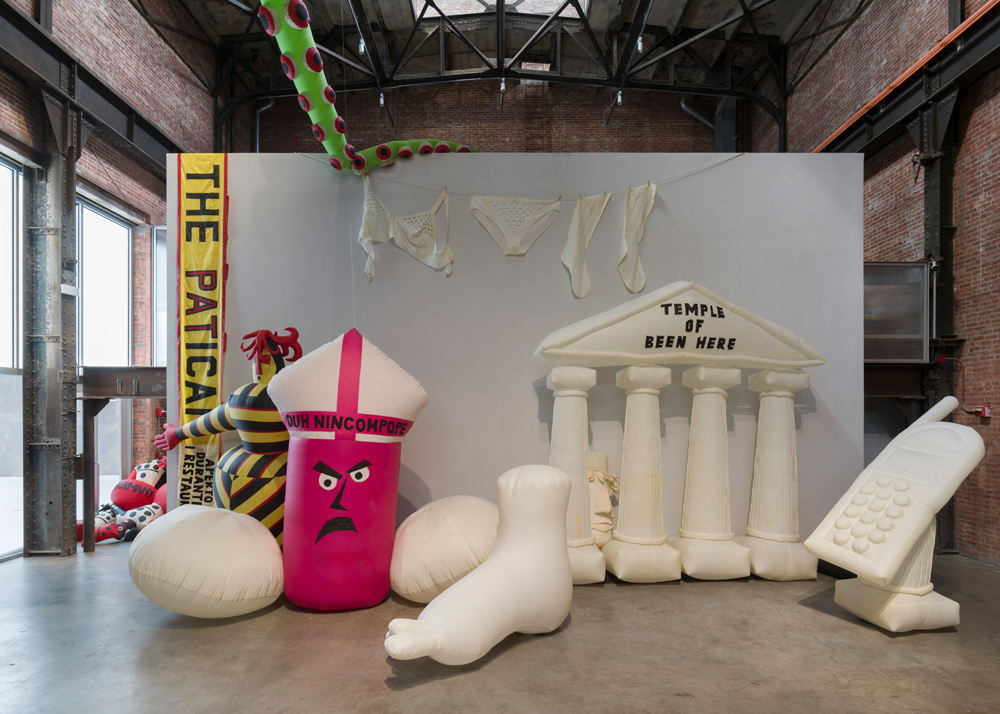
Pat Oleszko: Fool Disclosure, installation view. Courtesy SculptureCenter. Photo: Charles Benton. Pictured, center left: Duh Nincompope, 1999.
Her inflatables, which she began making in 1980, are in many ways the perfect metaphor for Oleszko’s lifelong project: to soften, and subvert, the presence of power, kept upright by—ah, the homophone—fans. See Miss Ill Cluster, a group of nylon bombs, and WarUSaurUs, a camouflage dragon (both 2007), which were made to stand against George W. Bush’s War on Terror; Duh Nincompope (1999) traveled with Oleszko to the Vatican, where she was arrested for blessing onlookers with holy water she shot out of a Super Soaker.
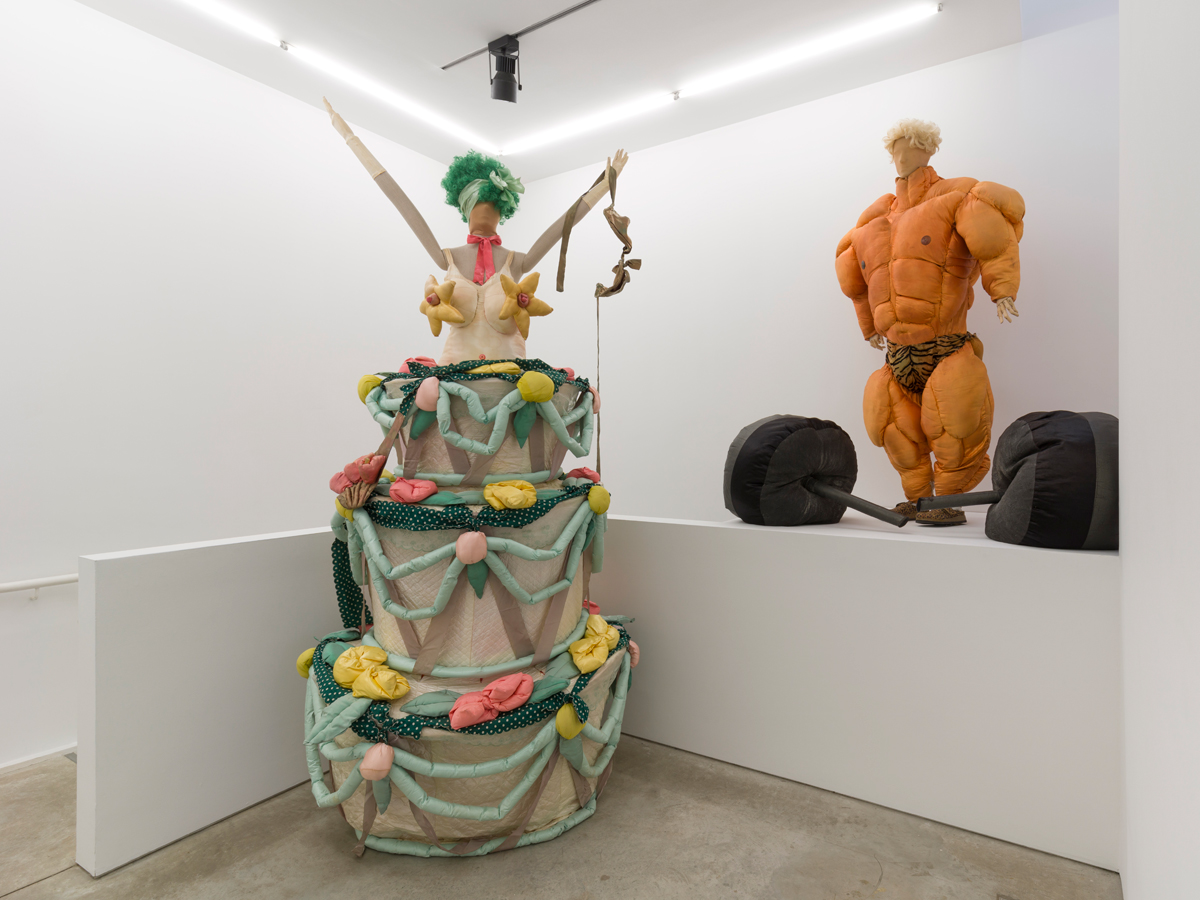
Pat Oleszko: Fool Disclosure, installation view. Courtesy SculptureCenter. Photo: Charles Benton. Pictured, left: Patty Cake, 1972. Right: Charles Patless, 1980; Barbells for Charles Patless, 1980.
Born in 1947, Oleszko studied sculpture as an undergraduate at the University of Michigan, Ann Arbor, but couldn’t figure out how to construct something that could stand on its own. So she put down the welding torch, plugged in her sewing machine, and, realizing that her six-foot-tall frame was her sturdiest and most reliable armature, began fabricating fantastic hybrid costume-sculptures that she wore in performances all over town. As Oleszko later recalled, “I worked parades, restaurants, beauty contests, films, magazines and wherever I saw a need to poke fun at seriousness ever resplendent.”
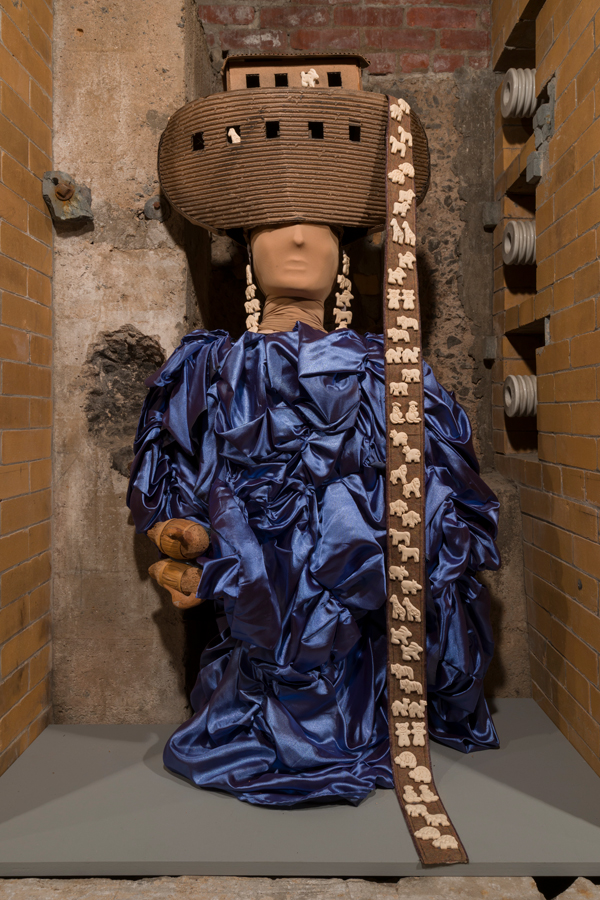
Pat Oleszko, Nora’s Ark, 2025. Felt, cardboard, animal crackers, fabric, and fake ducks. Courtesy the artist and David Peter Francis.
By the time she moved to New York in 1970, American artists had become terrifically adept at making spectacles of themselves. Those who were part of Judson Dance Theater and the Fluxus movement gleefully kept a certain gravity at bay. Robert Rauschenberg glided around on roller skates with a parachute on his back. Carolee Schneemann and her cohort wriggled around on the floor with raw meat. Cellist Charlotte Moorman once played while floating in the air, tied to a big balloon, and later performed with small televisions attached to her breasts at the behest of Nam June Paik. And so on. Such absurdity not only had the effect of rightsizing power and its hegemonic hold on artistic traditions, but also of rightsizing art and artists. Laughter laced these aesthetic experimentations with extra oxygen, levity, which appealed to those who, for example, found Minimalism a little heavy with machismo, Abstract Expressionism too po-faced and professional despite its feral appearances.
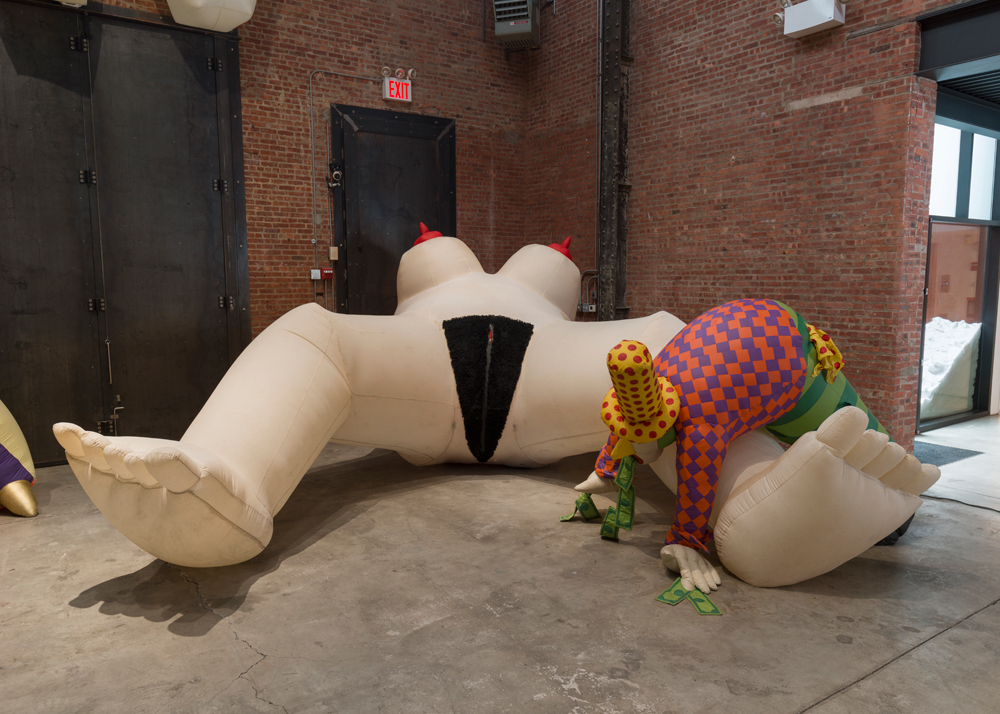
Pat Oleszko: Fool Disclosure, installation view. Courtesy SculptureCenter. Photo: Charles Benton. Pictured, center: Womb with a View (from Nora’s Art: P’at Too), 1990. Inside Womb with a View: Red Dick, 1993. Right: Mr. Green Jeans, 2000.
Oleszko and her peers—I count among them Mike Smith, Mike Kelley, Annie Sprinkle, Stephen Varble, and other beloved madcaps—wound their punch lines to hit a little differently than their predecessors. A generation raised on children’s television programs like Howdy Doody, variety and late-night shows featuring sets by hapless stand-ups—not to mention that excoriating genius of cultural comeuppance, MAD magazine—they sought to win (and lose) their audiences by deploying the forms and figures of popular culture as the means of protest and puncture.
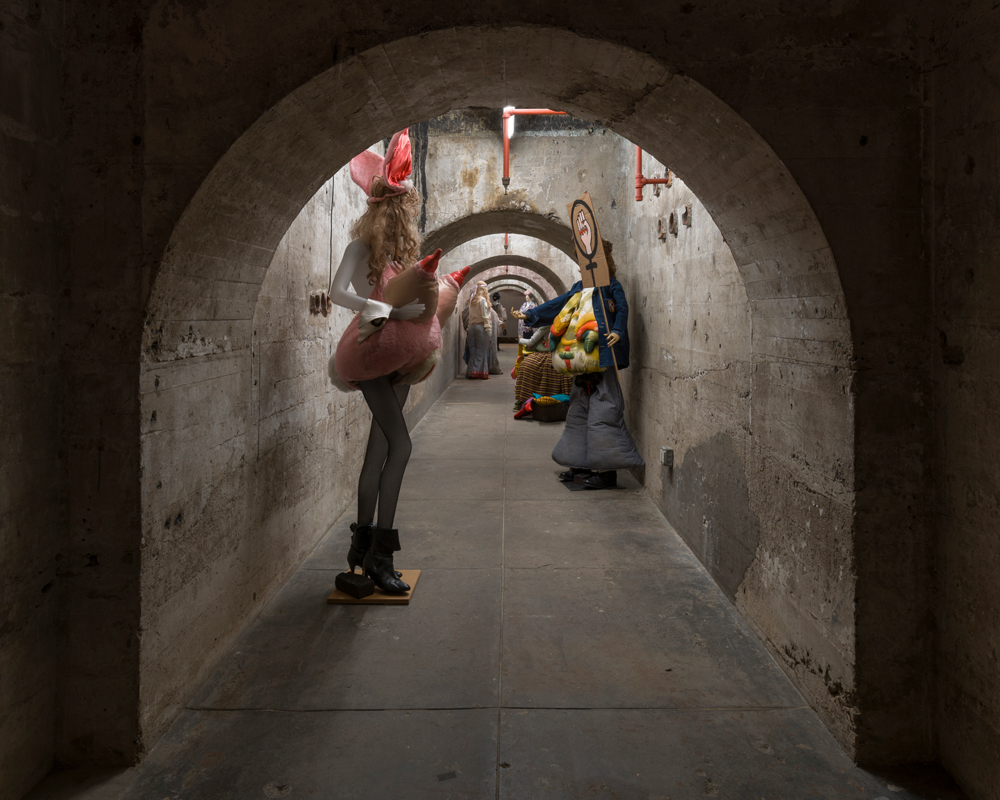
Pat Oleszko: Fool Disclosure, installation view. Courtesy SculptureCenter. Photo: Charles Benton. Pictured, center right: Women’s Libber, 1971.
From the get-go, Oleszko’s artillery was stacked with satire and a seemingly infinite supply of puns. For her 1971 exhibition at the Museum of Contemporary Crafts (now the Museum of Art and Design), she created Act Three: The New Yuck Women, nine costumes constructed of fabric and fiberfill that sent up various Big Apple archetypes. During the run of the show, she would put on one of her creations, then walk along the avenues in character, engaging with passersby. They’re here installed on the lower level of SculptureCenter, where visitors can inspect, say, the ping-pong-ball pearls of Oleszko’s Daughter of American Revolution, or ogle the sagging, tie-dyed cleavage of her Women’s Libber, or leer at the inappropriate outfit of Sally Sex-retary, for which the artist was once pulled off the street by cops, despite the fact that the ginormous tits beneath her sheer blouse were clearly, and magnificently, fake.
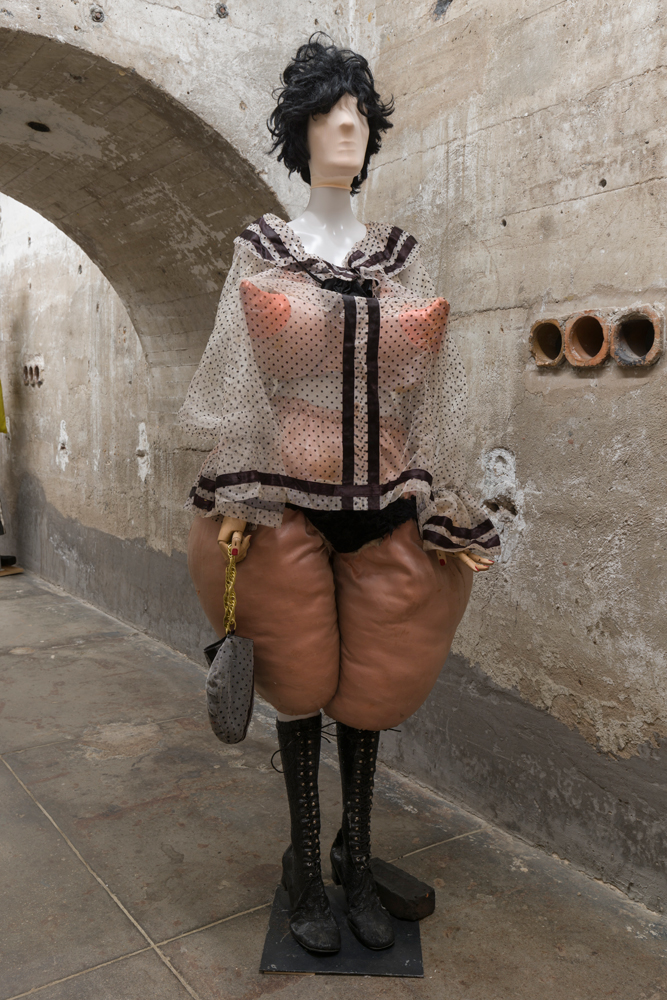
Pat Oleszko: Fool Disclosure, installation view. Courtesy SculptureCenter. Photo: Charles Benton. Pictured: Sally Sex-retary, 1971.
Part of what gives Oleszko’s practice its particular profundity is that she presents the female body as a site of playfulness, misbehavior, and endless delight. For millennia, women have digested images and stories of ourselves as the root causes, and carriers, of generational traumas stemming from violence, violation, and the persistent narration of such fates as though they were destinies. When recently asked what she was proudest of, Oleszko answered, “The fact that I can actually reach people in a way that is unprescribed. I can cause an effect that I know will make them think or make them remember, or, you know . . . I’m just aiming for genetic damage.” What a liberatory thought: that women also hold the power to reroute neural pathways now and for the future via insurgent spoofs, or incendiary wisecracks, or forceful acts of clowning around.
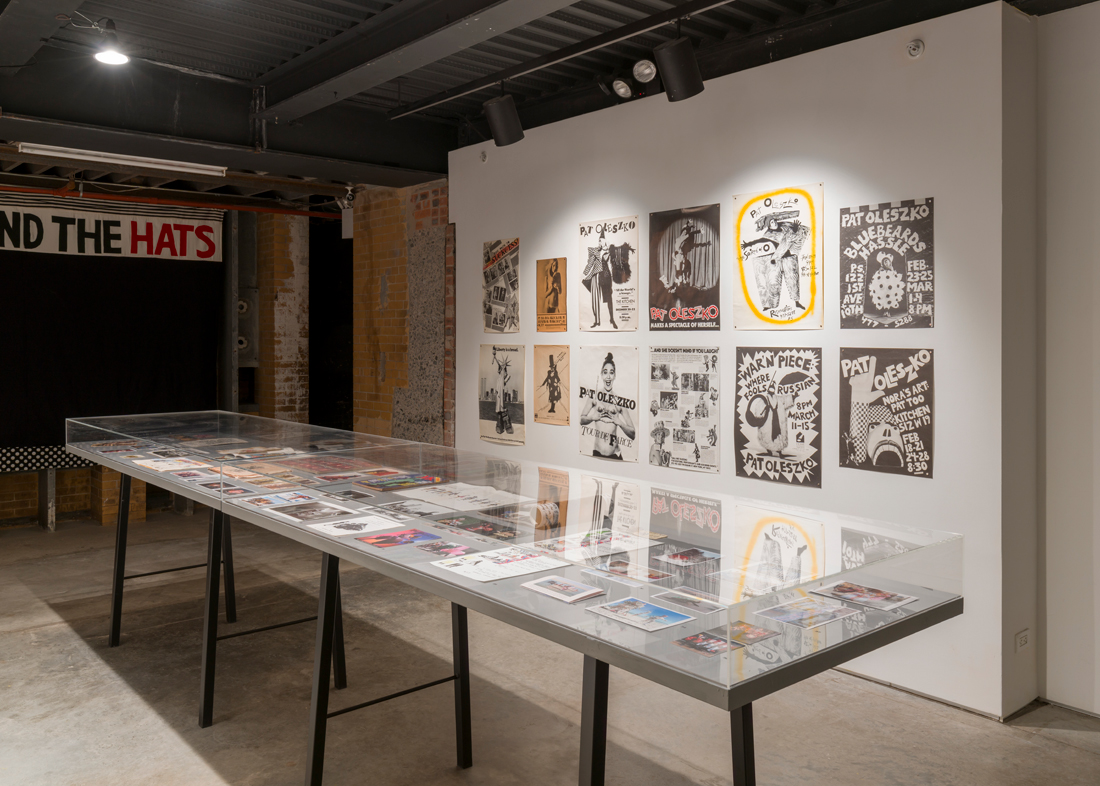
Pat Oleszko: Fool Disclosure, installation view. Courtesy SculptureCenter. Photo: Charles Benton.
Posters for performances with titles like All the World’s a Stooge, Tour de Farce, and War’n Piece: Where Fools Russian, presented at venues such as the Kitchen and PS122; a collection of hilarious hats, including one made of pine cones in the shape of a turkey, another a birdhouse built of Scrabble tiles, and a third featuring a small likeness of Trump sitting on a toilet; and still more and more costumes of wild characters and even wilder caricatures: Oleszko designs every single element of her projects for a laugh and a think. Yet, as is the case with all performance art, these things aren’t at their maximum charge without the artist present.
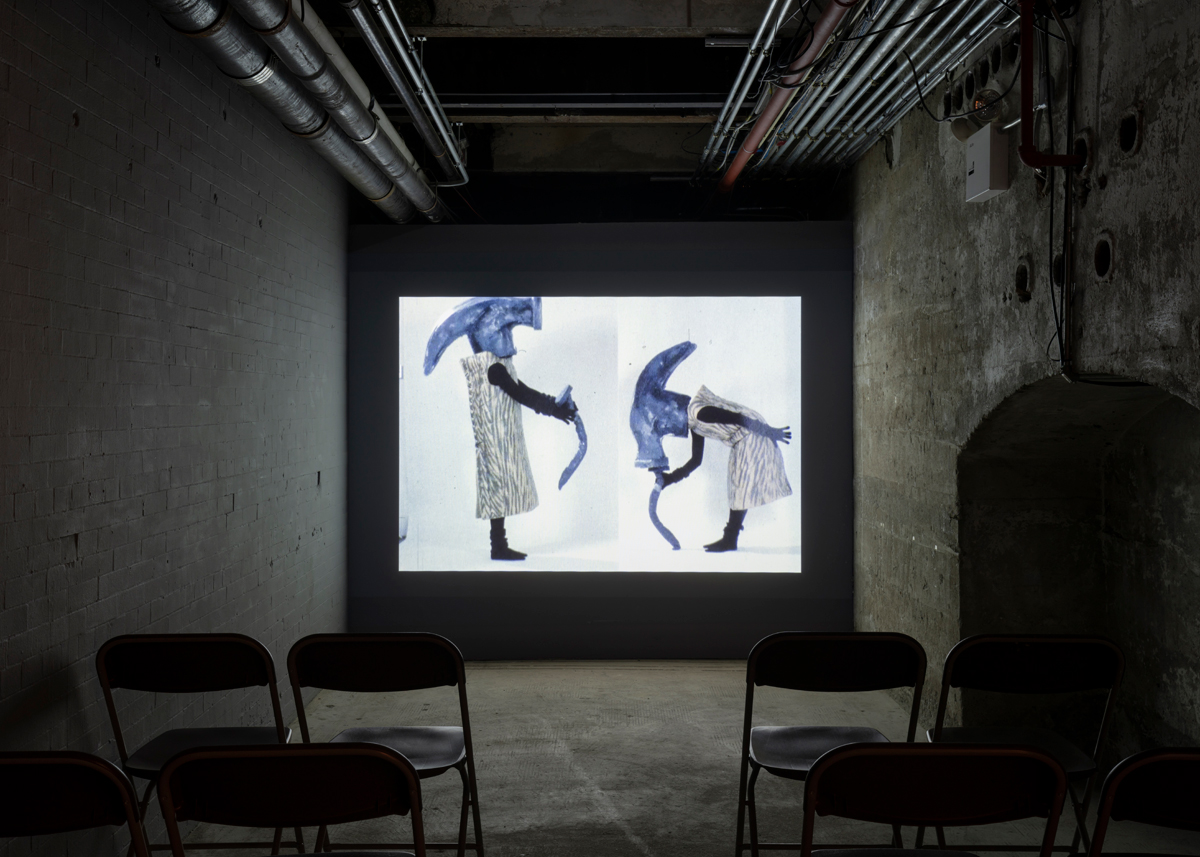
Pat Oleszko: Fool Disclosure, installation view. Courtesy SculptureCenter. Photo: Charles Benton. Pictured: Tool Jest, 1984.
In the SculptureCenter exhibition, her videos—each more offbeat and antic than the next—help convey the full impact of Oleszko’s prowess. Some document her performances, or were part of a live show, while others are pieces unto themselves. For her comitragedy Kneel and Dimples: Hon-Knee-Moon in Knee York (1979), the artist painted faces on her kneecaps and costumed her calves, one as a bride and the other a groom. Filmed from an ankle-eye view, the newlyweds have adventures on the mean streets, taking in a movie, the Statue of Liberty, and an exhibition of—what else?—“Kneorealism” before meeting their unfortunate end on a Coney Island beach. Not a Petty Slight (1986) launches with a meditation on John F. Kennedy’s famous gaffe “Ich bin ein Berliner,” later seeing the artist eat her way to freedom through a towering wall of jelly donuts. The Free Little Pig (1989) repurposes the classic fairy tale to tell a story of how greed turns a city hostile to those who simply want to make a home in it. But this is Oleszko’s world—a refuge from brutality, insanity—where no matter how bad the bad guys are, the joke is always on them.
Jennifer Krasinski is a writer, critic, and senior editor at Bidoun.