


 Eric Banks
Fellini, Fascism, and the last castrato: Martha Feldman’s study on Italian cultural politics weaves together opera and technology,
the sacred and the profane.
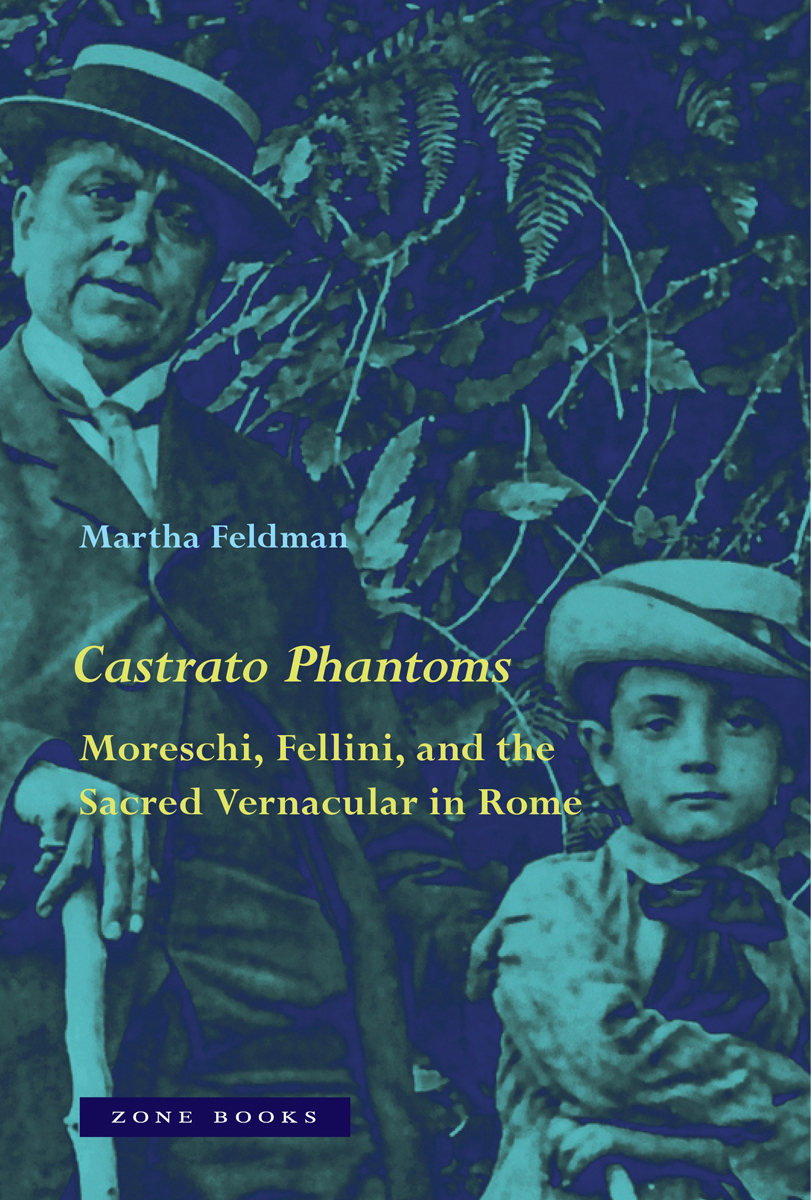
Castrato Phantoms: Moreschi, Fellini, and the Sacred Vernacular in Rome, by Martha Feldman, Zone Books, 479 pages, $38
• • •
Earlier this month in Rome, the faithful and the curious briefly thronged the typically low-traffic Basilica of San Lorenzo in Lucina, iPhones at the ready, aiming for a glimpse of an unexpected apparition: a fresco to which a self-taught restorer had appended the visage of extreme-right Prime Minister Giorgia Meloni on the winged body of a cherub. After the Vatican’s intervention, the addition was whited out, but not before the hybrid horror took flight and landed on any number of social-media platforms. Reflecting on the once-common Renaissance custom of painters incorporating images of rulers and patrons in their commissions, a scholar observed that “we are no longer used to seeing the faces of power appear in a sacred space.”
Setting aside the more obvious reasons why one might find the episode unsettling, are we really so surprised to see the holy and the all too earthly commingled and amplified by technology? This is Rome, after all, a place that can still seem drenched in the Felliniesque. His films reveled in moments in which all that was once sacred in Roman culture gets turned inside out in the modern city but never disappears. One thinks of the scene in La Dolce Vita when the journalist played by Marcello Mastroianni travels to the urban outskirts to cover a couple of children whose sighting of the Virgin is broadcast live to a rapt national audience. Or, more comically, to the movie’s iconic opening sequence, in which Mastroianni and his paparazzo wingman survey Rome by helicopter, hitting on the bemused, bikini-clad witnesses while trailing a second chopper toting a larger-than-life statue of Christ, which casts a literal shadow on the town below.
Fellini’s films, from his screwball debut, Lo sceicco bianco (The White Sheik, 1952), to his late rococo Casanova (1976), are at one end of a story that the musicologist Martha Feldman explores in Castrato Phantoms: Moreschi, Fellini, and the Sacred Vernacular in Rome. What gives her readings of Fellini their charge is the other end of her story: the life of Allesandro Moreschi (1858–1922), the “angelo di Roma” whose 1902 recordings by the sound engineers Fred and Will Gaisberg for the Gramophone and Typewriter Company (a Derridean name if there ever was one) represent the only disks ever made by a castrato, at the very moment the figure was becoming fully extinct.
Like Fellini’s flying Christ statue, castrati cast a long shadow over the development of opera. Castrated as boys, then trained to carry out the high-register vocalic gymnastics uniquely possible thanks to a developmentally arrested larynx and a set of (eventually) powerful, fully developed lungs, they were for many years the object of melophilic fascination (Mendelssohn meticulously described a castrato performance at the Sistine Chapel, which reminded him distastefully “very much of our old women at home in church”). Although intertwined with the birth of bel canto singing, they rapidly disappeared over the course of the nineteenth century. Feldman traces the steep decline in the production of castrati—a shadowy practice enabled by a quasi-official church network that often preyed on the very poorest in the small towns of Lazio—to the rise of the modern Italian state. “Nothing jangled against modernity more than those castrated men, whose treatment by the Roman church, especially as boys, cannot be entirely divorced from the church’s notorious treatment of boy acolytes, pupils, and choir boys all too familiar from the twentieth and twenty-first centuries.” Indeed, the twilight haunts of the castrati are not on the grand Italian and international stages but in sacred spaces—most notably in the Sistine Chapel choir, the final redoubt where a cadre of castrati lingered in their roles past the year of 1871, when the Papal States surrendered their political status in the Risorgimento. Only in 1903 would Pope Pius X’s motu proprio ban castrati in papal churches.
Moreschi thus lived his post-1903 years as an anachronism—a figure literally out of time—a walking (and singing) symbol of vanquished, atavistic Italy at the glittery moment of futurist fantasies and hypernationalist dreams. Feldman’s story of his years outside the cloistered Sistine world is fascinating. Embracing all the trappings of a solid bourgeois life in Rome, he wedded and became the good “adoptive father” to Giulio, born to his wife Guendalina not long after she married Moreschi (Giulio would also become a noteworthy performer and singing instructor). To her astonishment, Feldman discovered an actual family connection between the last castrato and Fellini: in 1944, Giulio’s daughter, Alessandra, married Federico’s brother Riccardo, himself a failed screenwriter who would haunt the “dream books” the director undertook in the 1960s at the suggestion of his psychoanalyst.
The history of opera and sacred music; the birth of recording technology; Italian cultural politics in the nascent moment of Fascism and in the time of postwar reckoning, especially in Fellini’s cinema; the unearthed story of family littered with episodes of failure, anger, and betrayal: Feldman’s narrative, or set of narratives, contains multitudes, as they say. She attempts to weave together all these strands as a kind of lipstick-traces history of myriad points of inflection where Moreschi the man and Moreschi the figure serve as phantom presences. It is a daunting task, and the path gets thorny in places. Yet for a text that at many points loses itself in a thicket of high-theory expository tics, including a thorny patch of fusty “hauntology studies” (flora rarely spotted in the wild in the past couple of decades), as well as some fairly imposing mountains of musicological analysis, it’s remarkably personal, almost intimate at times.
Feldman includes a great number of images—shots of material found in her archival research, grainy family photos, and even a picture of the now-shuttered Fellini pelletteria on via del Corso operated by her since-deceased elderly informants, Federico’s niece and her husband—and closes with a rather touching “Photo Essay” drawn from the Moreschi-Fellini Archive. As a kind of quixotic ghost story about an individual who remains (welcomely) enigmatic despite the many different contexts brought together in Castrato Phantoms, Feldman manages to bring to the page a complex picture of twentieth-century Italian cultural history reverberating with the specters of the past.
Feldman is especially interesting in asking what it means to consider Moreschi the “last” of the castrati, a man who finally outlives his art form but also one whose voice, thanks to the G and T recordings, has been rendered capable of endless iteration. “To perform in the glare of arc lamps while simultaneously meeting the demands of the microphone is a test performance of the highest order,” she quotes Walter Benjamin. “To accomplish it is to preserve one’s humanity.” What do the recordings reveal? An angelic, “unworldly” voice, as some of his contemporaries described? (Can an angel cast a shadow?) An aged and aging voice that by dint of history has become the castrati audio model? An unholy relic? I am still not quite sure how to describe what I hear when I listen to those ancient recordings online—though the remarkable benefit of Feldman’s ample and generous project is to sense that somehow the right answer can only be to choose all of the above and to be satisfied with all the contradictions that response entails.
Eric Banks is the director of the New York Institute for the Humanities at the NYPL. He is the former president of the National Book Critics Circle. He was previously editor-in-chief of Bookforum and a senior editor at Artforum.