


 Megan Milks
Jordy Rosenberg’s second novel, written from the point of view of a queerphobic mother, is equal parts reckoning and memorial,
plus pained, bitter laugh.
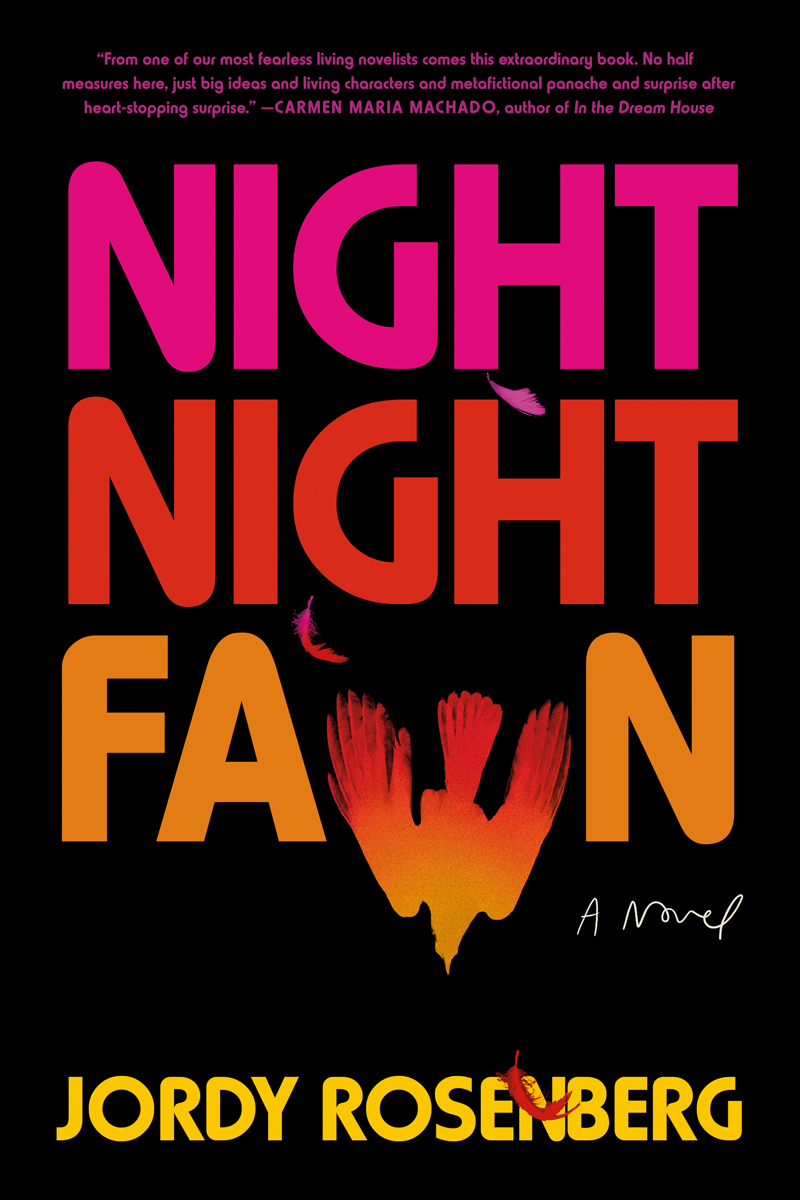
Night Night Fawn, by Jordy Rosenberg,
One World, 287 pages, $29
• • •
“Once you are a mother you become differently sized, and certain things can’t be helped,” observes Barbara, the narrator of Night Night Fawn, Jordy Rosenberg’s painfully brilliant new novel. It’s 1983, and she cannot permit her eleven-year-old daughter, Jordana, to show up to a family funeral wearing the corduroy blazer belonging to Jordana’s father. “I felt my own power radiating off me,” Barbara says. And although she may have an ambivalent relationship to this maternal power (“because while on the one hand as a mother you do become larger, you also become smaller”), she knows she can depend on it to produce the desired response. Jordana angrily removes the blazer and concedes to a black V-neck with pleated skirt. In this battle against encroaching queerness, Barbara has won.
That was then. In the present of the book, 2011, Barbara understands that it’s Jordana—now J.—who has all the power: “I’m wearing a diaper, after all.” Shriveled and weak from late-stage cancer, Barbara is living out her last days in the bedroom of her Upper East Side apartment, and J., after decades of estrangement, has returned home to act as her caretaker. But in the intervening years, an odd thing seems to have happened. Barbara’s daughter—“this offspring, this golem of upside-down gender”—appears to have turned into a bird. J.—or, more frequently now, “the bird”—is either some kind of monstrous bird-man, or Barbara is high on OxyContin . . . maybe both, and the book leans into this fuzziness. As an epithet, “the bird” offers language for Barbara’s misrecognition of J.’s transness while doubling as an escape hatch from her misgendering. It also introduces a darkly mysterious fabulist layer to the book.
Not since Jeannette Winterson’s memoir Why Be Happy When You Could Be Normal (2011) have I read such a blistering—or satisfying—indictment of a queerphobic parent. Rosenberg’s Night Night Fawn is all the more audacious for assuming that parent’s point of view. (As the author has made clear in a Q and A at the back of the advanced review copy, Barbara closely resembles and is named after his late mother.) The result is exultantly brazen, a zinger of a novel: equal parts reckoning and memorial and pained, bitter laugh.
Rosenberg is a scholar of eighteenth-century literature and gender and sexuality studies as well as a fiction writer, and his novel’s pleasures are enriched by the studied, historically grounded quality of his characters and style. Confessions of the Fox, his superb 2018 debut, relishes in the 1700s vernacular of his jailbreaking protagonist Jack Sheppard and the queer London underground, as well as the picaresques and “it-narratives” of the period’s literature. In Night Night Fawn, Rosenberg similarly delights in reconstructing the idiom of Brooklyn-born Barbara’s mid-twentieth-century milieu. The result is a caustically, rip-roaringly funny Jewish comic novel infused with seams of noir and Gothic horror.
Also like Confessions, this new book is, well, a confessional, and plays on its status as a textual artifact—in this case, a letter of apology that is spread throughout the book. If Barbara still can’t accept J., she’s canny enough to understand that she is dependent on them. And so, she is crafting this apology. “The doctors are telling me there’s no hope,” Barbara writes to J. “But you say there is hope in Marxism. So I, Barbara Rosenberg. . . . call on Karl Marx, god of impossible things. I am at the mercy of a monster. I must give it what it wants. My confession, my apology, my prayer.” As apologies go, Barbara’s is woefully inadequate, and only occasionally sincere; much of the comedy comes from how aggressively she sidesteps genuine self-reflection in favor of excusatory defensiveness.
The book is divided into five parts, with the confessional dispersed between them. The most substantial section, an autobiographical account titled “My Life, by Barbara Rosenberg” (a riff on Trotsky’s My Life), floats us back to her mother-in-law’s funeral in 1983: to the standoff over the corduroy blazer, and to a reacquaintance with Sugar Becker, an old high school friend whose comparative affluence has sent her life in a much different (better, Barbara thinks) direction. The funeral is an apt starting point for Barbara’s memoir, as it marks the beginning of the end of her relationships with both J. and, we soon learn (and for separate reasons), with Sugar. Plotwise, these twin estrangements make up the key conflicts of the novel.
The other conflict is between the two worldviews that clang together through Rosenberg’s layered perspective: while Barbara is the mouthpiece, Rosenberg’s presence, and through it, the shadow of J., are ever present and along for the ride. Barbara’s Zionism and queerphobia are simultaneously pitted against and refracted through J.’s (and the author’s) anti-Zionist queer utopianism. Who wins? There’s no contest, with Rosenberg wielding the power of the pen. But he gives Barbara her barbs, her outsize persona, and a developed social context. We learn that she grew up in Jewish Flatbush with limited means, then studied theater on scholarship at NYU before letting her performing aspirations die to take on the role of wife, mother, and assistant at a plastic surgeon’s office. “Understand that I balled up other people’s ass-grease paper for a living,” she tells us, “while my so-called daughter was learning to play Debussy uptown among the children of every single major royal family in exile.” Having invested in J. her income and hopes for class mobility, she resents the lack of return.
This book about Barbara’s abuse of maternal power is also about the relationship between normalized bigotry and state oppression. One of the most uproarious scenes sees Barbara giving her then-boyfriend and soon-to-be-husband Stephen a hand job at a screening of Exodus in a Flatbush movie theater. Still panting after she gets him off, Stephen proposes marriage—and thus is Jewish futurity ensured, Rosenberg satirically implies, presided over by Zionist propaganda. When their child arrives, Jordana is named after a character in the film.
To ventriloquize one’s parent is a bold move, and fictitious Barbara would absolutely read it as a betrayal. At the same time, it’s an intimate gesture to hold someone so close. Rosenberg’s affection for this character and her sharply observant, often brutally frank voice is evident, and he frequently plays the clashing perspectives for laughs. Take Barbara’s obsession with J.’s “lesbianism”: Was J., she wonders, when at piano lessons as a child, “having some kind of finger orgasm from the contact with this, now that I thought about it, suspicious-looking piano woman in the middle of a recital?”
The book’s knowing humor salves her cruelty’s sting without exonerating it. When “the bird” delivers her to the hospital for medical visits, Barbara expects them to wait for her in the parking lot; “neither of us needed to explain why.” And she tells J. point-blank, after they have taken on the thankless role of caretaker: “You’re the biggest mistake of my life.” These moments of rejection stick in the novel’s doubled throat.
The disappointment is mutual. “I understand that to people of today I sound like a monster, but this was a motherly concern I had,” Barbara explains, trying to justify her repudiation of J.’s sexuality and gender expression. “I felt a fear for her, an unspeakable terror for her life. . . . Gay people are very lonely people.” But in the end, Rosenberg makes clear, it’s Barbara who is the most alone. With vengeful compassion and furious grief, Night Night Fawn puts her to bed.
Megan Milks is the author of the novel Margaret and the Mystery of the Missing Body, finalist for a 2022 Lambda Literary Award, and Slug and Other Stories. Their new book Mega Milk: Essays is out now.