


 Eric Banks
In the late poet Keith Waldrop’s fictional memoir, gentle humor and a powerful afterglow of melancholy and loss.
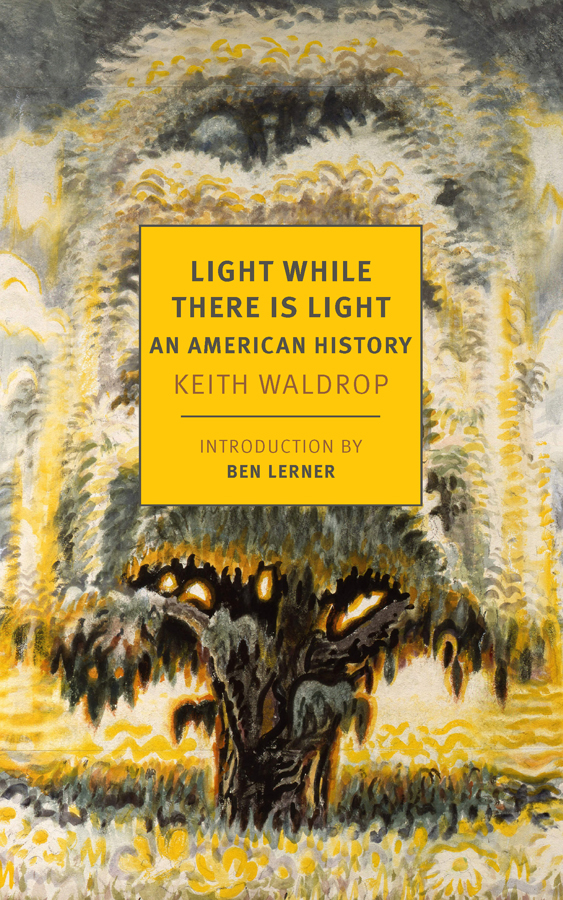
Light While There Is Light, by Keith Waldrop,
New York Review Books, 201 pages, $16.95
• • •
In his beguiling family story Light While There Is Light, Keith Waldrop writes, “Some people start reading—reading seriously—when they have religious doubts, and from that day on, they reject what they read as heresy or take it as gospel and swallow it whole. Others flee into books from the doldrums; henceforward they open to any page, plunging into adventure.” His family, while short on doubt, is a bit of both types, his brothers having an unquenchable thirst for escapades, his hard-shell evangelical mother obsessed with the Holy Word. Waldrop (1932–2023) pictures her in small-town Kansas, not long before she uproots her clan to relocate to even smaller-town North Carolina, where a Bible college promising better marrying material for his sister Elaine beckons. “So when Sunday morning came around, or Sunday night, or Wednesday night, my mother would cease from her moanings, comb her hair, put on her best, and she and Elaine and I would hasten to South and Commercial for some a cappella praise, some middling preaching and, with luck, a breath of ecstasy. As long as she was there, among the saints, her life seemed clear and meaningful. Outside, in the world, she was a complex of miseries that I am still not sure I can quite sort out. ‘My heart,’ she would say, finger to her throat, but it stood for a whole existence.”
Waldrop’s lovely, unclassifiable chronicle—he preferred the title “fictional memoir” for it, and the Library of Congress opts for “autobiographical fiction,” but it is manifestly drenched in the worldly facts and tangibility of his upbringing—is a record of his family’s questful peregrinations, powerfully reserved in its telling and quietly humorous in its observations. It’s a curious and compassionate portrait of a family in middle America at mid-century and the marginalized landscape they inhabit, part Tobacco Road, part Wise Blood, a vista of revival services and jailhouse ministries, Holy Rollers and small-time schemers, faith healers, cranks, and down-and-outers, not least his brothers, Charles and Julian, who put in time after the Army in consumer fraud, a dubious West Coast evangelical outfit, and the stockades at Leavenworth. Everyone here, no matter how grounded, seems possessed of a touch of the unworldly: “For us, God’s sphere of action and the local scene rarely make contact, separated by the patrol of cyclonic storms marshaled overhead by the great westerlies, or directed—we disagree on terminology—by the Prince of those powers. Once in a while, however, a spark manages to pass from one sphere to the other.”
The little sparks illuminate Light While There Is Light. There are flashes both comic and violent. At the North Carolina Bible college, where a dilapidated sign advertises “SHARON COLLEGE—A GOOD CHRISTIAN EDUCATION,” Waldrop’s brothers take up chicken farming by raising chicks in a disused latrine before moving the growing concern to their lodgings—where the little butterballs peck for twenty-four hours a day and cover the floor in a thin yellow film (after they donate the birds to the half-wit neighbor, Chigger, he kills them one by one). Later, in Urbana, Illinois, Waldrop begins his desultory studies. (He recounts a seminar on Henry James led by “a woman of great age and strength of mind, whose method of teaching was to abstract, precisely and sarcastically, the more important criticism of the novel we were reading, consigning it all, mercilessly, to the realm of error.”) Soon the family is reunited around the lot of secondhand jalopies Waldrop opens and operates on the side under the name Used Car Heaven, with his extended family taking up residence on the adjacent floors, their flimsy living quarters separated by curtains, with a single potbelly stove providing a modicum of warmth. Waldrop eventually makes his escape to France; his mother and a sibling linger to establish a decrepit fruit stand, the watermelons and tomatoes rotting away inside, with pages clipped from the Voices of Healing magazine pinned to the walls.
“I have always wondered what worlds are possible,” Waldrop writes. “Others have asked, of course, but I mean it, not as a logical, but as a practical question. People around me seem always to believe—more fervently the more desperate they are—that there is some means, plain or occult, by which to get whatever is most precious in life.” Light While There Is Light is an account of the author’s sentimental education, or sorts: what makes it so cunning is that it largely forgoes an outline of his own aesthetic formation (Waldrop went on to become a celebrated translator and poet—his 2009 collection Transcendental Studies receiving the National Book Award—and a revered mentor to generations at Brown). It focuses instead on the way his family’s quixotic drive imbues his own quest for meaning. Part of what makes the book so difficult to categorize—and so alive in the reading—is the oddly episodic nature of Waldrop’s narration, which skips and jumps with the peripatetic journeys of his family—here Atlanta (“the quack capitol of the South”), there Miracle Valley, Arizona (which could give Atlanta a run for its money). His brothers and sister and her preacher husband pop on and off the scene and on and off the page, dispersing as families are wont to do over time, then reassembling with their enigmatic pasts, each of them gravitating to one degree or another around their mother’s pull.
There is a strangely disjointed aspect to Waldrop’s memories, and, for all the humor of his recollections, a powerful afterglow of melancholy, of loss, runs throughout. The pages are peppered with ghostly black-and-white family photographs—the most striking being Julian and Charles, in an oddball getup of top hat and tails, luring passersby to Used Car Heaven. In another, his mother, nearing her end, alarmingly shields her face with her hands. You wonder what’s going on in the image. Maybe she’s just doesn’t want her picture taken. Or maybe the light is too bright for her eyes?
Light While There Is Light has gone through three iterations. First published by Sun and Moon in 1993, then Dalkey Archive Press in 2013, it is now fittingly reissued three years after Waldrop’s death by New York Review Classics, the same enigmatic title gracing its cover. Close to the end of his book, Waldrop writes, “I remember, for some reason, a film I once saw, in which sequences resembling old, contrasty photographs faded, not into darkness like the usual fade, but into a bright white empty screen, so that the story seemed sketched in elaborate shadows against a field of perpetual light—shining now through the picture, illuminating them, and now supplanting them, shining on its own.” In this strange little gem, Waldrop captures that shining light and the shadows it illuminates with a powerful and understated magnificence.
Eric Banks is the director of the New York Institute for the Humanities at the NYPL. He is the former president of the National Book Critics Circle. He was previously editor-in-chief of Bookforum and a senior editor at Artforum.