


 Jennifer Krasinski
Closer to the heavens: nearly one hundred architectural plans and drawings from a period when attention was directed upward and beyond the stone.
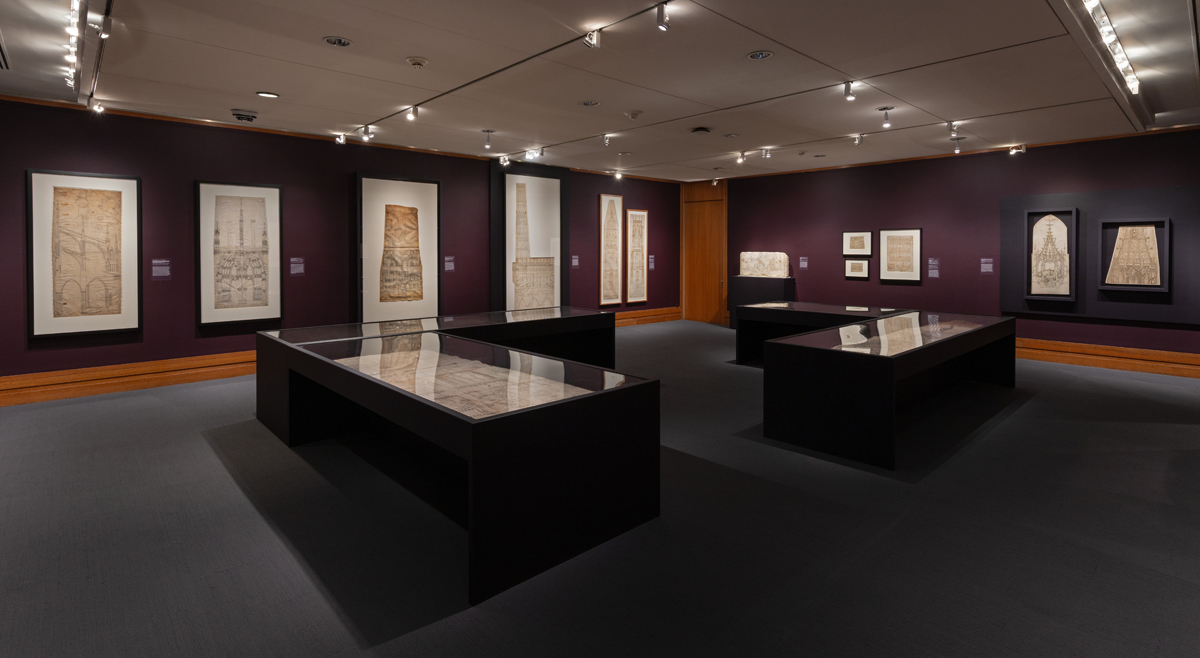
Gothic By Design: The Dawn of Architectural Draftsmanship, installation view. Courtesy Metropolitan Museum of Art. Photo: Eugenia Burnett Tinsley.
Gothic By Design: The Dawn of Architectural Draftsmanship, curated by Femke Speelberg, The Metropolitan Museum of Art, 1000 Fifth Avenue, New York City, through July 19 , 2026
• • •
In 1144, Robert de Mont-Saint-Michel, a Norman abbot and chronicler of his times, observed the collective spirit in which the Gothic style, then springing up all over Western Europe, was received. “In that year were to be seen for the first time at Chartres the faithful harnessed to carts, laden with stones, timbers, corn and whatever might be needed for the work of building the cathedral, the towers of which rose like magic into the heavens. . . .Everywhere men humbled themselves, did penance, and forgave their enemies. Men and women could be seen dragging heavy loads through mire and marsh, praising in song the miracle which God was performing before their eyes.” One can forgive them for thanking the Almighty rather than the architects for these wondrous structures. Just looking at the drawings and etchings featured in the Metropolitan Museum’s Gothic By Design: The Dawn of Architectural Draftsmanship left me genuinely awestruck, thinking that human ingenuity, and virtuosity of craft, might be as close as we ever get to godliness.
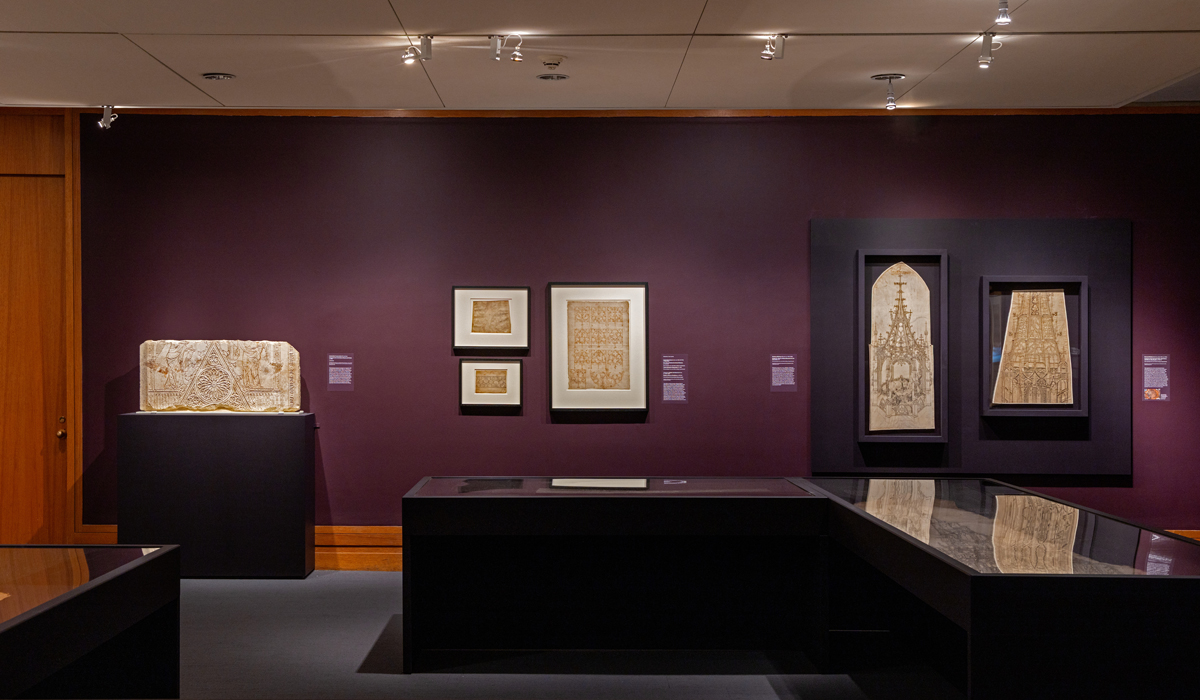
Gothic By Design: The Dawn of Architectural Draftsmanship, installation view. Courtesy Metropolitan Museum of Art. Photo: Eugenia Burnett Tinsley.
The technical plans, proposals, and elevations on view in this stellar show are some of the earliest surviving, dating from that time during which design was pushed to the fore of the process, and therefore an architect’s vision had to be rendered precisely, made legible for stonemasons, builders, and clients alike. Only six hundred or so such works from this era are known (the earliest was made around 1250); ninety are on display here, and the exhibition, curated by Femke Speelberg across three modestly sized rooms, is top form: tightly focused, unrepentantly scholarly, calling attention to what is rare, or rarified, or has been relegated to the archives, muscling new, meaningful space into the art historical record.
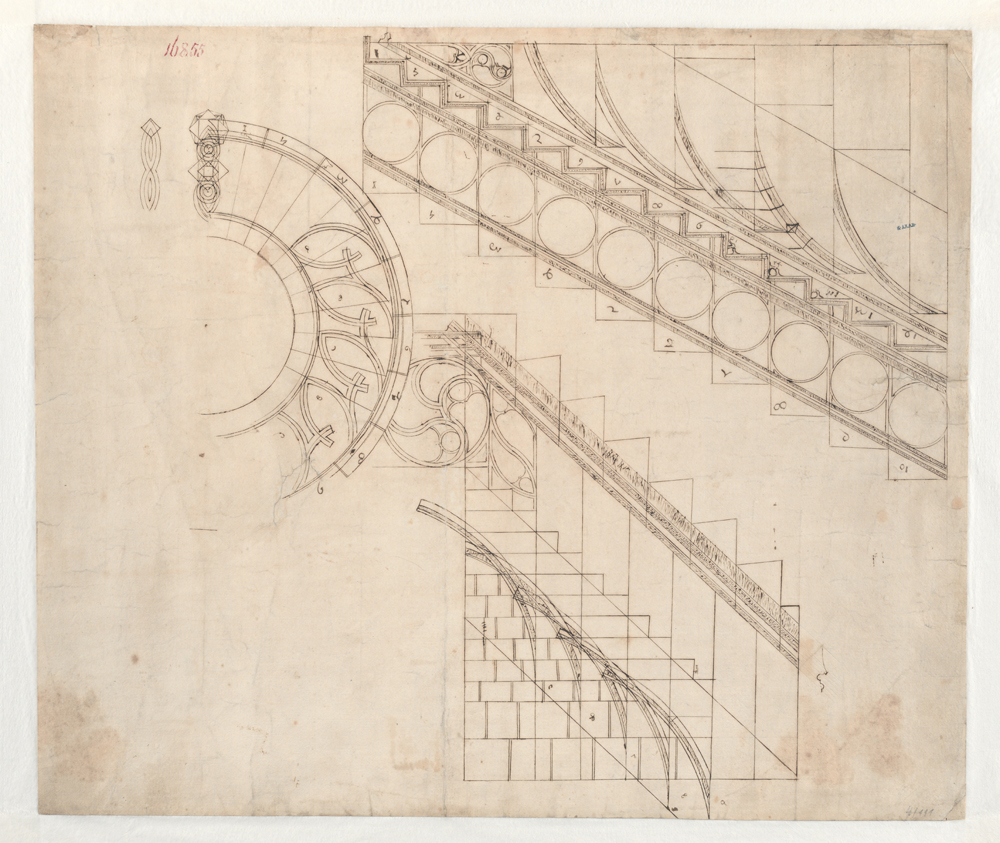
After Anton Pilgram, Elevation, Section, and Floor Plan for the Stairs to the Pulpit, Stephansdom (Saint Stephen’s Cathedral), Vienna, ca. 1515. Pen and brown ink, over blind ruling with stylus, guided by compass and straightedge, on paper. Courtesy Metropolitan Museum of Art.
Spanning the early thirteenth to the sixteenth century, Gothic architecture can still drop a jaw faster than that of almost any other era. It looks, in a word, impossible, defiant of gravity. Prior to its appearance, the European landscape was dominated by Romanesque structures, which were heavy, fortresslike, with round, sensible arches, all conveying a sense of impenetrability, protection, and the everlasting. Architects of the Gothic era refined rib vaulting to shift weight-bearing duties from walls to comparatively delicate columns, which allowed a ceiling to soar that much closer to the heavens. Pointed arches made room for more and larger windows with elaborate traceries, filling churches and cathedrals and abbeys with light and color. Attention was directed ever upward and beyond the stone.
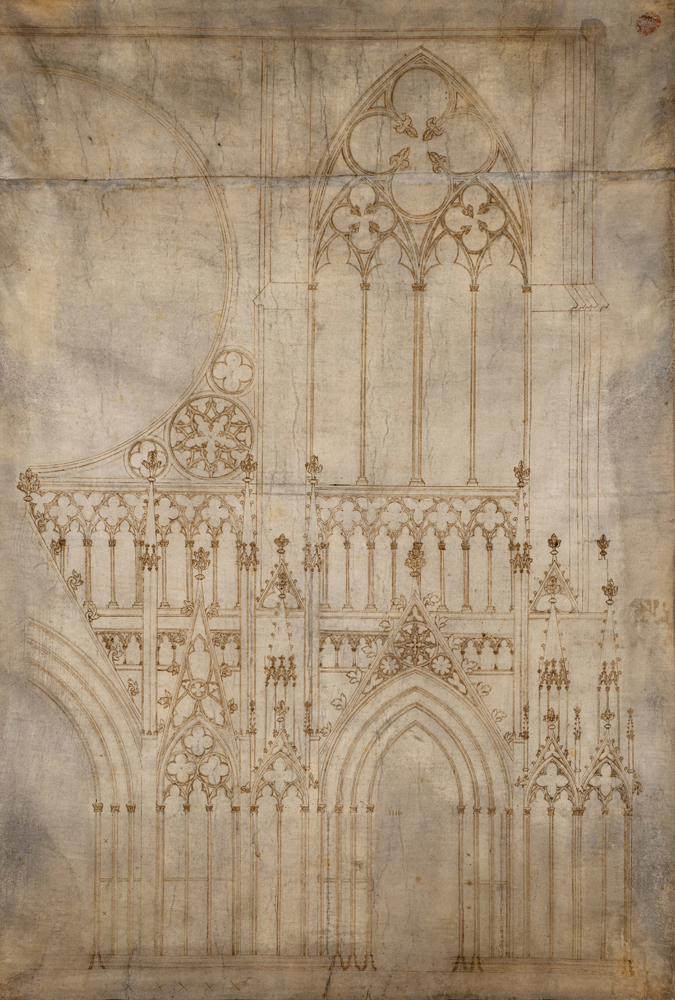
Attributed to Erwin von Steinbach, Partial Elevation of the Facade of Strasbourg Cathedral (Drawing A’), ca. 1260–70. Pen and brown ink on parchment. Courtesy Metropolitan Museum of Art.
Given the dauntingly detailed visions these drawings had to convey, it’s unsurprising how large some of them are. (Many are stained, warped, and torn, proof that these were working documents, now works of art.) One, Partial Elevation of the Facade of Strasbourg Cathedral with its North Tower (Drawing B’) (ca. 1278–1300), is approximately ten feet long and more than two feet wide, rendered in ink with such fineness of line that one could almost mistake it for a photograph that’s been given an acid bath, though that wouldn’t distill the building’s elements as succinctly. The drawing table offered architects a place to conceive and test ideas away from their building sites (now common practice). The practical matters of engineering could be set aside, at least for a moment, to allow for fresh approaches and ideas, a bit of experimentation, even a certain amount of indulgence. It also resulted in breathtaking feats of draftsmanship. An eye might get tangled for days in the many renderings of ornamental flourishes, quatrefoils and other floral motifs and carvings for around the columns, not to mention elaborate designs for croziers, censers, monstrances, all sporting architectural elements as though each could be its own place of worship.
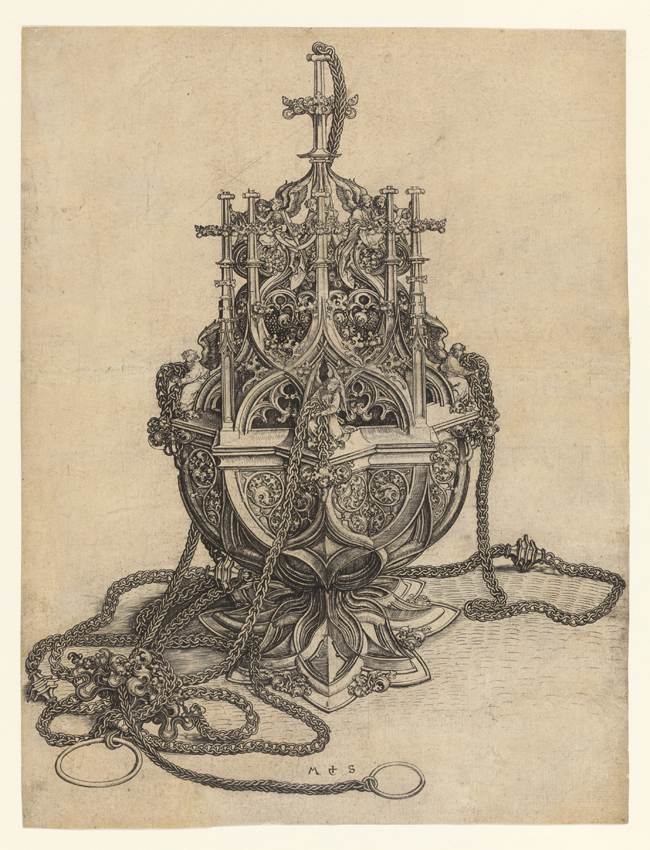
Martin Schongauer, The Censer, 1470–91. Courtesy Metropolitan Museum of Art.
It is unknown whether The Censer (1470–91), Martin Schongauer’s near-labyrinthine engraving of an incense burner, was an imagined object or copied from life. Either way, it’s a showstopper. Note how the links of its three chains—cascading down to the ground from the arms of three teensy figures who look like they can barely keep hold of them—are each a little out of line, meticulously kinked. One might wonder if, when creating something to honor the Creator (and, one assumes, a wealthy patron), an artist might choose to walk that razor’s edge between reverence and rivalry, sometimes opting to perfect imperfection. Via floor plans and studies, the exhibition also makes clear the principles of Gothic design that were less dramatic, more systematic and mathematic. The information they contain was relayed over centuries between masters and their apprentices rather than learned from manifestos or staunch directives. In a sense, the Gothic was an oral tradition, as rooted in language as it was in image—a perfect (ahem) expression of the same faith it sought to inspire.
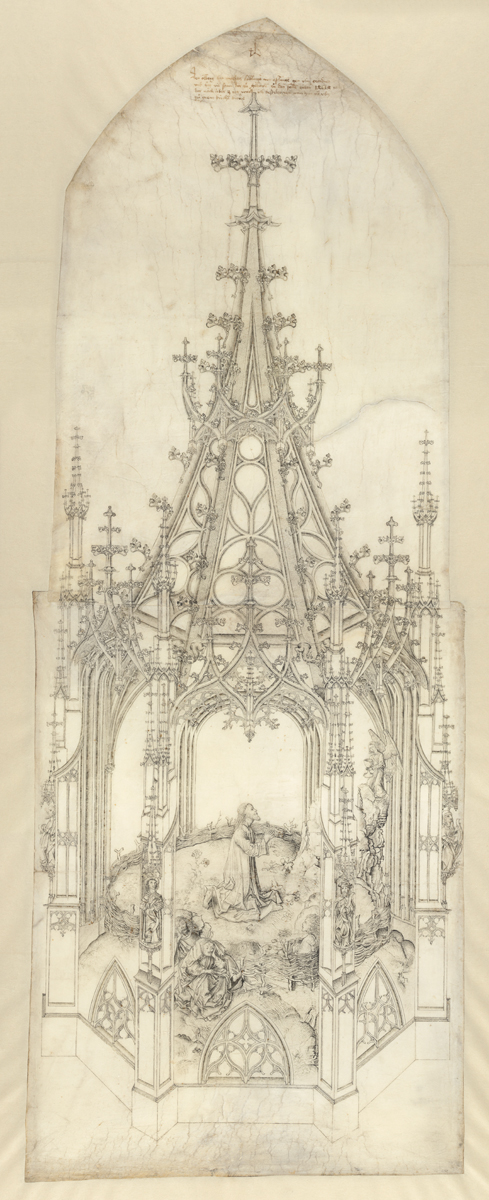
Matthäus Böblinger, Design for a Mount of Olives Monument for the City of Ulm, 1474. Pen and black ink, over blind ruling with stylus, guided by compass, on parchment. Courtesy Metropolitan Museum of Art.
What perhaps caught my eye most of all were the ways in which architects wove the living in with the stones, positioning a wee creature or suffering saint or noble pontiff somewhere atop a column, other times staging a scene. Why would this be so interesting? Matthäus Böblinger’s Design for a Mount of Olives Monument for the City of Ulm (1474) places Christ praying at the center, below arches and a jewellike spire. Two older figures—a man and a woman—sit nearby, utterly bored, possibly crabby, he likely drifting off to sleep. The woman’s voluminous robes resemble sheared rock from which her head, propped up by her hand, might tumble down any moment. By contrast, Christ is kneeling, perhaps rising, his gown elegantly falling around him, pooling at his feet, which gives him the presence of one between this world and the next. The scene is set as though Böblinger knows that there is nothing divine that isn’t human first. At least, that’s what I believe.
Jennifer Krasinski is a writer, critic, and senior editor at Bidoun.