


 Leslie Camhi
The Barnes Foundation presents an exhibition of fifty-five transportive paintings by the visionary artist who explored borders
and what lay beyond them.
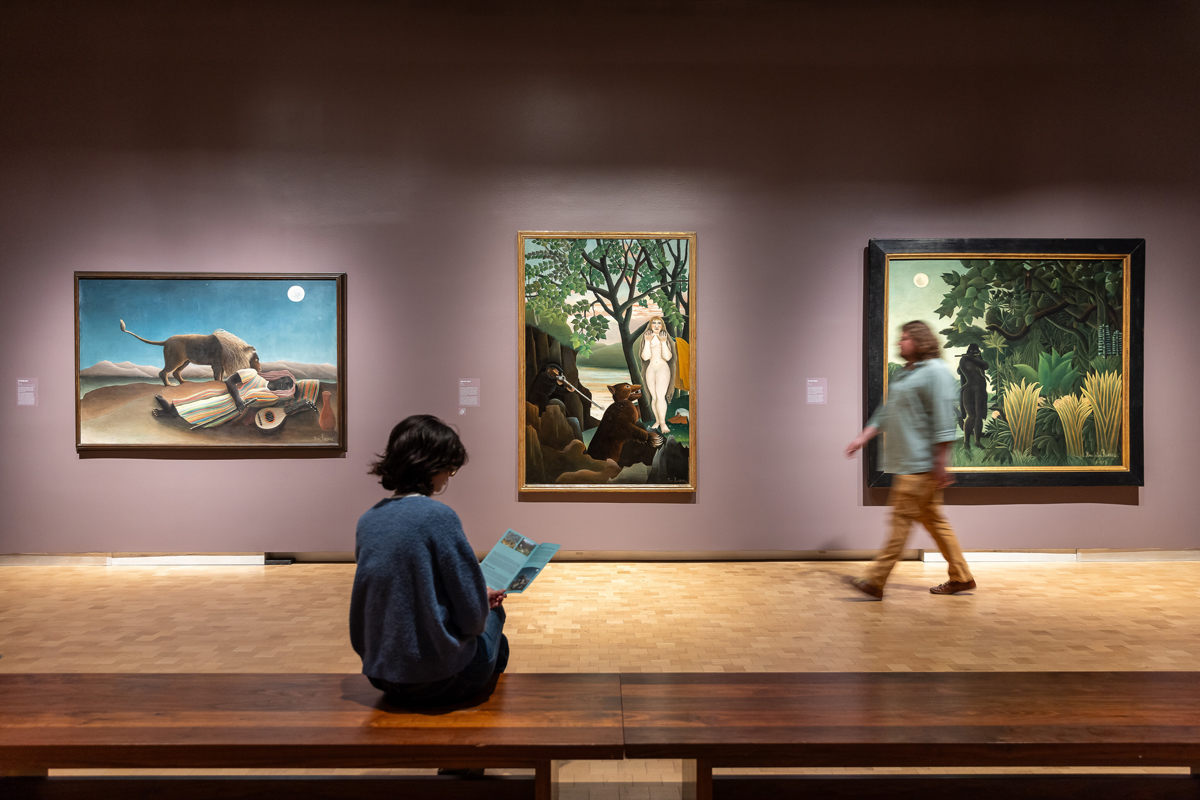
Henri Rousseau: A Painter’s Secrets, installation view. Courtesy the Barnes Foundation. © Barnes Foundation. Pictured, left: The Sleeping Gypsy, 1897.
Henri Rousseau: A Painter’s Secrets, curated by Christopher Green and Nancy Ireson with Juliette Degennes, Barnes Foundation, 2025 Benjamin Franklin Parkway, Philadelphia, through February 22, 2026
• • •
Though self-taught and long celebrated as a “primitive” artist, Henri Rousseau, the beloved Postimpressionist painter of dreamlike fantasies, was no simpleton. Iconic works, such as his 1897 The Sleeping Gypsy (which Alfred H. Barr Jr., who acquired it for MoMA in 1939, deemed “one of the most remarkable canvases of the nineteenth century”), render a scene with crystalline clarity yet remain profoundly mysterious.
The poet Jean Cocteau, sensing, perhaps, a kindred visionary, described the painting when it came up for auction in 1926, two years after it had been spotted in the private collection of a charcoal merchant (had the impoverished, elderly artist traded it for warmth?), and sixteen years after Rousseau’s death, when his work’s market value was at last ascendant. “We are in the desert,” Cocteau wrote. “The gypsy lying in the middle ground is lost in dream, or has been carried away by a dream, so far away—like the river in the background—that a lion behind her sniffs at her without being able to reach her. . . . How to describe this motionless, flowing figure, this river of forgetfulness?”
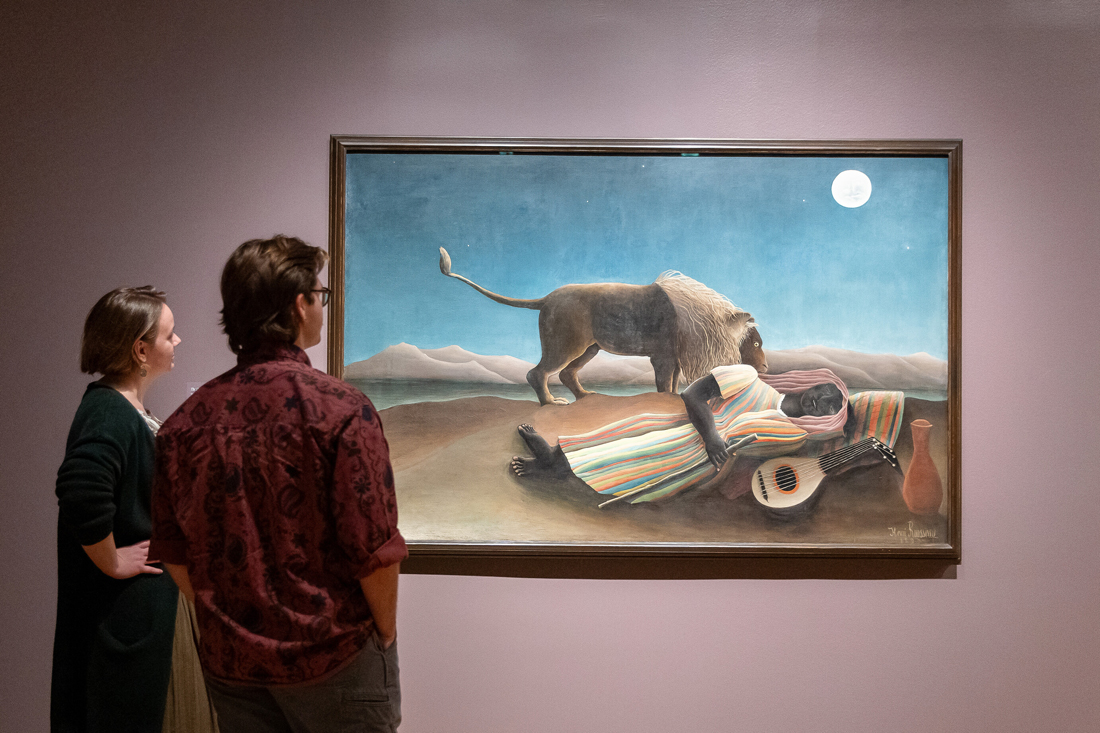
Henri Rousseau: A Painter’s Secrets, installation view. Courtesy the Barnes Foundation. © Barnes Foundation. Pictured: The Sleeping Gypsy, 1897.
I recently traveled from my home in New York City to Philadelphia, seeking, like Cocteau, a bit of forgetfulness—a momentary escape from both our current national nightmare and a deepening personal crisis. The Sleeping Gypsy is on view there, along with fifty-four other paintings by Rousseau (including rare loans), in an exhibition co-organized by the Barnes Foundation and the Musée de l’Orangerie in Paris, where the show will open next month.
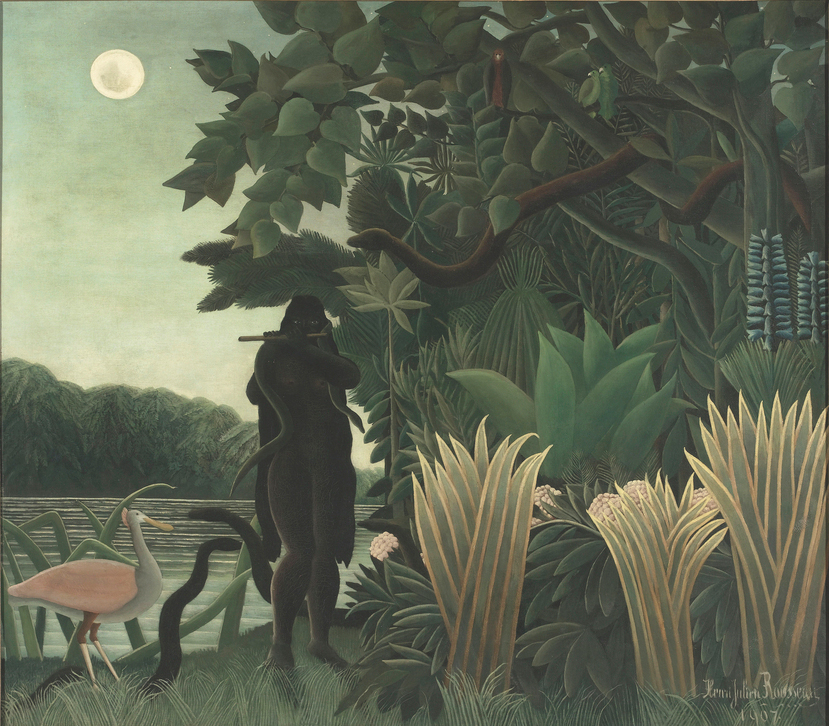
Henri Rousseau, The Snake Charmer, 1907. Courtesy the Musée d’Orsay.
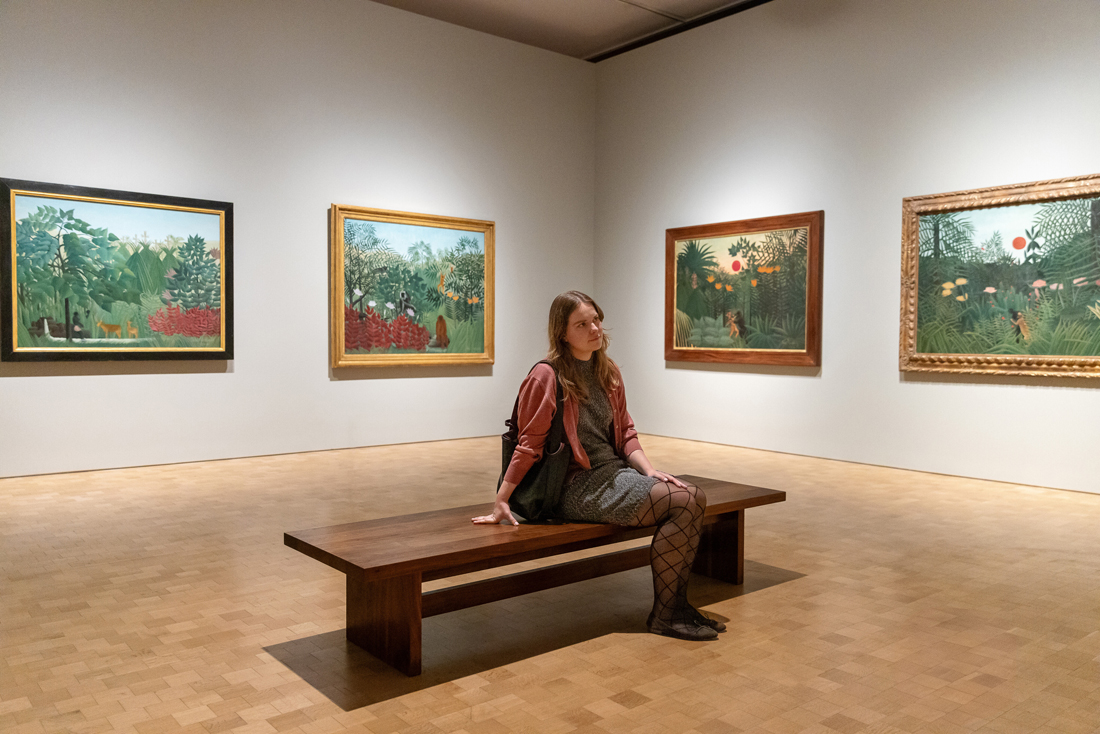
I counted on Rousseau’s images of mysterious figures walking in moonlit winter forests, on his portraits of uncannily solemn children and statuesque, larger-than-life women in mutton-sleeved dresses, and, above all, on his marvelously vivid jungle landscapes, with their gigantic vegetation never seen in nature and their delightfully unnerving beasts, to transport me.
And they did. But the exhibition also tells the story of a painter who, though remote from our own era, remains eminently relatable. Born into humble circumstances, Rousseau’s career as an artist was not laid out for him in advance. He came late to painting and afterward struggled constantly with poverty, debt, and the loss of those closest to him.
Henri Rousseau: A Painter’s Secrets, installation view. Courtesy the Barnes Foundation. © Barnes Foundation.
He revered nineteenth-century academic painters and aimed (improbably, given his lack of training) for conventional success and state commissions, yet found himself exhibiting by necessity alongside avant-garde artists forty years his junior, who were among his work’s earliest champions. One wild night in 1908, Picasso famously threw a raucous banquet in honor of Rousseau, who sat “enthroned” in a chair placed upon a crate while the wax from a Chinese lantern dripped on his head. (And though he pursued painting with dogged seriousness, his enthusiastic amateurism took other forms; he played the violin, wrote plays, and held musical and artistic soirees in his one-room Paris apartment, where neighborhood laundresses and grocers mingled with the likes of Guillaume Apollinaire and Robert and Sonia Delaunay.)
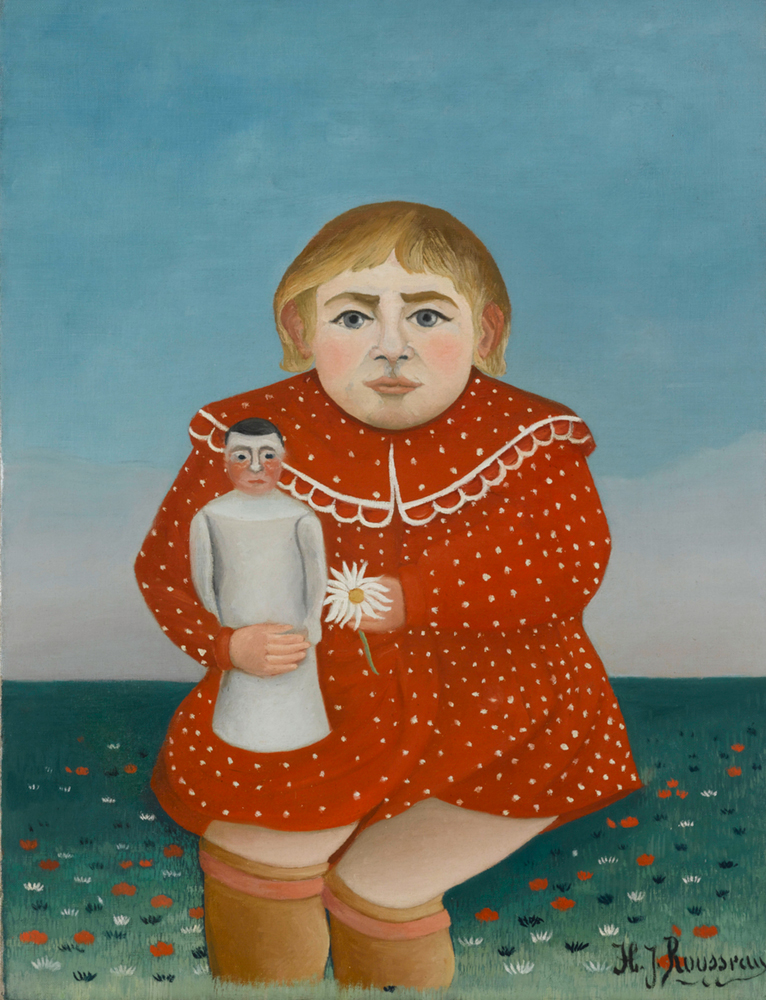
Henri Rousseau, Child with a Doll, ca. 1892. Courtesy the Musée de l’Orangerie.
The respect of his avant-garde friends could be tinged with mockery and colored by class distinctions. But they also admired him, and a few (including Robert Delaunay and Picasso) pilfered visual cues from him. The exhibition and accompanying catalog posit that the childlike “naivete” of Rousseau’s works was in part a deliberate construction, a charm that the artist consciously conserved and deployed. His paintings were informed by his intense professional ambitions and interest in modern technologies, by his canny sense of what might play to a broader public, and by his mastery of suspense; they are often marked by violence, danger, and a profound eroticism.
• • •
Born in 1844 in Laval, a town in northwestern France, the son of a tinsmith and a mother from a respected military family, Rousseau attended high school—not a given, at the time, for the children of artisans—and began working in a law office but was soon caught embezzling small sums from his employer. In 1863, before his case went to trial, he volunteered for the infantry, hoping that, as a soldier, he’d receive a more lenient sentence. He spent a month in prison, then rejoined his regiment, where he remained until 1868, when upon the death of his father, he was released from active duty.
He moved to Paris and married his landlord’s daughter, Clémence Boitard; the couple welcomed their first child in 1870. A year later, through his in-laws, he obtained a position as a clerk for the Octroi, the toll service that imposed duties on goods entering the city. The job offered him a secure salary, subsidized housing, and a chance for advancement, which he never took. Instead, he became a “Sunday painter,” finding the time to make art alongside his seventy-hour workweeks and sometimes painting on the job.
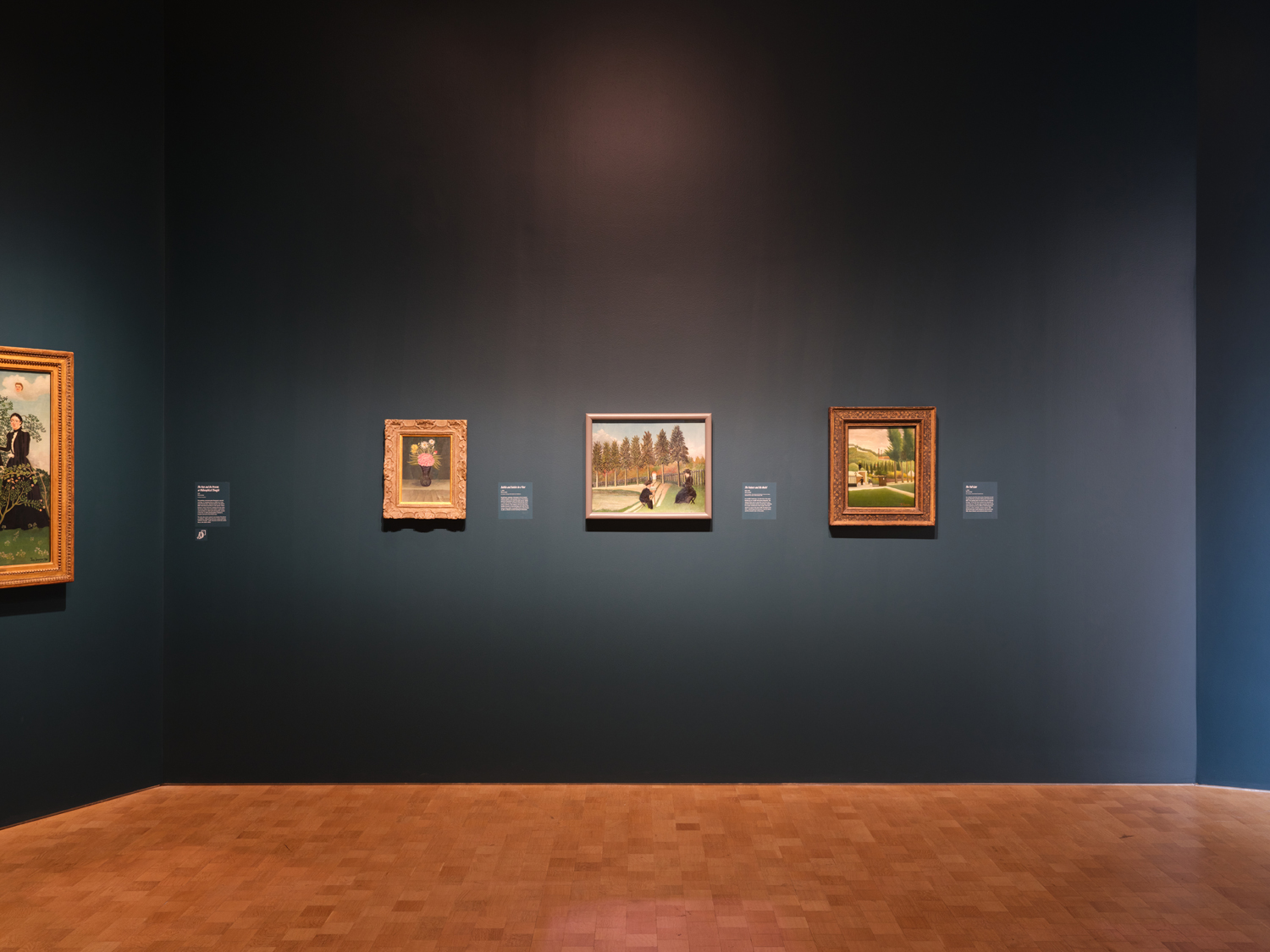
Henri Rousseau: A Painter’s Secrets, installation view. Courtesy the Barnes Foundation. © Barnes Foundation. Pictured, far right: The Toll Gate, 1890.
The nickname his artist pals later gave him—Le Douanier, aka the Customs Officer—was both a put-down and a bit of an exaggeration. He was a minor civil servant. Yet the sobriquet also points to something fundamental in his art. He was interested in borders and what lay beyond them. You can see it in his small painting The Toll Gate (1890), where two shadowy anonymous figures stand guard over an unspecified city limit, which divides carefully controlled expanses of greenery from rolling wooded hills and factories.
What price do we pay for transgressing the distinctions between classes, between amateurs and professionals, between dream life and the waking world, imagination and reality, or even between the living and the dead? These were limits Rousseau repeatedly attempted to cross. Five of the six children he had with Clémence would not survive to adulthood; Clémence herself would die in 1888. He retired early from the Octroi in 1893 to devote himself to painting, supplementing his small pension with rare sales of his work and by offering lessons in music and art.
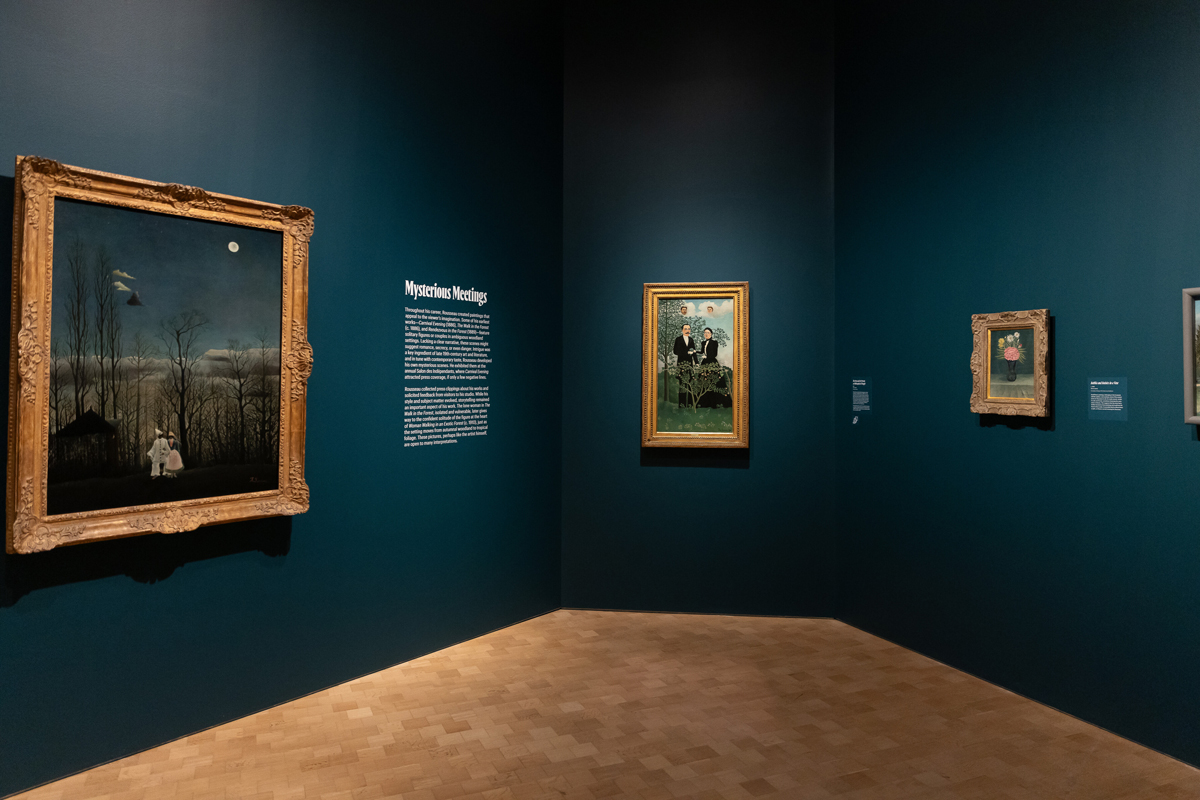
Henri Rousseau: A Painter’s Secrets, installation view. Courtesy the Barnes Foundation. © Barnes Foundation. Pictured, center: The Past and the Present, or Philosophical Thought, 1899.
And he began dabbling in spiritualism. In 1899, to commemorate his second marriage, to the widowed Joséphine Noury, Rousseau painted The Past and the Present, or Philosophical Thought. The newlyweds stand in a garden whose grass is strewn with forget-me-nots; Rousseau, appearing younger than his fifty-five years, hands his bride a little bouquet. Diminutive portraits of the couple’s deceased former partners (recalling nineteenth-century spirit photography) hover benevolently in the sky above them.
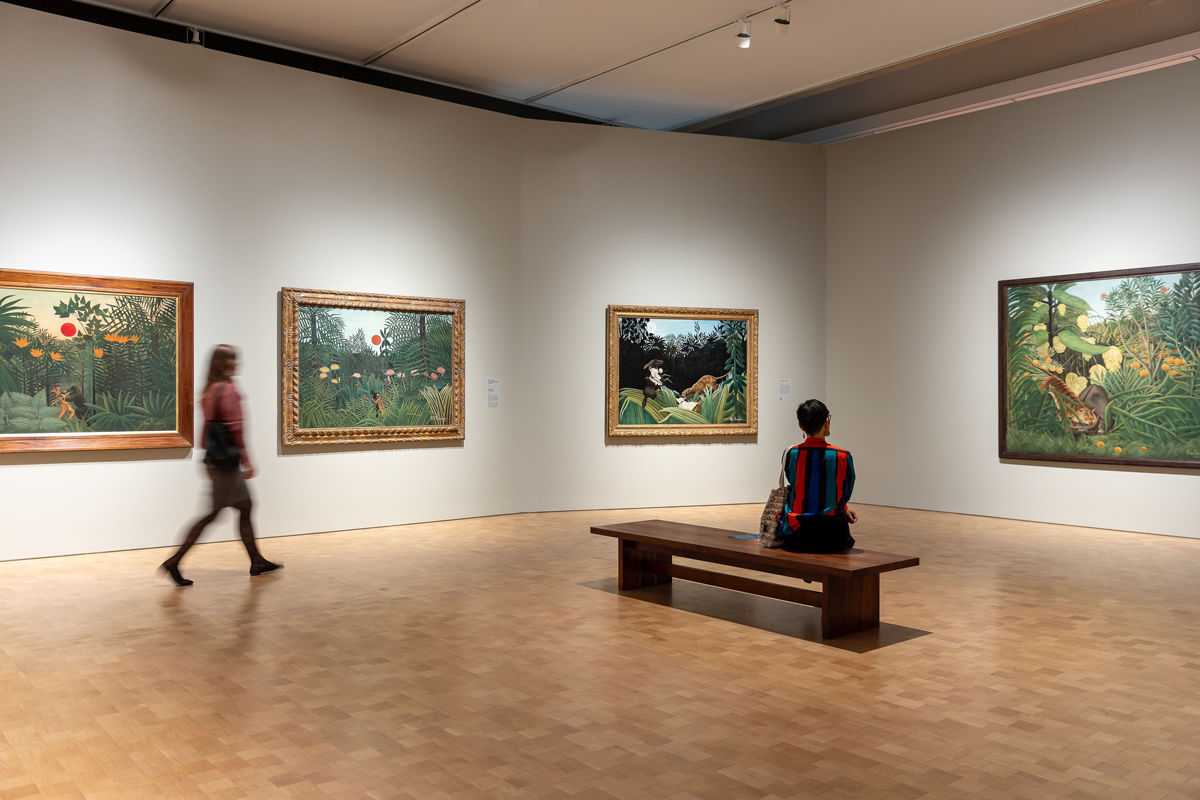
Henri Rousseau: A Painter’s Secrets, installation view. Courtesy the Barnes Foundation. © Barnes Foundation.
Joséphine died just four years later, yet Rousseau soldiered on—chasing large-scale, official commissions that never arrived, responding to occasional demands for portraits, creating small landscapes and still lives that would fit in his neighbors’ modest apartments. Beginning around 1904, and partly inspired, perhaps, by the vogue for exoticism in art that had accompanied the death of Gauguin one year earlier, he began his late series of jungle paintings. Contrary to rumors that circulated at the time (which he did not contradict), Rousseau had never traveled to the tropics. In fact, he never left France, but haunted the botanical gardens of Paris and reached into the deepest recesses of his imagination to create these images of a world as distantly remembered as childhood, filled with playfulness, ferocity, and an enduring beauty.
Leslie Camhi is an essayist, memoirist, and literary translator (from French), writing for the New Yorker, the New York Times, Vogue, and other publications. She is also a frequent contributor to art museum catalogs. Her first translation, of Violaine Huisman’s novel, The Book of Mother (Scribner), was a finalist for numerous awards and long-listed for the 2022 International Booker Prize.