


 Sasha Frere-Jones
Idris Robinson’s book presents a radical perspective on the role of martyrdom in the next American revolution.
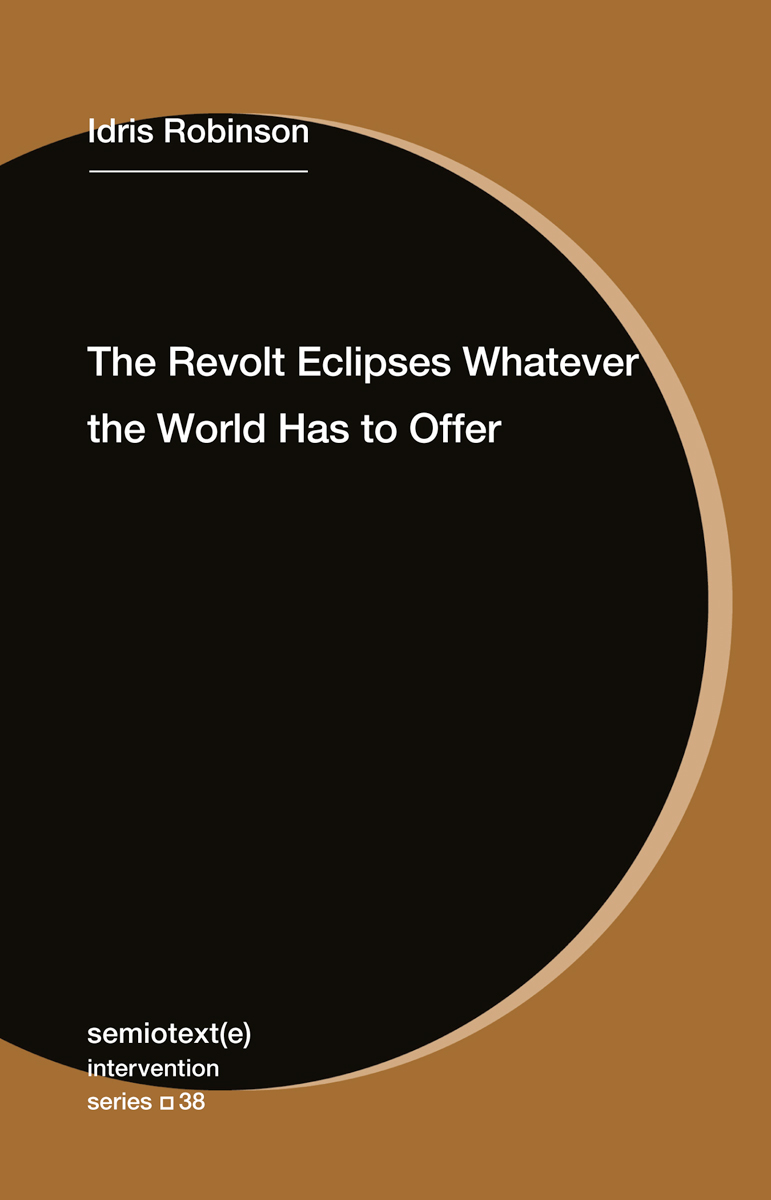
The Revolt Eclipses Whatever the World Has to Offer, by Idris Robinson, Semiotext(e), 252 pages, $16.95
• • •
The common slang term NPC—“non-player character”—marks someone as being run by the software, not acting of free will. There is a phrase that acts as the antipode to NPC: choose your fighter, and this is the concept we should use for Idris Robinson, assistant professor of philosophy at Texas State University and author of The Revolt Eclipses Whatever the World Has to Offer. His first book, it collects notes written on the fly, speeches given at protests, academic parsings, and a few texts it would be imprudent to classify. While reading this brief, convulsive volume, we are riding in a car with three fighters. There is the professor, who revises and animates the concept of “destituent power” by combing through Tronti, Agamben, Benjamin, and Aristotle to find the red threads that bind the idea. There is the young Black man, beset on all sides by unsolicited American advice and global pressure, thinking about suicide on a train platform: the subject in motion. And there is the transitional figure who takes Marx’s dialectical diagram as a prompt to become a philosopher—“philosophy finds its material weapons in the proletariat, so the proletariat finds its spiritual weapons in philosophy”—and discovers a framing for that life in “the hot pandemic summer of 2020.”
But this figure only got there by going into the streets first, and then being so alienated by the “petit bourgeois nonsense” of Occupy that he went into the academy: “The whole ordeal was so irritating that I eventually threw my hands up, filled out a few applications, and went to graduate school.” The “trust fund kids lying about their monthly allowances” are everywhere, so how to fight them as well as the imperial Voltron of death that is America?
Robinson takes the tack here, as a good street tactician, of trying to hold as many positions as he can. At some unspecified point in time, when his “entire existence” was “devoted to finding the next riot,” he goes to Jerusalem. While staying in a hostel, his friend Barry finds the man who might know where the riot is. This “art wizard” is “Peter Pan in a black cape with a bunch of silver jewelry: a complete fucking doofus,” the author tells us. The white man lectures Robinson about “deep connections” he feels with “the most militant of resistance fighters,” bums two cigarettes rather than the one offered, and eventually tells Robinson he sounds “really stupid.” Robinson slaps the cigarette out of the wizard’s mouth and a street fight of sorts ensues, including the wizard receiving a “perfectly executed judo shoulder throw,” also known in the vernacular as an “earth slam.” The purpose of this story is not necessarily to boast about bonking an art wizard but “to shine some light” on the fact that “white people really tend to act a fool when they visit the Holy Land.”
What starts as an amusing anecdote quickly takes flight. Once at the riot, Robinson sees the white people retreating “to a safe distance, while young Brown kids half their age charged the enemy with nothing more than stones.” The passive and idle spectators have revealed something deeper than cowardice. Robinson ties “martyr” to its derivation “from the Greek mārtus, which like the Arabic shahīd means ‘witness.’ ” This helps us understand “the falsity of an attempt to bear witness without achieving martyrdom.” And why is it important to consider that “white leftists and progressives often venture to the Land of Milk and Honey to purify themselves of colonial guilt”? Robinson brings the real point to the surface:
A person must therefore be willing to face both the negative and positive consequences of their participation: to endure the suffering, pain, and even death brought on by state repression, while savoring the bonds of solidarity and the profound euphoria that accompany liberation. The difficult choice faced by the martyr is that it is impossible to indulge in the latter without at least sometimes bearing the hardships of the former.
And it is in the Floyd uprising in that hot summer that we find another unified front, at least for a long moment. A “militant nationwide uprising did in fact occur,” and a “largely multiethnic rebellion managed to spontaneously overcome codified racial divisions.” As in Jerusalem, the riots were “spearheaded by a Black avant-garde,” but “different bodies, different shapes, different genders manifested themselves in the streets together.” How to end racism, a hot topic in what Robinson calls “corporate and academic circles”? Enforce an evenness of experience and consideration—where all assume the same level of risk in the streets and, everywhere all at once, treat each person as a human being. If the latter seems like a given, or some kind of anodyne tea towel, take a moment to seriously consider the moral rot at the center of the American-funded genocide in Palestine, carried out by “Israelis” from New Jersey and Belarus. The colonizer’s prior assumption of guilt is so toxic that Ms. Rachel has been publicly flayed by the AIPAC gang for being, as Hannah Black put it in a reading at the Poetry Project on October 22, “the only living American to believe in public that Palestinians are babies when they’re born.”
Where to bring this energy, the fully committed American agent who embraces martyrdom? A civil war, of course. At his book launch, held in early December at Francis Kite Club on the Lower East Side, Robinson put it simply: “Anything that breaks up America is a good thing.” In the book, he cites Du Bois’s Black Reconstruction as a source for helping to imagine an “emancipatory, liberatory, but nonetheless violent, civil war” that is due for a “second coming.” How do we introduce more dissolving into a huge industrial state that “is already beginning to break and fracture”?
Aside from the material obligation to stay in the streets and be ready to go John Wick for your comrades, there is the more diffuse idea that Robinson chooses to call “destituent power” (after more than one philosopher). He defines it here as “that which moves to sever the relational network of familial and political bonds encompassed by the (American white supremacist) state.” It’s a tricky position, one that is essentially unfinished. Robinson sees the liberal delusions of “intersectionality, identity, and privilege politics as roughly the same kind of trap in the way that it impedes any meaningful change.” The real change is located in this Westernized version of the martyr, the unafraid street subject. “The insurgents in a rebellion enter into a new and different relationship with time,” Robinson tells us. The bridge between subjects to a new social formation is located in this other time. Robinson writes that “the religious tradition tends to understand martyrdom as a gift.” Here we touch on the genuinely radical potential of his book, where Westerners can see martyrdom as “surrendering something lesser for something else of an immeasurably greater value: a judgment that the implicit humanity and lived experience of revolt eclipses whatever the world has to offer.” In plainer terms, ones that hopefully Robinson would not reject, the next American revolution will be infinitely more painful than the first, and the avant-garde will not be made of artists.
Sasha Frere-Jones is a musician and writer from New York. His memoir, Earlier, was published by Semiotext(e) in 2023.