


 Jennifer Krasinski
Skin and limbs, eyes and tongues: a mesmerizing ambivalence shades the artist’s monstrous creations enmeshing flesh and tech.
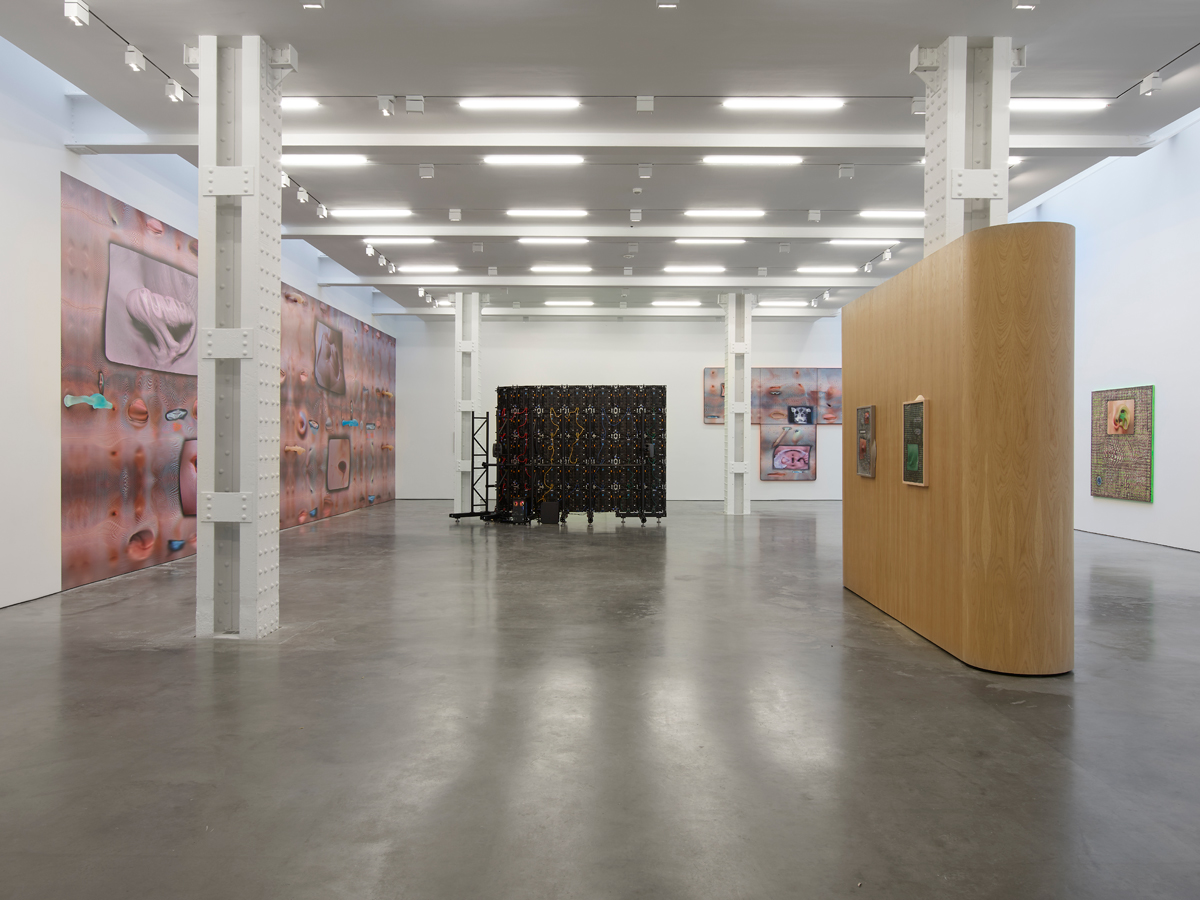
Tishan Hsu: emergence, installation view. Courtesy Lisson Gallery. © North First Studio / Artists Rights Society (ARS).
Tishan Hsu: emergence, Lisson Gallery, 504 West Twenty-Fourth Street, New York City, through January 24, 2026
• • •
One of Tishan Hsu’s most intriguing achievements—and there are many—lies in how his work elicits a certain aversion. It’s no wonder why. Deeply invested in questions of form while utterly disinterested in flattery, he has imagined bodies variously enmeshed with, and masticated by, technology. His paintings, sculptures, drawings, and videos are populated and punctured by orifices and eyes, tongues and limbs, outies and innies, growths and drains, often to mystifying, even monstrous, ends.
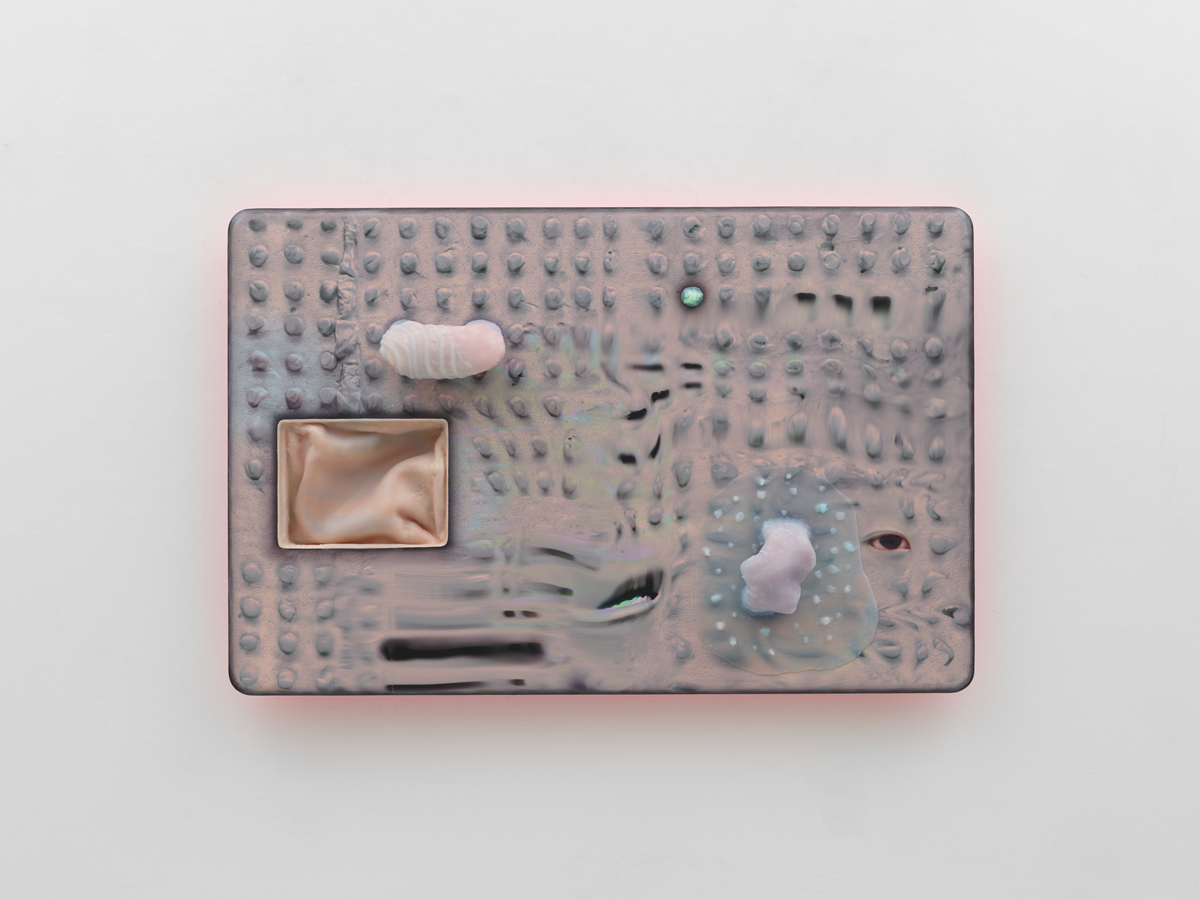
Tishan Hsu, Interface Infrared, 2024. UV print, silicone, ink, acrylic, and stainless steel on wood. Courtesy Lisson Gallery. © North First Studio / Artists Rights Society (ARS).
Hsu’s current show, emergence, at Lisson Gallery, presents a slew of new—well, what to call them? Perhaps think of them as “painthings,” to borrow a word from artist Richard Hawkins; all are hung on the walls. Apropos of our digitally driven times, Hsu creates confusion between a thing and its likeness, between an object and its image. (As part of the generation pummeled by the theories of Jean Baudrillard, I’m resisting mention of the simulacrum and . . . failing.) In one particularly dizzying example, the painted and UV-printed Interface Infrared (2024), odd nubbins, some in focus, others warped and smudged, appear against a backdrop of what looks to be silvery skin dotted with pores. Elsewhere in the work erupt an eye, a mouth. As in most of Hsu’s creations, he sculpts silicone into “artificial organic” matter—like bits and pieces of an alien familiar—and embeds them into his picture planes so they seem to be making their way into the real world (if that’s what we’re still calling it): a rumpled swatch of fleshy stuff; a transparent puddle of some such; a plump, wormy whatnot.
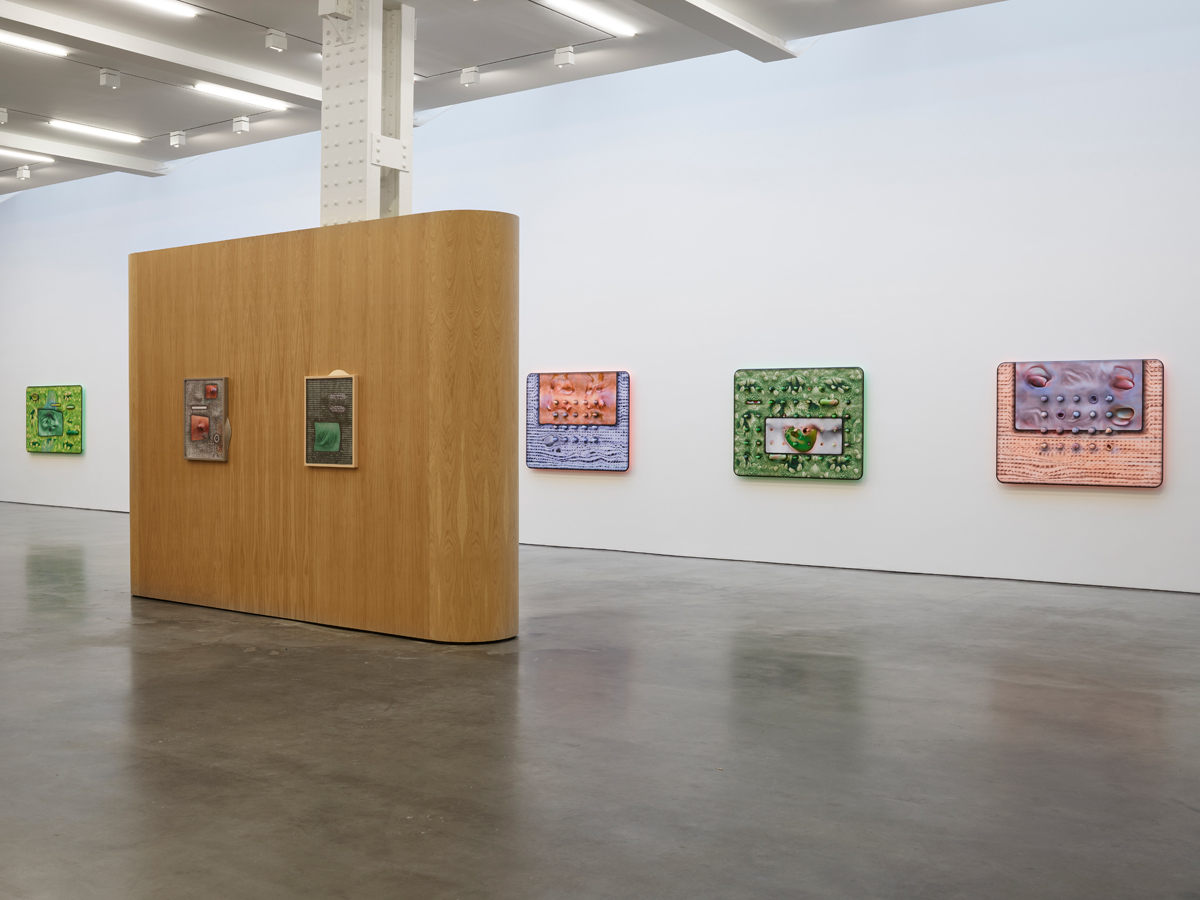
Tishan Hsu: emergence, installation view. Courtesy Lisson Gallery. © North First Studio / Artists Rights Society (ARS). Pictured: left to right on background wall: stomata-skin-3; skin-fur-mesh-blue; stomata-skin-2; skin-fur-mesh, all 2025.
What beasts do these parts belong to? Or, if not an animal, what do they add up to? Titles such as skin-glitch, skin-fur-mesh, skin-grass field, and stomata-skin-2 (all 2025)—their hyphens like nails half-pounded between the words—underscore how nothing quite coheres, at least not yet. My brain got knotted up trying to think inside the nuanced (perhaps nonexistent) distinctions between the synthetic (that which is proudly human-made) and synthesis (amalgamations that have achieved at least the look and demeanor of a natural whole). This stuff, caught in a state of continual metamorphosis, of emergence, to use the artist’s word, also began to look like the signs of material and existential indigestion.
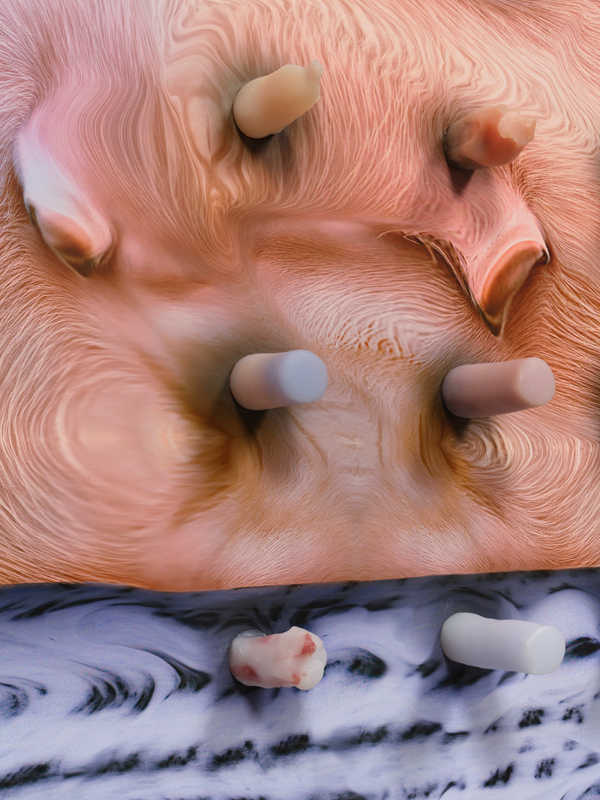
Tishan Hsu, skin-fur-mesh-blue, 2025 (detail). UV print, silicone, ink, acrylic, and stainless steel on wood. Courtesy Lisson Gallery. © North First Studio / Artists Rights Society (ARS).
The exhibition’s video, emergent mesh (2025), interjects movement and time into the conversation. I sat and watched for a while, finding the piece exceptionally mesmerizing, though hard to parse. (Fair enough. Given Hsu’s overall interest in technology and its seizure of the human experience, perhaps making sense of it is less important here than experiencing the overwhelm.) What I saw were two greenscapes—one that looked photographed, the other computer-generated—rotating around one another, continuously churning but going nowhere. (Later, I read that the artist built this “real-time” video inside a game engine, which allows for variations in the speed as well as in the audio elements.) Which images are captured, and which are created? In the digital realm, the answer is invariably both and neither. Blazing from LED tiles that together create a seamless screen, Hsu’s video is so blindingly sharp that it felt as though my eye was undergoing some kind of autopsy. I could see everything and nothing all at once.
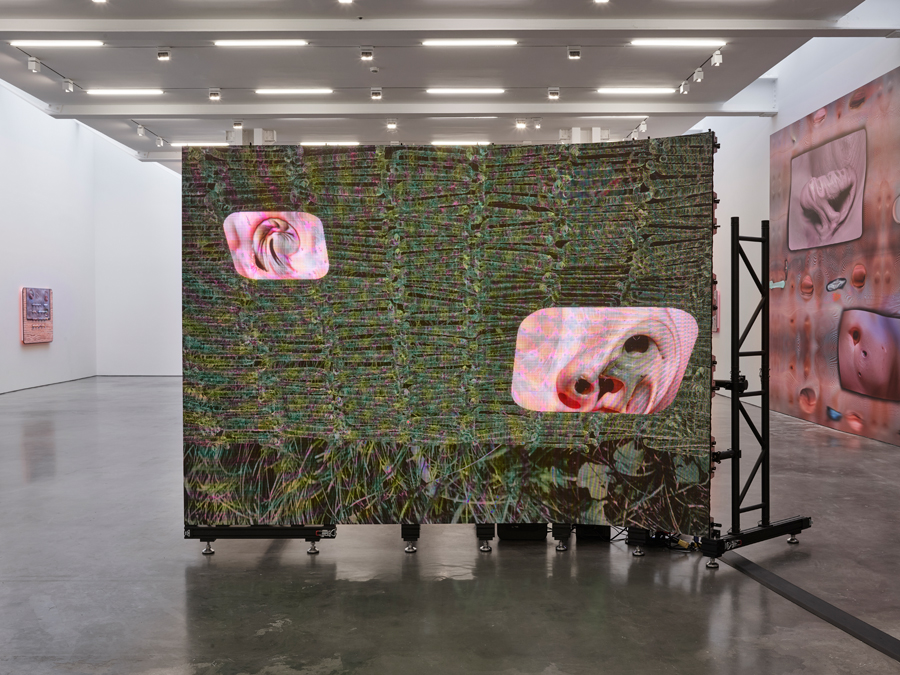
Tishan Hsu: emergence, installation view. Courtesy Lisson Gallery. © North First Studio / Artists Rights Society (ARS). Pictured, center: emergent mesh, 2025.
Hsu first developed his ideas about the inevitable fusion of the physical and digital worlds as a young artist in the mid-’80s. While working on Wall Street, long before the Age of the Internet and our Tech Bro Times, he felt the tides shifting toward a hyper-technologized self as he sat at a computer terminal all day. He had no particular prescience regarding the blunt-force trauma that screens would eventually have on critical thought, communication, memory, desire, intimacy, literacy, work, leisure, and every other corner of life and mind; he simply paid attention to the world as it was unfolding. What he noted, as he explained in an interview in 2021: “There’s this kind of cognitive, emotional, psychological resonance going on between us as this organic body, and this screen, and it is affecting us and the culture, if not the world, in deeper and deeper ways. And so I felt the affect is important for us to become more conscious of in some way, if possible, just to stop a minute and ask, what is going on here? What is this? What we are going through is unprecedented in human history.”
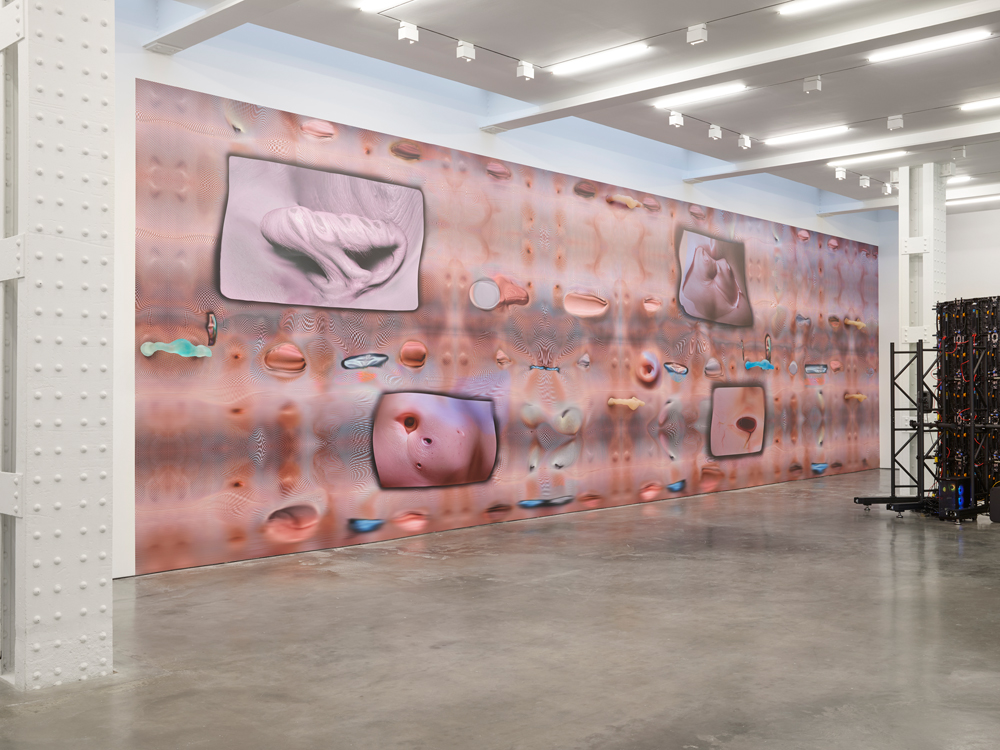
Tishan Hsu: emergence, installation view. Courtesy Lisson Gallery. © North First Studio / Artists Rights Society (ARS). Pictured: ears-screen-skin with casts: New York (Lisson), 2025.
Hsu was dead right. In Oliver Sacks’s “The Machine Stops,” an essay posthumously published in 2019, the neurologist despaired about minds now burdened by, and reliant upon, the internet, social media, and the devices that shrink the vast, complex world to the size of a screen. He pronounced, “What we are seeing—and bringing on ourselves—resembles a neurological catastrophe on a gigantic scale.” Yet part of why Hsu’s productions are so entrancing, arresting, is that one can’t quite tell if he shares the scientist’s alarm. There is no way to shake off the unbounded ambivalence that permeates the work. This ambiguity is, strange as it sounds, fantastically refreshing. Hsu offers no easier or more palatable feeling, no doomsday message or pat morality tale on which to hang our fates. Instead, he compels us to think inside the most terrifying time and place that we, so inundated with tech, are always trying so desperately to escape: the present, as we’re bearing witness to our own unbecoming, unsure of what’s to come.
Jennifer Krasinski is a writer, critic, and senior editor at Bidoun.