


 Ed Halter
An exhibition of sci-fi video installations showcases the artist’s technophilic explorations of labor and media.
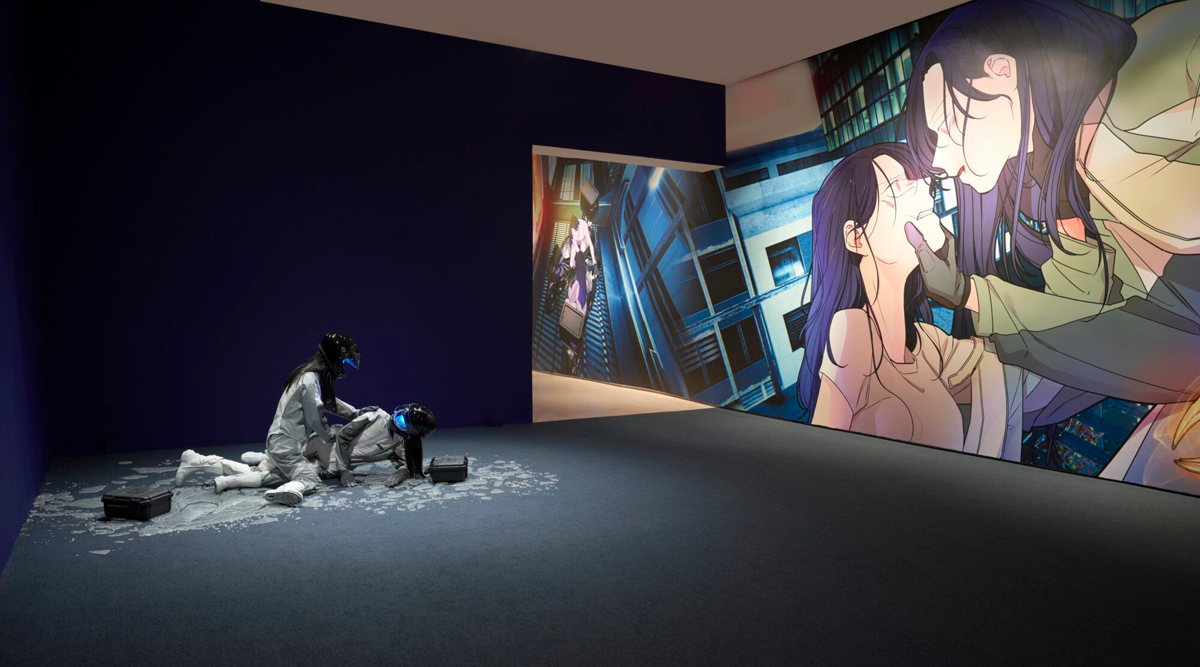
Ayoung Kim: Delivery Dancer Codex, installation view. Courtesy MoMA PS1. Photo: Roz Akin. Pictured, left: Ghost Dancers B, 2022.
Ayoung Kim: Delivery Dancer Codex, organized by Ruba Katrib, MoMA PS1, 22-25 Jackson Avenue, Queens, New York,
through March 16, 2026
• • •
Like many other institutions in your life, MoMA PS1 has decided you are not yet completely sick of being force-fed the fruits of artificial intelligence and would love to experience more. Or so you can only assume after visiting Delivery Dancer Codex (on view since November on the museum’s third floor), a sprawling showcase for Ayoung Kim’s technophilic Delivery Dancer trilogy of supersized science-fiction-themed video installations. Celebrated as a rising global star by what remains of art-world publications—the same photo of Kim’s DDC sculpture Ghost Dancers B (2022) appeared simultaneously on the covers of frieze and Artforum last fall—and lauded with multiple major awards, Kim produces big shiny spectacles that promise to say something about twenty-first-century media by embodying its look and logic, but in the end offer little more than frictionless capitulation to the average audiovisual languages of contemporary entertainment.
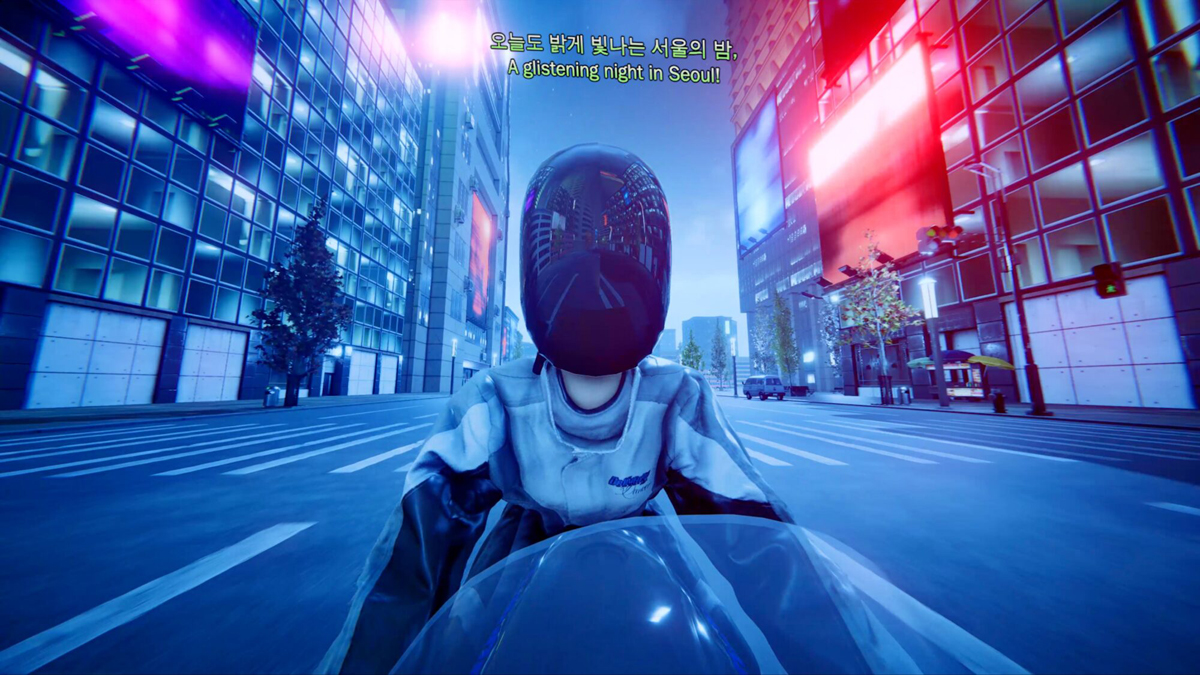
Ayoung Kim, Delivery Dancer’s Sphere, 2022 (still). Courtesy the artist and Gallery Hyundai.
The single-channel Delivery Dancer’s Sphere (2022) introduces the characters and loose premises of Kim’s trilogy. In the video, a courier named Ernst Mo (Seokyung Jang) works as a Delivery Dancer, zipping on a motorbike through a futuristic Seoul. Her assignments are managed by the Dancemaster algorithm, which chitters directions as she navigates a labyrinthine city devoid of people (Kim has referred to DDS as a “pandemic fiction”). This series of trips provides some of the more visually dynamic sequences in the exhibition: the city is pictured via game-engine animation, its buildings distorted with multicolored fungal extrusions, as well as through meatspace video footage, optically warped into kaleidoscopic fun-house-mirror patterns. Ernst runs into her doppelgänger, En Storm, clad like her in a smart full-body windbreaker and reflective black helmet; the two engage in a choreographed struggle, and finally Ernst zips off on her bike once more. The whole is set to a soundtrack of repetitive electronic percussion, like the inexorable ticking of a timer.
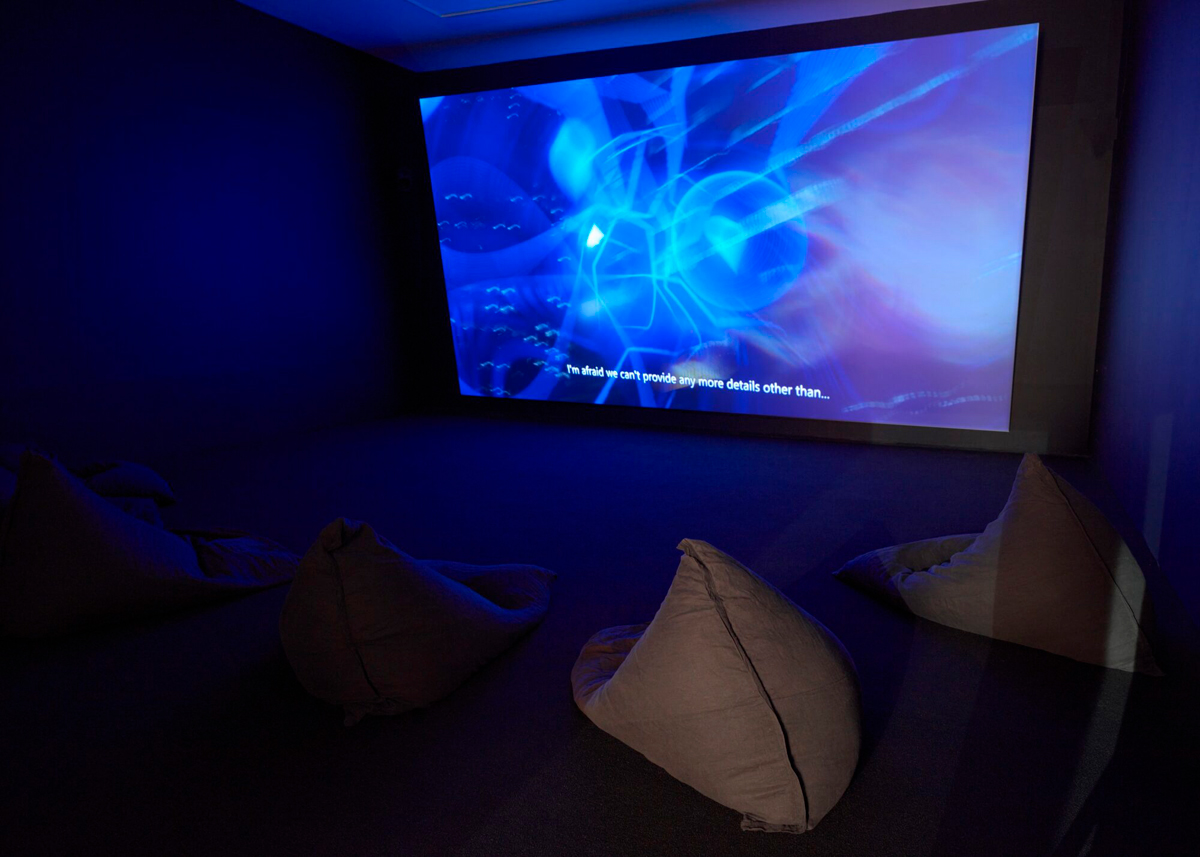
Ayoung Kim: Delivery Dancer Codex, installation view. Courtesy MoMA PS1. Photo: Roz Akin. Pictured: Delivery Dancer’s Sphere, 2022.
At PS1, DDS is presented in a darkened chamber with a few limp beanbag chairs for seating. You arrive by walking through two other rooms with prop-like sculptures that reproduce major visual elements from the video. Ghost Dancers A (2022) consists of two motorcycle helmets suspended to face one another; each contains a small screen depicting a Delivery Dancer on her motorbike zooming into an urban horizon. Stipulation (2022) is a mobile phone held up by a wall-mounted arm, its display looping the same neon-blue Dancemaster app animations that appear on Ernst’s phone. Hanging from the ceiling and mounted on walls are six Orbit Dance sculptures (all 2022); these are physical realizations of an abstract digital logo that swims through the sky in DDS, recursively composed of circles within circles and made out of reflective metals. According to the wall label, the Orbit Dance pieces have been fashioned from brass, nickel, and what are known as “supermirrors.” Intended for scientific use, supermirrors are hyper-reflective optical surfaces that, to the everyday observer, look exactly like normal mirrors, but cost thousands of dollars to produce.
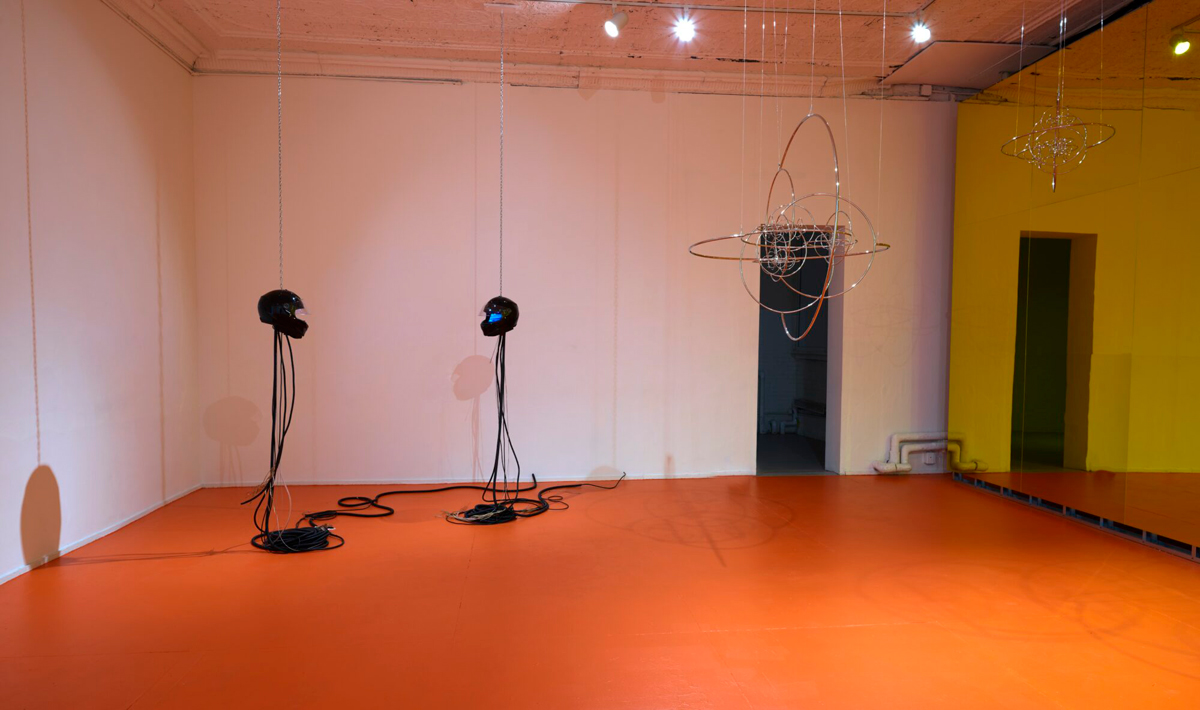
Ayoung Kim: Delivery Dancer Codex, installation view. Courtesy MoMA PS1. Photo: Roz Akin. Pictured, left: Ghost Dancers A, 2022. Right: Orbit Dance sculptures, 2022.
Aside from the repetitive fragmentation of its micro-narrative, DDS offers very little that distinguishes it, in terms of its sonic and visual qualities, from a typical mid-budget science-fiction episodic. Each frame sticks to the simplistic, centralized composition familiar from first-person video games and television productions; the editing hits every beat exactly where expected. With their blunt connections to DDS, the sculptures enact Kim’s world-building through an imitation of corporate IP, functioning like official branded merch for her most loyal fans, promising a breadcrumb trail of “lore” in lieu of anything conceptually substantial. This is art that has more or less given up on creating new forms or imagining how video might exist otherwise; it is content to speak in the established media languages viewers already know.
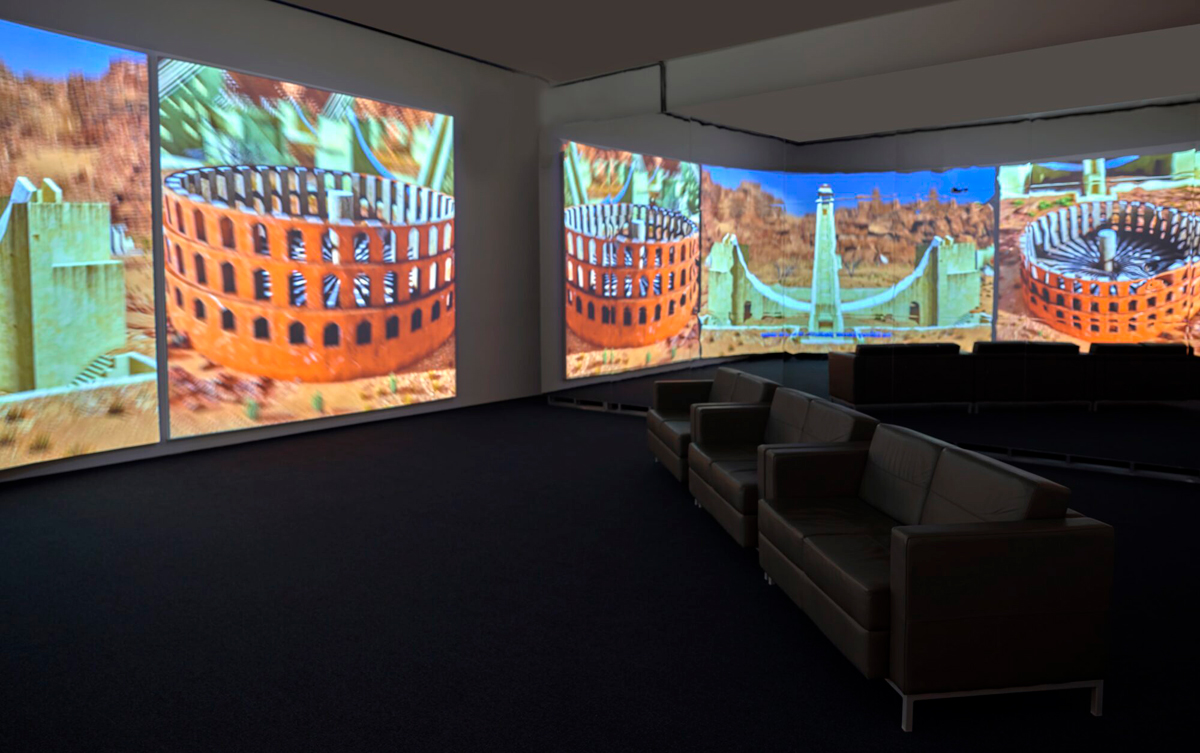
Ayoung Kim: Delivery Dancer Codex, installation view. Courtesy MoMA PS1. Photo: Roz Akin. Pictured: Delivery Dancer’s Arc: 0º Receiver, 2024.
The trilogy continues with the installments Delivery Dancer’s Arc: 0° Receiver and Delivery Dancer’s Arc: Inverse (both 2024). A side-by-side three-channel triptych, Receiver pits Ernst and En on a mission to deliver “time,” and shows the pair continuously roaring on their bikes through endless algorithmically generated canyons on a planet with two moons, then wrestling once again. Inverse is presented on three massive ceiling-mounted screens with ramps covered in polyester carpet underneath for reclined viewing. The most dispiriting of the three, Inverse takes place in the fictional world of Novaria, which Kim visualizes through bulbous, artifact-laden cityscapes all-too-obviously created with generative AI. Perhaps when Kim began making Inverse, she may have thought the telltale mediocrity and cliche-blending of AI-generated images would give the work an up-to-the-moment sensibility, but in early 2026, these ugly renderings look like little more than cheap approximations of professionally produced, bigger-budget SFX. The cruel irony of using the most anti-worker technology of our century to tell a story about labor is nowhere addressed; any jobless film technician or aspiring art student gazing up at Kim’s triumph is instead told, yet again, that the future will not require their paid services.
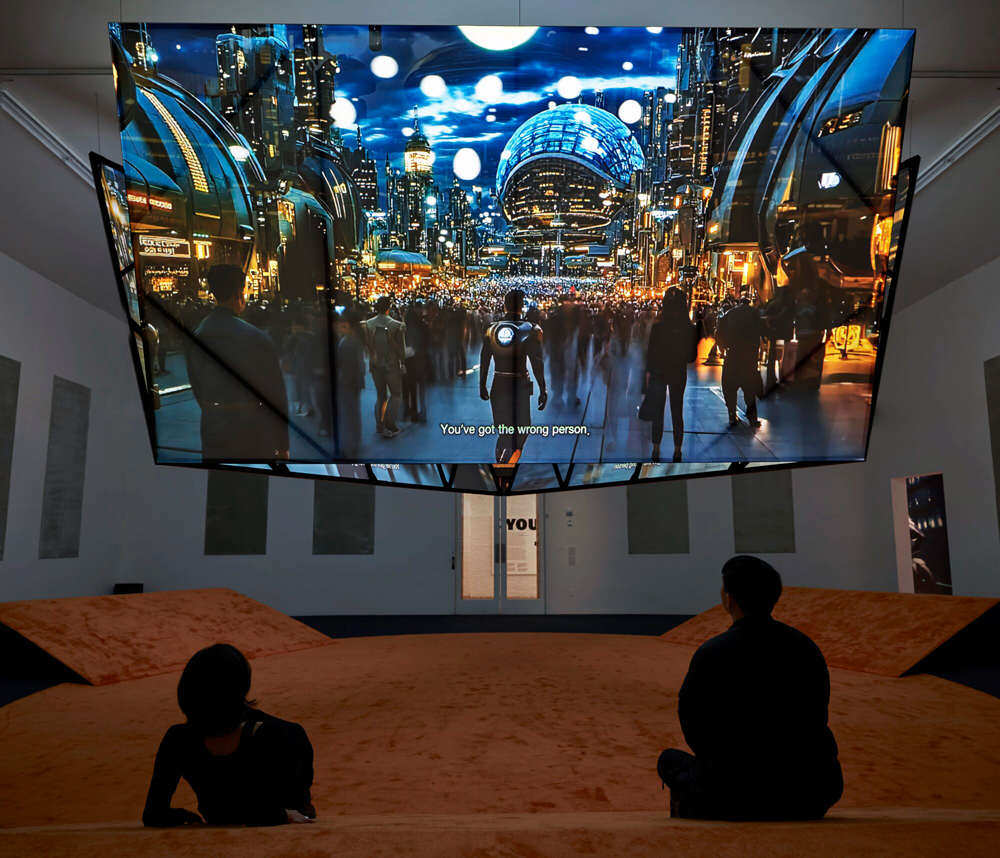
Ayoung Kim: Delivery Dancer Codex, installation view. Courtesy MoMA PS1. Photo: Roz Akin. Pictured: Delivery Dancer’s Arc: Inverse, 2024.
Kim and her handlers have made ambitious claims for what she’s articulating through these hyperkinetic amusement-park rides. In a statement on her website that relies heavily on the work of its prepositional structure, Kim asserts that DDS “is not only about the gig economy and platform labor . . . but also about the topological labyrinth, the possible world(s), the hypervigilance, and the accelerationist urge for optimization of body, time and space.” Similar proposals are dutifully promulgated by PS1’s press release, which informs us that Kim “interrogate[s] technologies” and “challenges capitalist pressures to meet increasing global demands through self-optimization.” One wonders if the viewers I saw scrolling on their phones while chilling out on fabric cushions understood they were in the midst of an interrogation, or if Kim even cares what they thought: in a recent interview, she makes clear that she believes “art shouldn’t have an obligation to change the world.” But if art only reflects our own world back to us, then who needs it? Any old mirror will do.
Ed Halter is a founder and director of Light Industry, a venue for cinema in all its forms in Brooklyn, New York, and Critic in Residence at Bard College in Annandale-on-Hudson, New York.