


 Sjón
Sjón
In the 1970 novel by Halldór Laxness, an essayistic tale of ordinary people and a small town church from the Viking Age to the twentieth century.
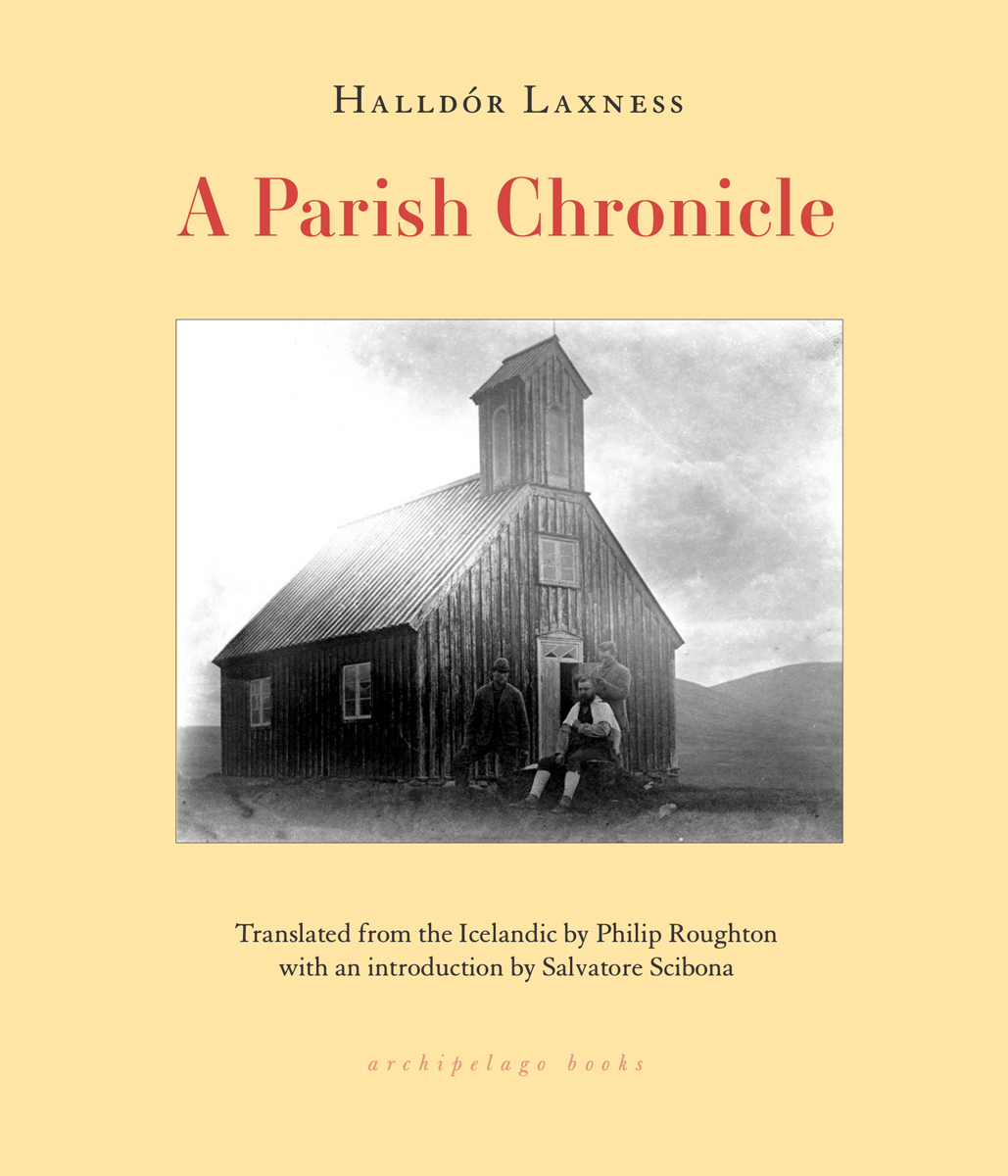
A Parish Chronicle, by Halldór Laxness, translated by Philip Roughton, Archipelago Books, 124 pages, $19
• • •
When he received the Nobel Prize for Literature in 1955, the Icelandic author Halldór Laxness was shown to what we call skáldabekkur in Icelandic (the “Bench of Poets”). While our Parnassus might not be a mountain reaching the sky but a piece of wooden furniture, it is still furniture that originated in the halls of kings: a bench from which poets rose to deliver their epic poetry before the sovereign. The stakes were high, as kings in those days rewarded some poets handsomely while others were ridiculed, and then there were those who barely escaped with the skin on their backs, if at all—for that is what every poet has risked since the beginning of time: applause, snickers, the axe.
At the age of fifty-three, Laxness himself stood before a Nordic king, King Gustaf VI Adolf of Sweden, and received his own skáldalaun (“Poet’s Reward”): the golden Nobel Prize medal and a calligraphed diploma, while the reward money of the richest literary prize in history was being transferred to his bank account as they stood there face-to-face: King and Poet. In that moment, Laxness must have felt that he had truly followed in the footsteps of the Icelandic court poets of old; that he had arrived in literary history and been shown to his place on that famed bench.
Now, that brings us to the aftermath of receiving a major literary prize. It comes with well-known complications. When the hazy days of the ceremony and celebrations, interviews and travels have passed, back at home the prizewinner is left alone with the prize. Resting on laurels offers only so much comfort; they always feel prickly in the end.
It is from such a situation that Innansveitarkrónika (A Parish Chronicle, 1970) was born.
In the year following his Nobel, Laxness immediately wrote the novel Brekkukotsannáll (The Fish Can Sing), a story about an artist whose fame is fake. Then came Paradise Reclaimed in 1959, which was favorably received but judged a lesser work compared with his earlier masterpieces. He tried his hand at theater, only to be politely told that, as amusing as his plays might be, they showed that he was more of a novelist than a dramatist.
It is not difficult to imagine that one day, while walking the dog Grettir on the southern slopes of Mosfellsdalur Valley, Laxness might have paused and gazed over to its northern side. It was a landscape he knew well, for this is where he had lived as a child before going out into the world at sixteen, only to return as a grown man in the 1940s. This time, his eyes may have lingered a little longer on a hill at the Hrísbrú farmstead, where the church of Mosfell had been built in the thirteenth century. Hidden beneath the ground, where no church now stood, lay the remains of the Viking poet Egill Skallagrímsson. And among the bones was the famously unbreakable skull that had housed the warrior’s fertile brain—the very source of the poetic thought that had moved his tongue in verse from the age of four until his death in old age, if the saga dedicated to him is to be believed.
Being a poet himself, Laxness looked into the hill at Hrísbrú and found there the empty eye sockets of his forebearer, gazing back at him from the darkness of the earth. And thus the pagan national saint of Iceland—as the living author would later call this long-dead colleague in A Parish Chronicle—helped him discover that his next work should be a tale from the small world of Mosfellsdalur.
(For Laxness enthusiasts, it should be noted that the encounter described here took place in 1961, before the writing of the 1968 novel Kristnihald undir jökli [Christianity Under the Glacier]. But in the spirit of this review, I will argue that it was born of the same entirely fictional event.)
And with that we move on to A Parish Chronicle, the first volume of the autobiographical essay-novels he assembled in the final stretch of his writing life. In this thoroughly enjoyable book, its author dons the cloak of the investigating chronicler and recounts the history of the church of Mosfell, from Egill Skallagrímsson’s day to the moment he himself puts down his pen. The main events revolve around a decades-long dispute between the farmer at Hrísbrú, Ólafur Magnússon, and the combined forces of governmental and religious authority, when a decision to merge parishes results in the practical matter of tearing down the old church where Egill’s relics may—or may not—be buried. Ólafur will have none of it. What ensues is a comedy that cleverly allows deeper truths to peek out from behind the curtains.
It is to be applauded that A Parish Chronicle is finally available in English from Archipelago. Philip Roughton’s translation looks as good to my Icelandic eyes as his other translations of Laxness’s later works. He delivers the pleasures found in the twists and turns of the narrative, keeping its tone while wisely refraining from competing with the idiosyncrasies of the original text, where Laxness revels in obscure words and homemade spelling. The laugh-out-loud moments are all there.
The book is filled with some of the strangest characters Laxness ever gave us (and there are many, believe me), and with events that on the surface are so mundane that they would normally not demand attention, let alone be written about. Yet Laxness’s able hand pushes the pen until they are infused with tender mystery that makes us care for them all. Among these are Farmer Ólafur and his son, who’s life in big and small is measured by the needs of their sheep, and just as the sheep hasn’t changed its habits over a thousand years, neither have they, except in taking on some of the animal’s features: “Those people never wore coats, but their woolen cardigans and sweaters stood up to water and wind like the fleece of an Icelandic sheep.” No less formidable is the farmer’s wife, Fimmbjörg, who’s never been seen by anyone, but rules everything from her bed, so deep inside the complex of turf houses that she’s taken on the character of an ancient deity, such as the mother-goddesses of Malta.
And then we have “The Story of the Precious Bread,” an anecdote about Guðrún Jónsdóttir, a maid to the priest at Mosfell church, who is entrusted with bringing a loaf of bread home from the fields and cares for it more than for her own life.
“What you’ve been entrusted with, you’ve been entrusted
with,” says the woman.
Question: “Can one never be too devoted to one’s master?”
The woman asks in return: “Can one ever be faithful to
anyone but oneself?”
The story has taken on a life beyond the book and become one of Laxness’s most beloved texts in his home country.
Laxness is one of the great fabulists of modern letters. Buried in A Parish Chronicle is his metaphorical skull, looking back at us from beneath the text, reminding us that the seeds of culture and humanity are carried across generations by the hands of ordinary people. For human culture is their rightful inheritance. It was people like themselves who made it—often against all odds—just as they keep making it now. And no authority will stop them.
Sjón is an Icelandic author of novels, poetry, libretti, and screenplays, whose award-winning works have been translated into forty languages. His latest novel, Red Milk, was published by MCD Books at FSG in autumn 2021. Christmas 2026 will see the premiere of Werwulf, a medieval horror film he’s cowritten with its director, Robert Eggers.