


 Ania Szremski
Many lives aquatic: a fiercely imaginative book by Mandy-Suzanne Wong seeks to evoke and manifest the unknowability of mollusk consciousness.
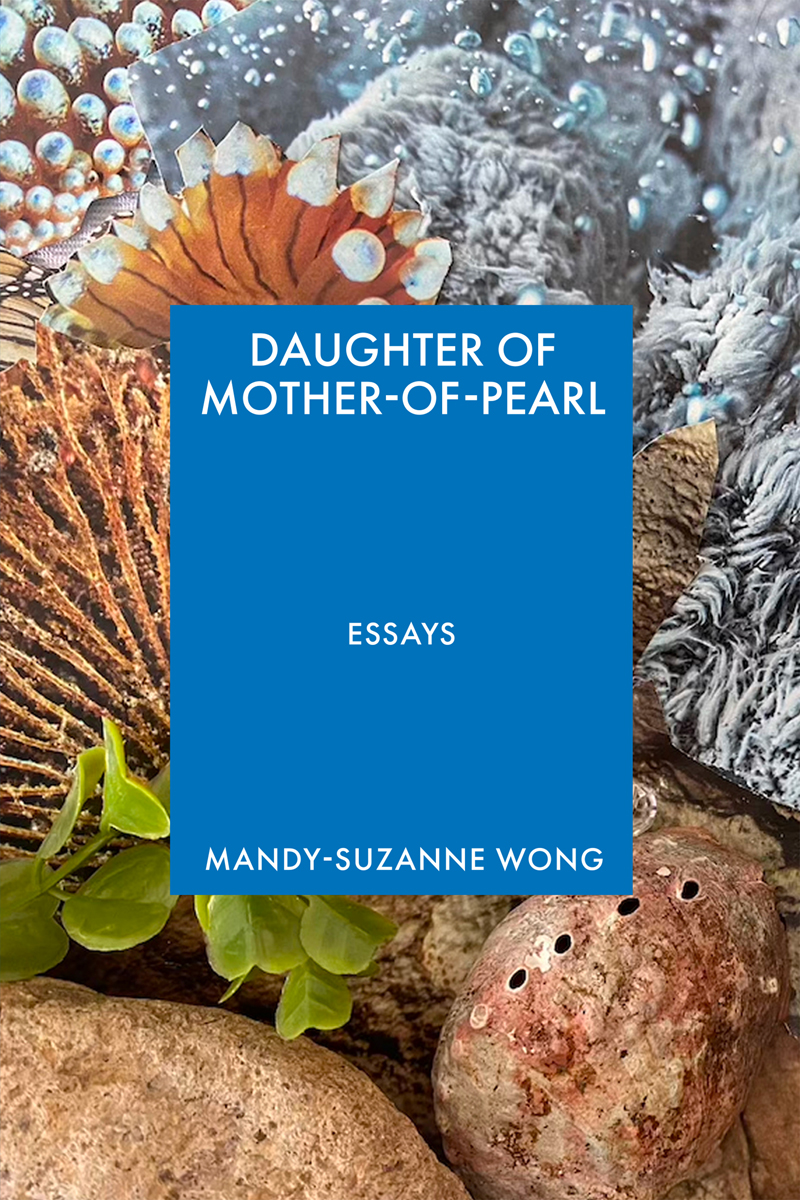
Daughter of Mother-of-Pearl, by Mandy-Suzanne Wong, artwork by Kathryn Eddy, Graywolf Press, 154 pages, $18
• • •
What naturalist Sy Montgomery did for the cephalopod with her 2015 Soul of an Octopus, fiction writer Mandy-Suzanne Wong has now done for the mollusk with her new book of fiercely imaginative and poem-like, though technically nonfiction (speculative nonfiction, perhaps?), essays, Daughter of Mother-of-Pearl. She has made sea snails totally present on the page, magically uncurling their opaque inner worlds, making them resonant subjects of marvel and love. In alternating chapters throughout this slim volume, she hallucinates the emotional and intellectual experiences of a number of different mollusks, from the absolutely tiny to the relatively large, rendering each a complete individual. These include the miniscule benthic adherent (meaning, it lives on rocks) who lingers in the ocean near Japan, where it is called an awabi; the upside-down drifter in the neuston (the community of organisms that lives just on the sea’s surface film) who adores bubbles and squirts violet ink, called the Janthina janthina; a spiral-shelled veliger whose calcified self-made home Wong explicates with quotations from those lucid-dreaming architects Shūsaku Arakawa and Madeline Gins; to, in her last essay, the (comparatively) enormous triton snail, whose shell can surpass two feet in length. She envisions their first glimmers of consciousness in the saline water, how alone they are, the utter mutual indifference that exists between the individual snail and its kind, the tremendous dangers they face at every possible moment, from every imaginable kind of predator, with humans at the apex. And their sheer wonder at simply being alive.
Daughter of Mother-of-Pearl is up there with some of my favorite animal writing of the past decade, from Montgomery’s massively popular study, to Australian philosopher and diver Peter Godfrey-Smith’s books on alien underwater consciousness, to philosopher David M. Peña-Guzmán’s recent When Animals Dream. All of these authors have made indelible cases for nonhuman-animal selfhood, whether terrestrial or aquatic—the latter being, historically, the harder type of entity for humans to relate to, with, in the case of Wong’s subjects (invertebrates), their cold blood and nonmammalian ways. Wong joins them beautifully in this quest—but takes a very different tack in so doing. In fact, she professes some disdain for both naturalists and philosophers (“I’ve limited patience for generalizations,” she says of the latter). She is, first and foremost, a writer, and Daughter of Mother-of-Pearl is not just about mollusks, but is also a gambit for rethinking the form and purpose of the essay.
Her 2023 novel The Box, a 250-page narrative about, well, a box, unfolds like a game, in the words of David Szalay in his New York Times review, and this essay collection could be described as a puzzle, too, in its hide-and-seeking with words and their meanings, quiz-like literary references, and peekaboo play with images (the text is scattered with mysterious collages by Kathryn Eddy). The texts in Daughter of Mother-of-Pearl vary widely in tone, shape, and style, including, aside from the chapters on the secret lives of snails, an alleged reproduction of an anonymously authored report on sea anemones that cribs from eighteenth- and nineteenth-century studies; ekphrastic paragraphs describing images of Japan’s women pearl divers; and Wong’s own memoiristic encounters with snails, starfish, and crabs. The pieces tend to be densely packed with scientific terms Wong does not explicate for the reader but deploys with a poet’s hand, and in her search to evoke such an unknowable thing as mollusk consciousness—to open up the mind of a being that is half inanimate—she tries out strange and angular phrases, describing the snail’s “skin-sniffing” and “one-footed walking,” its thought like “the shape of a water droplet being born.” But she also uses strange and angular phrases to describe human animals (we are “extra-aquatic aliens,” malevolent “giants,” “specimens of a class of which a single arm hinged at midpoint by a neck or head is the defining characteristic”) to decenter us and make us strange to ourselves. Along the way—without diverting her gaze from the mollusks and other mute aquatic creatures, like jellyfish and mussels, that humans have long denied possess consciousness, much less selfhood—she draws from and riffs on and argues with essayists from Montaigne to Dostoevsky to Cixous as she experiments with essayistic form after form, trying to find a writing that can open the unopenable.
For Wong, the stakes are high in this. Born and raised in Bermuda, of Jamaican and Afro-Cuban-Chinese parentage, she has witnessed firsthand the extreme ecological devastation born of the twinned forces of colonialism and climate change that those of us sheltered in metropolises like New York City, completely divorced from the natural world by our moats of concrete and asphalt, may feel is far away. She inveighs against the new word we have developed, “endling,” to describe the last of a species—a word too sweet, too puppyish and tinged with hope, she says, for us to feel what we ought to feel when talking about extinction. Pushing against the limits of nonfiction writing to get at the truth of a thing, she upholds poets and novelists who do it better, citing Joanna Lilley’s poetry collection Endlings (“It won’t hurt / letting all the animals go. / That’s the surprise.”) and Yōko Ogawa’s novel The Memory Police, in which things (roses, for example) keep disappearing from an island and humans consequently lose any feeling they ever had about them. Wong wants us to feel the loss of the extinctions around us—not just the fear and trembling of our own imminent extinction, but the grief of losing our beloved neighbors, on land and sea. This is what she wants the essay to do.
All of this is an awful lot of work to accomplish in less than 150 pages, and the going is often uneasy. While there are many pleasures in it, this book is not necessarily pleasurable, but nor is it intended to be, I think. I found I had the best success in treating Daughter of Mother-of-Pearl not as a small, straightforward volume to be devoured in one sitting, but rather like a collection of poetry, to pick up and put down and contemplate between its fragments. Fragments that inquire how a jellyfish might feel and think, when its body is almost completely constituted by its environment? And what happens when the starfish expels one of its limbs and that arm goes on to continue living, single-limbedly—are the consciousnesses of the two divorced now, or still shared? And in that vein, what of, yes, the fan-favorite octopus, with its, essentially, nine brains—is it driven mad by such a surplus of viewpoints? And what does the mussel feel when we crack it open in our demented desire for its pearl? To try to imagine the unknowable answers to these questions, Wong suggests, we must try to feel something new and unusual, and writing’s magic is one way to get us there, before it’s too late.
Ania Szremski is the senior editor of 4Columns.