


 Ania Szremski
Big stories emerge from a small showcase at the Morgan centered on the Italian painter’s Boy with a Basket of Fruit.
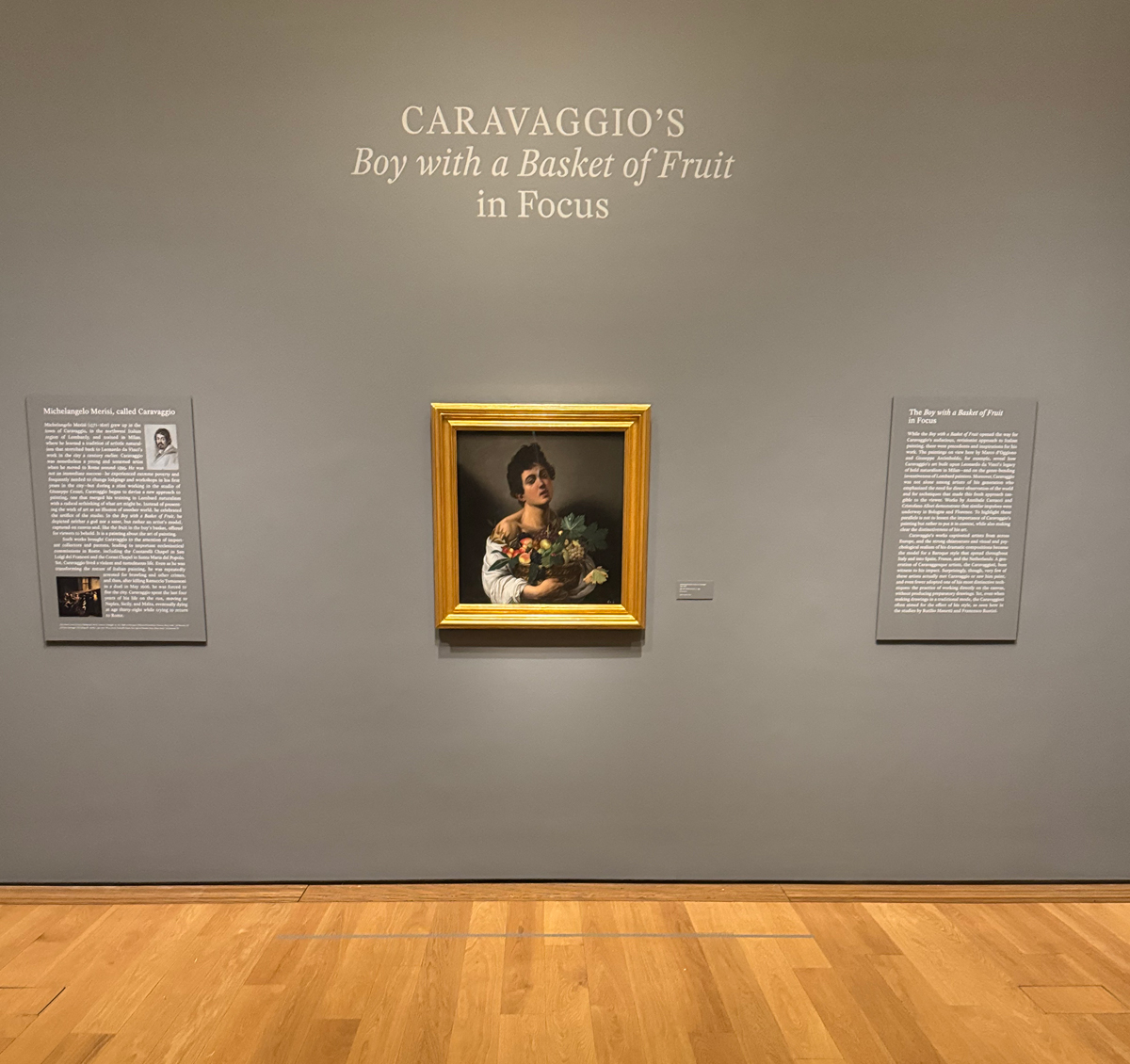
Caravaggio’s Boy with a Basket of Fruit in Focus, installation view. Photo: Ania Szremski. Pictured, center: Boy with a Basket of Fruit, ca. 1595.
Caravaggio’s Boy with a Basket of Fruit in Focus, curated by John Marciari, Morgan Library & Museum, 225 Madison Avenue, New York City, through April 19, 2026
• • •
The boy looks tired—and he probably is tired, tired of posing. His shoulders, the right one bare, slump forward (suggestively, some say); his head, framed by lush black curls that people today would pay a lot of money to attain, tilts slightly back; his sweet ruddy mouth is relaxed open; his gaze is vacant, his dark eyes don’t quite meet ours, the intimations of exhausted shadows beneath them, even if his flushed cheeks still suggest some lingering vitality, maybe even ardor, or maybe just exertion. His left arm and hand, positioned away from the viewer, hold the bottom of a woven basket filled with fruit; his right hand delicately supports it from the front.
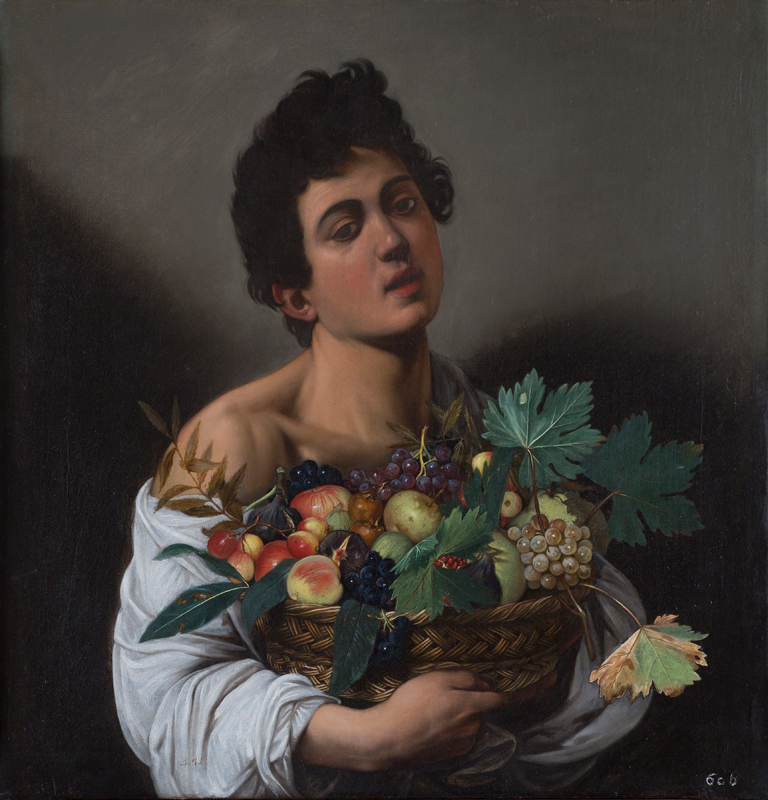
Caravaggio, Boy with a Basket of Fruit, ca. 1595. Courtesy the Morgan Library & Museum. Photo: Mauro Coen. © Galleria Borghese.
As charming as this somewhat gender-ambiguous boy may be (art historians have, in the past, mistaken him for a girl, and much has been made of this), the fruit is really the point here. What fruit it is! Almost pouring out of the perfectly depicted basket, ripe and glistening—a profusion of purple and pale-green grapes, blush-red apples and rosy peaches, wildly suggestive figs, jewellike pomegranate. Leaves and stems are still attached, like these delicacies were put in this basket directly from being picked. The fruits certainly look ready for eating but some are perhaps overly so—a fig and pomegranate have lasciviously split; a withering peach leaf on the cusp of giving up entirely suggests we should hurry up and get it while it’s good.
This is Caravaggio’s Boy with a Basket of Fruit (ca. 1595), sometimes known as The Fruit Vendor, a modestly sized oil on canvas that is one of the earlier works the painter executed in his now-unmistakable style after his youthful arrival in Rome in 1592. It was done during the eight months he toiled at the studio of Giuseppe Cesari, probably painted on spec for the new market in Rome for small pictures. It was still in Cesari’s possession, though, in 1607, when Pope Paul V seized his entire art collection and gave it to his nephew, Cardinal Scipione Borghese, which is why today the painting lives in Rome’s Galleria Borghese. But lucky New Yorkers—it has now traveled here to temporarily reside at the Morgan Library and Museum, the star of a showcase that marks the first time Boy has been in NYC in over forty years. (It was last here in 1985 for the Age of Caravaggio exhibition at the Met.)
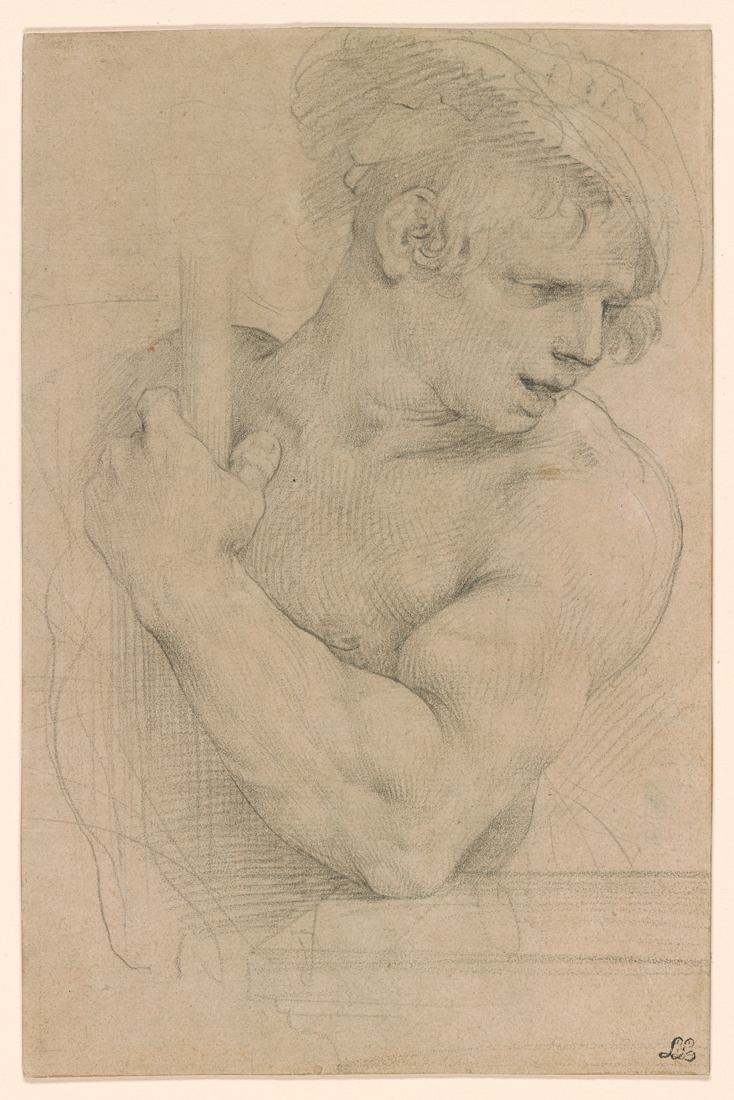
Giuseppe Cesari, Study of a Young Man, ca. 1594–95. Courtesy the Morgan Library & Museum. Photo: Steven H. Crossot.
This little showcase is staged in an enclosed room in the Morgan’s courtyard, and it is worth it to visit the institution just to see the beautiful Boy, but curator John Marciari’s smart selection of ten contextualizing paintings and works on paper is also exquisite, and despite its tiny size, the exhibition manages to pull out some big stories. Hanging on the wall to the right of the Boy we get a story of lineage: there is a chalk drawing (ca. 1580–90) by Caravaggio’s teacher in Milan, Simone Peterzano, which demonstrates the naturalistic life drawing that was becoming important in North Italy at the end of the sixteenth century; a Study of a Young Man (ca. 1594–95) by Cesari, who is the one who got Caravaggio started on painting fruits in the first place; and slightly later works by artists like Cristofano Allori and Rutilio Manetti, who would carry the torch of Caravaggio’s style through the seventeenth century.
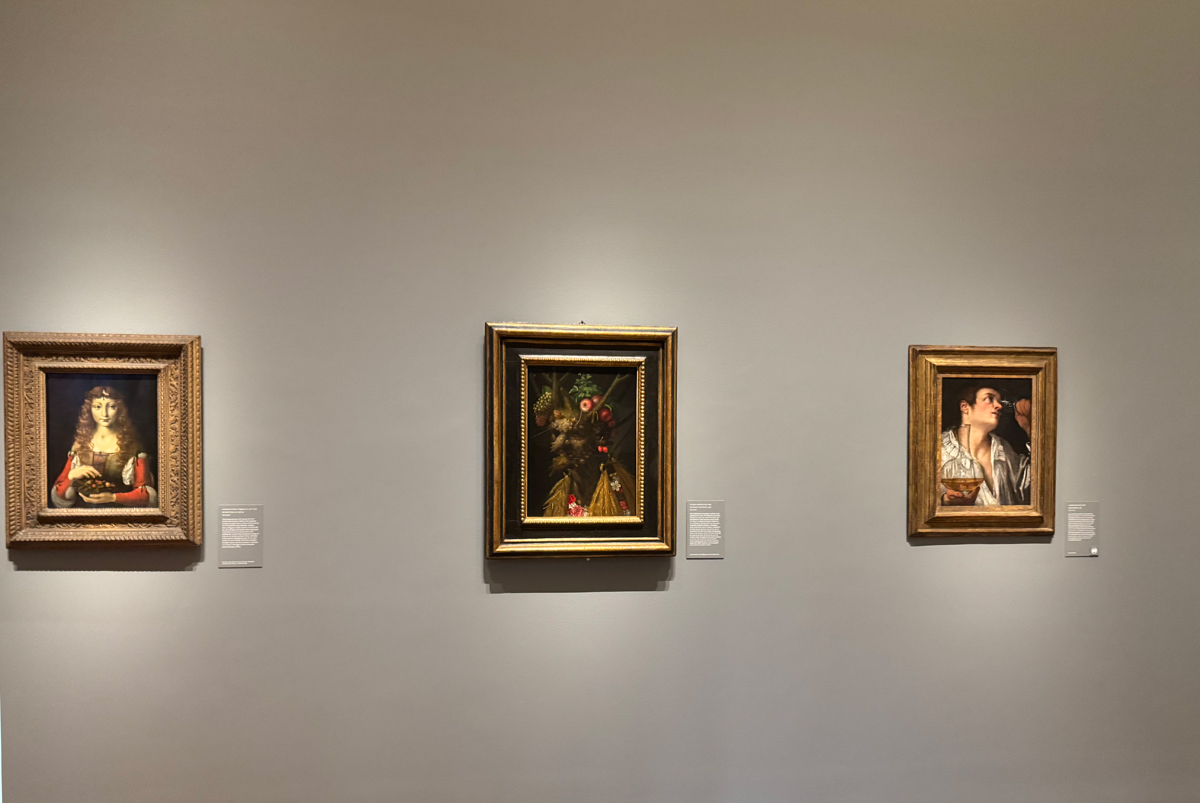
Caravaggio’s Boy with a Basket of Fruit in Focus, installation view. Photo: Ania Szremski. Pictured, center: Giuseppe Arcimboldo, Four Seasons in One Head, ca. 1590. Right: Annibale Carracci, A Boy Drinking, ca. 1583.
To the left of Caravaggio’s painting are three pieces that bring up ideas of nature painting, allegory, and genre, like Arcimboldo’s hilarious and grotesque Four Seasons in One Head (ca. 1590), which Caravaggio could well have seen (or at least heard about) as a student in Milan. But for me, most exciting was the inclusion of the exceptional Bolognese artist Annibale Carracci’s A Boy Drinking (ca. 1583), one of at least three variations on this theme Carracci painted in the early 1580s, this one from a private collection, which has never before been seen in public exhibition. What a thrill!
And what’s up with Carracci’s boy? He’s depicted on a canvas even smaller than Caravaggio’s, one that’s vertically oriented, and his torso is crammed into the picture, even cropped by it, like a close-up photograph. He wears a loose white blouse similar to the other boy’s; it’s undone in the front, so his pale, underdeveloped chest peeks out. His right hand, which seems to project coextensively out of the picture plane, cups the bottom of a carafe nearly emptied of its amber liquid, as if he might be offering it to us; his left is grasping the stem of an entirely empty glass chalice, holding it up to his thrown-back head as if he were trying to get the very last drop. His hair is fair, and closely cropped; his cheeks, too, are blushed; his eyes gaze into the mid-distance as if lost in reverie, fixed on a point up and away from us.
Note how this boy holds the carafe—it balances in his palm, a sure sign that he is a server. Note how he holds the glass—like someone uneducated, who doesn’t know how to drink from a goblet; is he trying to sneak a taste after the dinner party is over? It’s interesting to observe that in another version of this painting at the Cleveland Museum of Art, the boy holds the chalice “correctly,” grasping its base between his thumb and index finger, imitating how the nobility would have done it. Here, the clumsy hand grasping the glass in such a low-class way is painted so roughly it’s more like a paw; in general, the application of paint is so loose and incidental that there are moments where the style looks almost modern (though of course that’s how my 2026 eyes would be primed to see it).
The sexy implications of Caravaggio’s paintings, including Boy with a Basket, are well-known, and there’s so much else written about it besides, but positioning the Carracci right next to his canvas brings forward a whole other field of interpretation, one having to do with class and labor and hunger, as demonstrated in the galvanizing and vigorous scholarship of Sheila McTighe. These are both working boys—they are nobodies, unrecognizable from literature or scripture, but totally individuated at the same time, painted from life, in all their youthful beauty. The 1580s–90s marked the emergence of class categories almost as we know them today, when discourse moved beyond taxonomies like “country and city” or “aristocracy, clergy, third estate” and started to specify urban worker, rural worker, intellectual worker, and assign value accordingly. Carracci and Caravaggio weren’t the only ones, by a long shot, making paintings of these subjects. At a time when Italy was beset by periods of tragic famine and an attendant mass migration of agrarian workers to urban centers, many artists painting in this natural style were in fact naturalizing the harrowing fate of those workers by underscoring their lowly positions and vulgar appetites—marking them as different, deserving of their lot. Carracci, on the other hand (himself the upwardly mobile nephew of a manual laborer) would do a life-size painting of butchers in their shop that quoted Raphael, asserting their dignity; Caravaggio would, famously, go even further, painting a sex worker as the Virgin in one of his most important commissions. Nobodies become threatening bodies in such uncertain times, and Carracci and Caravaggio don’t let us look away.
Ania Szremski is the senior editor of 4Columns.